

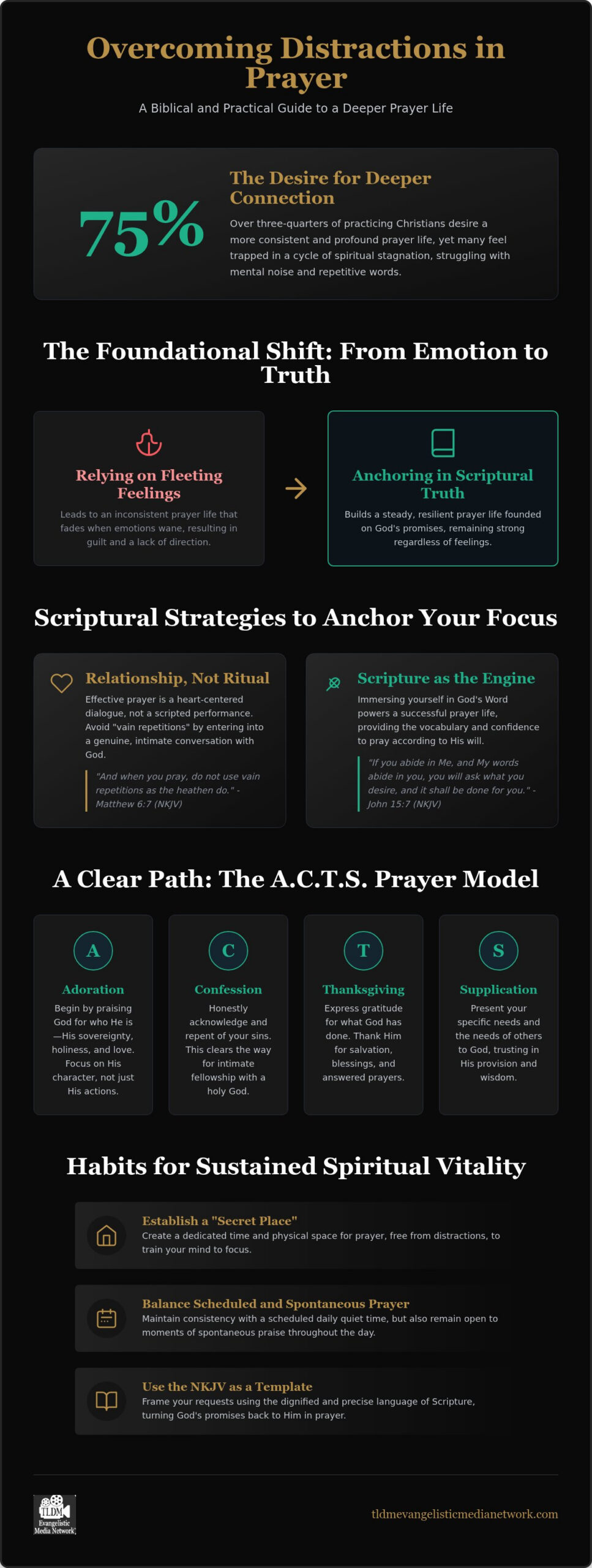
Recent data reveals that over 75% of practicing Christians desire a deeper and more consistent prayer life, yet many find themselves trapped in a cycle of spiritual stagnation. You likely know the frustration of setting aside time for the Lord only to have your focus shattered by a sudden influx of mental noise or the weight of a busy schedule. It’s common to feel that your words are repetitive or that your voice isn’t reaching the heavens, but these challenges don’t have to define your spiritual journey. By intentionally overcoming distractions during prayer, you can move past the guilt of inconsistency and enter into a season of renewed vitality.
In this article, you’ll learn biblical strategies and practical frameworks designed to silence the clamor of the world and root your heart in the Word of God. We’ll examine how to transform your quiet time from a struggling discipline into a source of profound inner strength and peace. Through a methodical approach to scriptural meditation and structured focus, you can cultivate a vibrant daily habit that builds your confidence in the presence of the Father. Let’s begin the process of restoring the power and purpose of your personal altar.
Key Takeaways
- Shift your focus from fleeting emotional experiences to scriptural truth to build a prayer life that remains steady regardless of your feelings.
- Master the discipline of overcoming distractions during prayer by using the NKJV to frame your requests through the lens of God’s own Word.
- Utilize strategic frameworks like the ACTS model and the Lord’s Prayer to provide a clear, logical path through your daily conversation with God.
- Establish a dedicated “Secret Place” and balance scheduled sessions with spontaneous praise to maintain spiritual consistency and peace.
- Leverage instructional tools like the Teach Me To Pray series to deepen your understanding of biblical prayer and sustain your spiritual vitality.
Understanding the Foundation of Effective Prayer Strategies
Effective prayer is far more than a spontaneous outburst of emotion or a desperate plea in times of crisis. It is a purposeful act of communication that aligns the believer’s heart with the character and revealed will of God. Many people struggle with their spiritual life because they rely on fleeting feelings to drive their petitions. When those feelings fade, the motivation to pray often vanishes with them. Developing a consistent habit requires a shift from emotional dependency to a firm foundation in scriptural truth.
Prayer is a spiritual skill that must be cultivated through intentional study and practice. It is not an innate talent, but a discipline that matures as we grow in our knowledge of the Word. By understanding distraction and its psychological roots, we can better prepare our minds to enter the presence of the Lord with clarity. This preparation is the first step toward overcoming distractions during prayer, as it allows us to distinguish between spiritual warfare and simple mental fatigue. This process involves distinguishing between intercession, where we stand in the gap for others, and supplication, where we bring our specific needs before the throne of grace.
The Difference Between Ritual and Relationship
In Matthew 6:7, Jesus warns His followers, “And when you pray, do not use vain repetitions as the heathen do. For they think that they will be heard for their many words.” This passage highlights the danger of religious performance. Effective prayer is a heart-centered dialogue, not a one-sided monologue or a scripted ritual. When you approach God based on scriptural knowledge, you move beyond repetitive phrases and enter into a genuine relationship. This intimacy ensures that your conversation remains focused, effectively overcoming distractions during prayer that often arise from boredom or lack of direction.
Why Scriptural Education is the Engine of Prayer
Scriptural education serves as the vital engine that powers a successful prayer life. Jesus taught in John 15:7, “If you abide in Me, and My words abide in you, you will ask what you desire, and it shall be done for you.” This promise links the effectiveness of our petitions directly to our immersion in the Word. Understanding the scriptural foundations for prayer provides you with the necessary vocabulary and confidence to speak to God according to His promises. Equipping yourself with the right biblical teaching resources can move you from passive reading to a truly transformative scriptural education that deepens your prayer life. To master this discipline, believers often need authoritative teaching from seasoned leaders like Dr. Thomas L. Driver. His insights help bridge the gap between ancient texts and modern application, ensuring that your time with the Lord is both biblically sound and spiritually transformative.
Scriptural Strategies to Anchor Your Focus
Anchoring the mind in the Word of God is the most reliable method for overcoming distractions during prayer. When the mind begins to wander toward daily anxieties or mental clutter, the written Word acts as a spiritual tether that pulls the heart back to the presence of the Father. This scriptural discipline is essential for maintaining depth in your dialogue with God, as it replaces internal noise with the steady, authoritative voice of the Spirit. By building your prayer life on a foundation of Scripture, you ensure that your requests are aligned with the divine will.
The Psalms serve as an exceptional template for this work, offering a divine vocabulary for emotional honesty and praise. David and the other psalmists did not shy away from their struggles, yet they always resolved their cries into declarations of God’s sovereignty. You can use these texts to frame your own experiences, allowing the ancient poetry of the Bible to articulate the deep needs of your soul. This practice prevents your prayer time from becoming a repetitive list of temporal desires and instead focuses your energy on spiritual outcomes, such as the cultivation of peace, patience, and godly wisdom.
Identifying specific promises in the Bible provides the necessary legal ground for intercession. When you claim a promise, you are not trying to convince God to act, but rather agreeing with what He has already declared. This shift from begging to believing transforms the atmosphere of your quiet time. To help you fight distraction in prayer, you must learn to actively engage with the text rather than passively reading it.
Using the NKJV as a Prayer Template
Using the New King James Version (NKJV) to frame your requests provides a dignified and accurate language for your spiritual petitions. To turn a verse into a personalized prayer, follow these steps: select a passage that addresses your current need, replace the universal pronouns with personal ones, and speak the text aloud as a direct address to God. This method increases your confidence because you are speaking the very language the Holy Spirit inspired. For example, you might pray Philippians 4:6-7 by saying: “Lord, I will be anxious for nothing, but in everything by prayer and supplication, with thanksgiving, I let my requests be made known to You; and Your peace, which surpasses all understanding, will guard my heart and mind through Christ Jesus.”
The Power of Scriptural Affirmation
Scriptural affirmation is the practice of consciously agreeing with the truths God has revealed about Himself and your identity in Him. This strategy is a powerful tool for overcoming distractions during prayer because it forces the mind to focus on objective truth rather than subjective feelings. When you affirm the Word, you build a shield of faith that protects your focus from the intrusive thoughts of the world. Engaging with resources such as the Teach Me To Pray series can help you master these affirmations and deepen your spiritual dialogue. This intentional study ensures that your prayer life remains vibrant, consistent, and rooted in the unchanging character of God.
Comparing Structural Prayer Models for Daily Use
Many believers experience a sense of aimlessness when they begin their quiet time, which often leads to a wandering mind and a lack of spiritual fervor. This lack of direction is a primary catalyst for mental fatigue, but implementing a structural model can provide the necessary guardrails for your heart. By following a proven framework, you eliminate the cognitive burden of deciding what to say next. This intentionality is a vital component in overcoming distractions during prayer, as it allows the Spirit to lead through a clear and biblical order.
Choosing a structure does not stifle the Spirit; rather, it creates a disciplined environment where the Spirit can speak more clearly. Whether you prefer a simple mnemonic or a more detailed liturgical pattern, having a plan reduces the anxiety of silence. It transforms your prayer from a series of random thoughts into a methodical journey toward the throne of grace. When you know the path you are taking, you are less likely to be lured away by the intrusive thoughts of the day.
The ACTS Framework: A Balanced Approach
The ACTS model is a classic framework that ensures your prayer life remains balanced and biblically sound. It moves the heart through four distinct phases: Adoration, Confession, Thanksgiving, and Supplication. You begin with Adoration, praising God for His attributes as seen in Psalm 145:3, which declares that “Great is the Lord, and greatly to be praised.” This shift in perspective is crucial for overcoming distractions during prayer because it centers your attention on the majesty of God rather than the magnitude of your problems.
- Adoration: Focus on who God is. Praise His holiness, sovereignty, and love.
- Confession: Agree with God about your shortcomings, claiming the promise of 1 John 1:9 for cleansing.
- Thanksgiving: Express gratitude for specific blessings, following the command in 1 Thessalonians 5:18 to give thanks in everything.
- Supplication: Present your requests and intercessions with confidence, as instructed in Philippians 4:6.
To transition effectively, simply acknowledge the shift in your heart. You might move from praise to confession by recognizing that His holiness reveals your need for grace. Keep your movements steady and intentional.
The Lord’s Prayer as a Strategic Map
The Lord’s Prayer, found in Matthew 6:9-13, was never intended to be a mere rote recitation; it is a strategic map for the soul. Jesus provided these categories of concern to help His disciples cover every essential area of the spiritual life. For instance, praying “Thy kingdom come” is a direct call for modern evangelistic efforts and the expansion of the Gospel in your community. This model anchors your focus by providing a comprehensive outline that leaves no room for aimless repetition. For those seeking to master these disciplines, the resources available at the TLDM Bookstore offer deeper insights into the “Teach Me To Pray” methodology. By treating the Lord’s Prayer as a series of headings for your own dialogue, you ensure that your time with the Father is both productive and profound.
Practical Habits to Sustain Spiritual Consistency
Establishing a designated “Secret Place” is a foundational step in overcoming distractions during prayer. This concept, rooted in the teachings of Jesus, involves finding a specific physical location where you can regularly meet with the Father. Psychologically, this habit creates a powerful association between that environment and spiritual focus, making it easier for your mind to settle. Whether it is a quiet corner in your home or a specific chair in your office, this sanctuary serves as a boundary against the noise of the world. Enhancing this space with intentional lighting from MundoLED can help create a peaceful atmosphere, providing the quietude necessary to transition from the chaos of daily life into a state of deep reflection.
A well-rounded spiritual life also requires a balance between scheduled and spontaneous prayer. Scheduled sessions build the infrastructure of your faith, ensuring you give God the first fruits of your time. Spontaneous prayer, however, maintains your connection to the Spirit throughout the day’s various demands. To track your journey, consider the discipline of journaling. Writing down your requests and noting when they are answered transforms abstract faith into concrete evidence of God’s faithfulness. This practice not only builds your confidence but also serves as a spiritual record that you can look back on during seasons of doubt.
Integrating Prayer into a Busy Schedule
Modern life is often fast-paced, but a busy schedule shouldn’t be an obstacle to your spiritual growth. You can utilize “Take5” moments, which are brief intervals of intentional prayer scattered throughout your workday. These short pauses allow you to reset your focus and invite God into your current tasks. For those who spend significant time traveling, the Sharing The Word Podcast is an excellent tool to set a spiritual tone during your morning commute. If you struggle to sit still, try a “prayer walk” in your neighborhood. This physical movement can help clear mental fog and make overcoming distractions during prayer feel much more natural.
Overcoming Distractions and Spiritual Dryness
Spiritual dryness is a common experience, but it doesn’t mean your prayers are unheard. During these seasons, consistency matters far more than intensity. Even when you don’t feel an emotional spark, showing up for your scheduled time demonstrates a heart of obedience. If you find your focus slipping, try reading aloud or using Christian literature to ignite new thoughts. Engaging with paperback books from trusted spiritual mentors can provide the fresh perspective needed to break through a plateau. These resources act as a bridge, helping you move from a place of stagnation back into a vibrant dialogue with the Lord.
If you are ready to deepen your practice and master these strategies, you can find comprehensive guides and instructional resources at the TLDM Bookstore.
Elevating Your Prayer Life with TLDM Resources
Mastering a lifestyle of prayer is a long-term commitment that requires more than just good intentions. It demands access to reliable, scripturally-sound guidance that can weather the storms of a busy life. By utilizing the resources provided by TLDM, you move from being a seeker to becoming a mature practitioner who understands the mechanics of spiritual victory. The “Teach Me To Pray: Lessons From Scripture” instructional series serves as a comprehensive masterclass, providing you with the depth necessary for overcoming distractions during prayer. This scholarly approach ensures that your spiritual growth is built on a rock-solid foundation of truth.
Consistency is often the greatest hurdle for the modern believer, but you don’t have to walk this path alone. The Sharing The Word Podcast acts as a daily mentor, offering the steady encouragement needed to maintain your focus. By integrating these teachings into your routine, you gain the psychological and spiritual momentum required to sustain a vibrant prayer life. Scholarly biblical teaching resources are not just for the academic; they are a practical tool for every Christian seeking to live a life of purpose and peace. Through disciplined study, you can transform your quiet time into a source of enduring power.
Deepening Your Knowledge at the TLDM Bookstore
The resources found at the TLDM Bookstore are specifically curated to bridge the gap between rigorous academic study and warm pastoral care. You can find the Teach Me To Pray series and other Christian books that transform abstract theological concepts into manageable daily actions. These materials provide the spiritual nourishment required to keep your heart engaged and your mind focused on the Word. Investing in your education is a vital step in overcoming distractions during prayer and achieving lasting consistency. Each resource is designed to help you mature in your faith and develop a more profound relationship with the Father.
Joining a Global Community of Faith
Engaging with the Sharing The Word Podcast connects you to a wider body of believers who are all striving for a deeper connection with the Creator. This community is led by the authoritative yet humble guidance of Dr. Thomas L. Driver, whose advanced academic background and pastoral heart ensure that every lesson is both credible and encouraging. His leadership provides a bridge between ancient texts and contemporary life, making the wisdom of the Bible accessible to everyone. We invite you to take the first step toward a renewed prayer life by putting one scriptural strategy from this guide into practice today. Whether you choose to pray a Psalm or designate a “Secret Place,” your commitment to growth will yield a harvest of spiritual strength and peace.
Stepping into a Season of Spiritual Renewal
Transitioning from a prayer life of frustration to one of vitality requires both a heart of obedience and a strategic approach rooted in the Word. By embracing structural models and establishing a dedicated “Secret Place,” you move beyond the limitations of your feelings and enter into a disciplined, rhythmic dialogue with the Father. Success in overcoming distractions during prayer is a skill refined through the authoritative teaching of the NKJV and a commitment to daily consistency.
You don’t have to navigate this journey alone. With the scholarly insights of Dr. Thomas L. Driver, PhD, DMin, and the daily encouragement of the Sharing The Word Podcast, you have access to a wealth of wisdom designed to foster spiritual maturity. These tools bridge the gap between ancient truth and your modern schedule, ensuring that your time with God remains focused and powerful. Your path to a deeper connection with the Lord starts with a single, intentional step toward the Word.
Begin your journey to a more powerful prayer life with the Teach Me To Pray series today.
Frequently Asked Questions
What is the most effective way to start a daily prayer routine?
How do I know if I am praying according to God’s will?
You can be certain you are praying according to God’s will when your petitions are firmly rooted in the truths of Scripture. The NKJV reminds us in John 15:7, “If you abide in Me, and My words abide in you, you will ask what you desire, and it shall be done for you.” By studying the character of God through the Bible, your desires begin to align with His purposes. This alignment brings peace and confidence to your spiritual life.
Can I pray effectively if I only have five minutes a day?
You can absolutely pray effectively in five minutes by focusing on the quality and sincerity of your communication rather than the length. Short, intentional sessions like “Take5” messages allow you to center your heart on Christ amidst a hectic schedule. These moments of focused intercession act as spiritual anchors throughout your day. While longer sessions are valuable for deep study, a focused five-minute prayer is far better than no prayer at all.
Why does it feel like my prayers are not being answered?
It may feel like your prayers are not being answered because God is operating on a divine timeline that transcends our immediate understanding. Sometimes the answer is “no” or “wait” because He has a more profound purpose or protection in mind. James 4:3 in the NKJV notes that we may ask amiss to spend it on our pleasures. Reflecting on your motives and trusting in His sovereignty can provide peace during these seasons of silence.
What does the NKJV say about the importance of persistent prayer?
The NKJV emphasizes the necessity of persistence through several parables and direct commands from Jesus. In Luke 18:1, the text states that “men always ought to pray and not lose heart.” This persistent approach is not about badgering God but about demonstrating a heart that is fully dependent on Him. It reflects a steady conviction that God is faithful to His promises and will respond in His perfect time.
How can listening to a Christian podcast improve my prayer life?
Listening to a Christian podcast provides daily mentorship that helps you maintain a scriptural focus throughout the week. Resources like the Sharing The Word Podcast offer scholarly insights that are essential for overcoming distractions during prayer by filling your mind with biblical truth. This constant intake of the Word provides the vocabulary you need for a more vibrant dialogue with God. It serves as a practical tool for keeping your spiritual life healthy and active.
Is it better to pray out loud or silently in my heart?
Whether you pray out loud or silently depends on your environment and personal need for focus. Praying aloud can be a powerful strategy for overcoming distractions during prayer because it engages your physical voice and helps keep your thoughts from wandering. Silent prayer is equally scriptural and allows for deep, internal communion in any setting. Many believers find that a combination of both methods provides a well-rounded and effective prayer life.
What should I do when I feel too spiritually drained to pray?
When you feel spiritually drained, the best course of action is to lean on the strength of the Word rather than your own energy. Use the “Teach Me To Pray: Lessons From Scripture” series to find specific passages that can spark your dialogue when words feel hard to find. Simply reading a Psalm back to God can provide the nourishment your soul needs to recover. Remember that God’s grace is sufficient for you even in your weakest moments.