

What if the most life-changing announcement in human history has been obscured by religious noise and complex traditions? Many people today feel a profound sense of spiritual disconnection or carry the heavy weight of past mistakes, wondering if genuine peace is truly attainable. You might find yourself searching for clarity amidst contradictory religious messages that leave you feeling more confused than comforted. Understanding what is the gospel message is not just an academic exercise. It is the essential key to finding a steady anchor in a restless world.
It’s natural to feel overwhelmed by the demands of modern life and the nagging sense that something vital is missing from your spiritual journey. This article promises to help you discover the profound scriptural meaning of the gospel and how this message of hope offers spiritual victory for your daily life. We’ll move beyond simple definitions to explore the heart of God’s grace and the vitality of His Word. You can expect a clear explanation of the core elements of the “good news,” a path toward the assurance of your salvation, and practical ways to apply these timeless biblical truths to your modern circumstances. Let’s begin this journey toward a deeper, more vibrant faith together.
Key Takeaways
- Uncover the historical meaning of “Euangelion” to see the gospel as a powerful, royal announcement of victory rather than a set of rules.
- Gain a clear scriptural understanding of what is the gospel message by focusing on the substitutionary death and resurrection of Jesus Christ.
- Learn to distinguish between the performance-based heavy burdens of religion and the life-giving, unmerited gift of God’s grace.
- Discover how the reality of being a “new creation” provides a fresh identity that is no longer defined by your past mistakes.
- Identify the biblical steps of repentance and faith to move from simple intellectual agreement to a personal, transformative relationship with Christ.
Defining the Gospel: The Ancient Meaning of the Good News
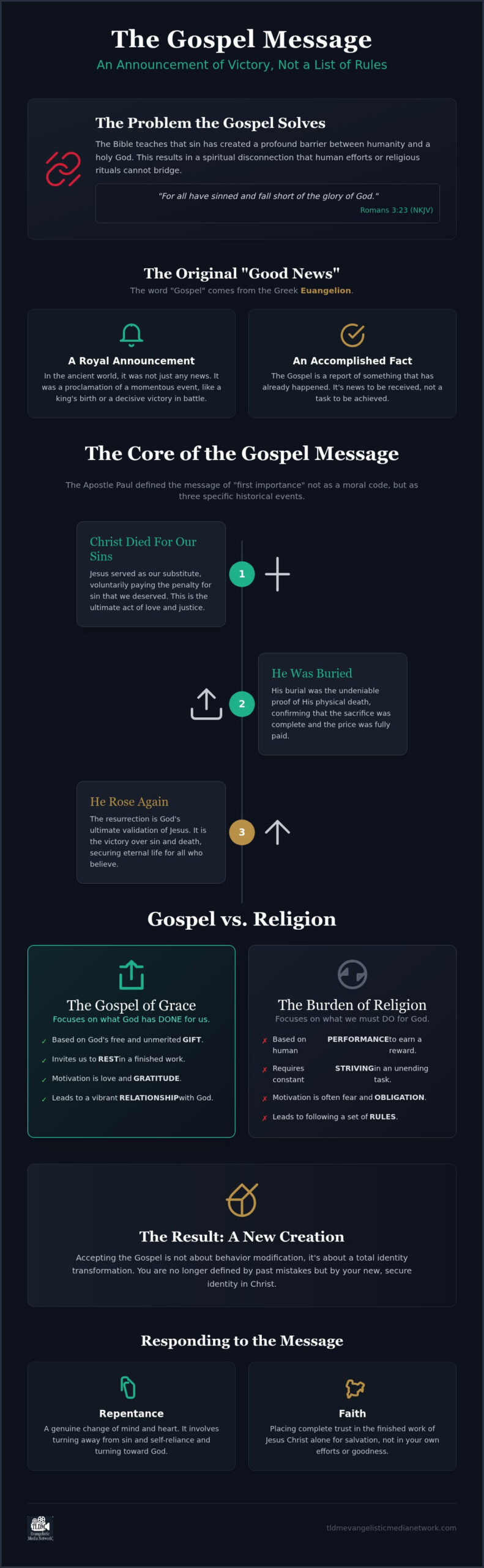
To truly grasp what is the gospel message, we must look back at the ancient meaning of the word gospel. The term comes from the Greek word euangelion, which historically signaled a momentous, life-altering event. In the ancient world, this wasn’t just any news. It was a specific type of proclamation reserved for the birth of a king or a decisive victory on the battlefield. While the Roman Empire used this term to celebrate the “good news” of Caesar’s reign, the biblical writers reclaimed it to announce a far greater King and a more permanent victory.
This historical context reveals a vital truth: the gospel is a report of an accomplished fact, not a list of religious instructions. It’s an announcement of something that has already happened in history. When we view it this way, the focus shifts from our performance to God’s provision. It’s a message that invites us to rest in a finished work rather than striving to complete a task.
The Herald’s Message: Why It Is an Announcement
In ancient times, a herald was a runner who carried news from the front lines of a war back to the city. If the battle was won, the herald would shout “Euangelion!” to the waiting citizens. This meant their safety was secured and their enemies were defeated. The citizens didn’t fight the battle; they simply received the news of a victory someone else had won.
Because the gospel is an announcement, it’s something to be heard and believed rather than achieved through human effort. It doesn’t ask us to win the war; it invites us to enjoy the peace that follows the triumph. The gospel is the announcement of God’s victory through Jesus Christ.
The Problem the Gospel Solves
Every rescue plan requires a reason for the rescue. The gospel is only “good news” because of the reality of the “bad news” regarding our spiritual condition. Scripture tells us that sin has created a profound barrier between humanity and a holy God. Romans 3:23 (NKJV) states, “for all have sinned and fall short of the glory of God.”
Human efforts to reach God always fall short of His perfect holiness. This creates a sense of spiritual lostness and a lack of peace that no amount of religious ritual can fix. Understanding what is the gospel message requires us to see it as a divine rescue rather than a human achievement. It sets the stage for the rescue plan that God initiated to bring us back to Himself.
The Core Elements: What the Bible Says About the Gospel
In his first letter to the Corinthians, the Apostle Paul identifies the “first importance” of the Christian faith. He doesn’t point to a complex moral code or a list of religious duties. Instead, he points to a specific set of historical events that form the core elements of the gospel. When we seek to understand what is the gospel message, we are looking at the essential truths that Paul delivered as the foundation of the church.
These truths are not mere suggestions. They are the very power of God for salvation to everyone who believes. They provide the definitive answer to our search for peace and spiritual victory. By focusing on these core elements, we move from religious confusion to a place of steady conviction and quiet confidence.
Christ Died for Our Sins According to the Scriptures
The first pillar of this message is that “Christ died for our sins according to the Scriptures” (1 Corinthians 15:3, NKJV). This concept, often called substitutionary atonement, means that Jesus took the place of humanity. Because God is perfectly holy, sin requires a just penalty. Jesus, being the only perfect and sinless sacrifice, voluntarily stood in our place to pay that debt.
He didn’t die as a tragic martyr but as a purposeful Savior. His death was the intentional fulfillment of centuries of Old Testament prophecy, proving that God’s plan for our rescue was in motion long before the cross. This means that your past mistakes don’t have to define your future. The price has already been paid in full by the only One who could afford it.
The Power of the Resurrection
The gospel doesn’t end at the grave. Paul continues by stating that Christ “was buried, and that He rose again the third day according to the Scriptures” (1 Corinthians 15:4, NKJV). The burial confirms the reality of His death, while the resurrection serves as the ultimate validation of His divine claims. It’s the absolute guarantee of spiritual victory for every believer.
If Christ remained in the grave, our faith would be empty. However, His triumph over death proves that the penalty for sin was fully satisfied. Understanding what is the gospel message requires us to look at the historical reliability of the resurrection, which was witnessed by hundreds of people. You can explore these truths more deeply by listening to the Sharing The Word Podcast, where we break down these scriptural foundations daily.
The Gospel Versus Religion: Grace as a Gift, Not a Reward
Many people spend years trying to climb a spiritual ladder of their own making. They hope that by attending enough services, helping enough people, or checking off a list of moral requirements, they will eventually find peace with God. However, when we search for the truth of what is the gospel message, we discover that it is fundamentally different from this performance-based approach. While religion is often defined as man’s attempt to reach up to God, the gospel is the announcement that God has reached down to man.
This distinction is vital because it addresses the core of our spiritual anxiety. If our standing with God depends on our own goodness, we can never truly be sure if we have done enough. We live in a constant state of uncertainty, wondering if a single mistake might topple our progress. The gospel replaces this fragile religious performance with the solid provision of Christ’s righteousness. It moves us away from the exhausting cycle of trying to be “good enough” and brings us into the unshakeable security of being fully accepted in Christ.
The Burden of Performance vs. the Rest of Grace
Attempting to live by a strict moral code without the power of the gospel is a recipe for spiritual burnout. This burden of performance creates a heavy weight of guilt and a persistent lack of peace. The gospel of grace as a gift offers a different path through the reality of Justification by Faith. This means that God legally declares a person righteous, not because of their own works, but because of their trust in Jesus. Salvation is not a wage that you earn through hard labor. It is a gift that you receive with humble gratitude.
How the Gospel Changes Our Motivation
Once you understand that you are saved by grace, your entire motivation for living a godly life shifts. In a religious system, you might obey God out of fear or the hope of being loved. In the gospel, you obey because you are already deeply loved and eternally secure. The “have to” of religious duty transforms into the “want to” of a joyful heart. This internal change is the key to experiencing Biblical Principles for Spiritual Victory in 2026. By resting in what Christ has done, you find the strength to live for Him with vitality and purpose.
The Practical Power: How the Gospel Message Transforms Your Life
Understanding what is the gospel message involves more than just grasping a historical event. It is about experiencing a present reality that reshapes your entire existence. When the truth of Christ’s victory moves from your head to your heart, it acts as a catalyst for profound personal transformation. This isn’t a temporary self-help fix. It is a fundamental shift in how you view yourself, your past, and your future.
The core of this transformation is found in the “New Creation” reality described by the Apostle Paul. In 2 Corinthians 5:17 (NKJV), we are told, “Therefore, if anyone is in Christ, he is a new creation; old things have passed away; behold, all things have become new.” This means the gospel provides you with a completely new identity. You are no longer defined by your past failures, your deepest regrets, or the labels others have placed on you. Instead, you are defined by the perfect righteousness of Jesus Christ.
Finding Peace and Purpose in the Truth
The Gospel in Your Daily Walk
To experience spiritual victory over fear and stagnation, you must learn to apply the gospel to your daily struggles. A practical way to do this is to “preach the gospel to yourself” every morning. Remind yourself that your standing with God is secure because of Christ, not your own efforts. This perspective empowers you to forgive others as you have been forgiven. It removes the bitterness that often stems from a performance-based mindset.
The Holy Spirit plays a vital role in this process, constantly reminding you of these truths and providing the strength to live them out. If you need a tool for daily encouragement, the Sharing The Word Podcast offers scriptural insights that can help you stay focused on the power of the cross. By immersing yourself in these truths, you move from spiritual disconnection to a life of vibrant purpose. To deepen your study and find more resources for your journey, visit the TLDM Bookstore today.
Responding to the Message: Next Steps in Your Spiritual Journey
The weight of the truth we have explored requires a personal response. Understanding what is the gospel message is the vital first step, but the biblical invitation goes beyond mere intellectual agreement. It calls for a decisive turn toward God, a process the Scriptures describe through the concepts of repentance and faith. This isn’t about achieving moral perfection before you come to Christ. It’s about acknowledging your need for a Savior and placing your total trust in His finished work. It is the moment where the abstract becomes personal and the ancient text becomes your current reality.
True faith is more than acknowledging historical facts. It is a heartfelt reliance on the person of Jesus Christ. When you move from knowing about Him to personally trusting Him, you enter into the spiritual victory we have discussed. This transition marks the beginning of a lifelong walk characterized by peace, purpose, and a growing intimacy with your Creator. You are no longer a distant observer of the “good news.” You are a participant in the life of God, invited to experience His grace in every moment.
How to Accept the Gift of Salvation
Accepting the gift of salvation is a simple, profound act of turning toward God and trusting His promise. You don’t need a special formula or a complex religious ritual to begin this relationship. What God desires is a sincere heart that recognizes its own spiritual poverty and reaches out for His abundant grace. This turning, often called repentance, is simply changing your mind about who is in control of your life. It is the humble admission that your own efforts are insufficient and that Christ’s sacrifice is your only hope.
Invite yourself to reflect on the victory Christ has already won for you. This reflection provides the confidence to take the step of faith. It is an invitation to rest in His love and let go of the heavy burden of trying to save yourself. Salvation is a gift that is received, not a goal that is achieved. Once you accept this truth, the Holy Spirit begins the work of renewing your mind and guiding your steps toward a life of lasting transformation.
Deepening Your Understanding of the Word
Once you have responded to the gospel, the journey of spiritual growth begins. This process of becoming more like Christ is supported by consistent study and prayer. It’s helpful to start with manageable steps that keep you anchored in biblical truth throughout your busy day. We recommend starting with the Take5 Messages for short, impactful daily truths that fit easily into any schedule. These brief messages act as spiritual nourishment, helping you maintain a gospel-centered perspective in a world full of distractions.
As you continue to grow, you may find that you have deeper questions or a desire for more comprehensive study. Visiting the TLDM Bookstore can provide you with literature specifically designed to support your spiritual development. Remember that spiritual maturity is a process, not an overnight event. By surrounding yourself with trustworthy scriptural education, you ensure that your foundation remains strong as you navigate the complexities of modern life. Understanding what is the gospel message was the beginning. Living it out is the adventure of a lifetime.
Walking in Spiritual Victory Today
The truth of the gospel is more than a historical fact. It’s a living power that offers a steady anchor for your soul. You’ve discovered that the heart of what is the gospel message isn’t found in your performance. Instead, it’s rooted entirely in the finished work and resurrection of Jesus Christ. By resting in His grace, you move from the exhaustion of religious duty into the vitality of a new creation. This shift in perspective transforms your identity and empowers you to face daily challenges with quiet confidence.
As you move forward, consistency in the Word is the key to maintaining this spiritual momentum. We invite you to Listen to the Sharing The Word Podcast for daily gospel encouragement. This ministry is dedicated to your spiritual victory, providing scholarly insights from Dr. Thomas L. Driver in an accessible audio format perfect for your busy schedule. Let these scripture-based messages nourish your heart and strengthen your walk. You’re not alone on this journey. You have a trusted companion in the Word of God. May you walk today in the fullness of His peace and the strength of His victory.
Frequently Asked Questions
Is the gospel just for people who have committed ‘big’ sins?
No, the gospel is for every person because everyone has fallen short of God’s perfect holiness. Whether a sin seems “big” or “small” in human eyes, it still creates a barrier between us and our Creator. Understanding what is the gospel message means recognizing that it addresses the universal human condition of spiritual separation. It offers the same transformative path of grace to everyone, regardless of their background or past mistakes.
What is the difference between the gospel and the Ten Commandments?
The Ten Commandments represent the Law, which reveals God’s righteous standard and our inability to meet it perfectly. In contrast, the gospel is the announcement of what Christ has already done to fulfill that standard on our behalf. While the Law says “do,” the gospel says “done.” It is the vital difference between a list of moral requirements and a report of a completed victory over the power of sin.
Can I lose the salvation offered in the gospel message?
Biblical teaching suggests that salvation is secured by God’s power rather than our own fluctuating efforts. Because the gospel is a gift of grace, your security rests in Christ’s finished work rather than your daily performance. When you truly trust in Him, your relationship is based on His faithfulness to His promises. This provides a steady sense of peace that doesn’t disappear when you face daily struggles or minor spiritual stumbles.
How do I explain the gospel to someone who doesn’t believe in the Bible?
You can explain the gospel as a message of restoration that addresses the universal human longing for meaning and peace. Focus on the historical person of Jesus and the undeniable impact His life has had on human history. Describe it as a divine solution to the brokenness we see in ourselves and the world. It is an invitation to a relationship with a Creator who values and loves every person individually.
Why are there different ‘gospels’ mentioned in the New Testament?
The New Testament includes four biographical accounts that provide different perspectives on the same historical events. Matthew, Mark, Luke, and John each wrote to a specific audience to highlight different facets of Jesus’s ministry. While these accounts vary in their focus and narrative style, the core theological message remains identical. They all point toward the same reality of salvation and spiritual victory through the life, death, and resurrection of Christ.
Do I need to go to church to receive the gospel?
You don’t need to be inside a church building to receive the gospel, as it is a message you can accept anywhere. Salvation is a personal response between you and God that happens in the heart. However, joining a community of believers is essential for your ongoing growth and encouragement. While a building isn’t a prerequisite for grace, the support of a church family helps you live out your faith with consistency.
What does it mean to ‘believe’ in the gospel message?
To “believe” in the gospel message means to move beyond simple intellectual agreement to a place of personal trust. It’s the difference between knowing a bridge is strong and actually walking across it. You are actively relying on Christ’s sacrifice as your only hope for peace with God. This belief involves a sincere heart that rests in His promises, leading to a life of steady conviction, quiet confidence, and vibrant spiritual purpose.
How does the gospel help me with my daily anxiety?
The gospel helps with daily anxiety by shifting your focus from your temporary circumstances to your eternal security in Christ. When you realize that you are fully accepted and loved by God, the pressure to prove your worth begins to lift. You can rest in the truth that He is in control of your future. This provides a quiet confidence that guards your heart and mind against the restlessness and noise of modern life.