

The best Christian books for your growth may not be the ones you finish fastest. They’re the ones that lead you back to Scripture with a deeper understanding. A full bookshelf doesn’t guarantee stronger faith. You may have read books that felt inspiring but offered little biblical depth, or finished a chapter without knowing how to put its ideas into practice.
It makes sense to look for more than encouraging words. Trustworthy Christian literature should help you distinguish biblical teaching from an author’s interpretation and apply Scripture with care. This guide offers practical ways to choose books that support lasting spiritual growth, rather than just provide a brief lift.
Explore Christian books for prayer, biblical understanding, and daily discipleship, along with a practical plan for choosing what to read next. You’ll also learn how to check a book’s claims against Scripture and build a reading habit with purpose.
Key Takeaways
- Choose Christian books that support your spiritual growth while keeping Scripture, not an author’s opinion, as your authority.
- Build a balanced reading list with resources for prayer, biblical understanding, and daily discipleship.
- Compare a book’s key claims with the NKJV, reading cited passages in context.
- Start a steady reading habit with fifteen focused minutes a day, then reflect on one practical way to respond to what you read.
- Explore TLDM’s Christian books, including the Teach Me To Pray series, as resources for deepening your prayer life.
Understanding the Role of Christian Books in Spiritual Maturity
Christian books engage with the Bible, the person of Jesus Christ, and the life of faith. They include devotionals, biblical studies, theology, church history, and reflections on daily life. The history of Christian literature shows the range of these forms. But a book’s Christian label alone doesn’t establish that its teaching is faithful to Scripture.
Think of a trusted book as a secondary guide, not a replacement for the Bible. Scripture remains the primary authority. A thoughtful author can help you understand its context, consider its implications, and apply its wisdom. Keep an open Bible beside you as you read. A book can point toward truth, but it cannot take the place of the Word of God.
Intentional reading can create space to slow down, organize your thoughts, and reflect on what you believe. A devotional may help you pause with a passage during a demanding day, while a careful study can clarify a text’s background or meaning. Neither guarantees inner peace or instant change. But when reading leads you back to Scripture and prayer, it can support a steady walk of faith.
The Difference Between Devotional and Scholarly Works
Devotional books focus on encouragement and daily reflection. They often connect a biblical passage with a practical response, such as praying about a concern or extending forgiveness. Scholarly works examine theology, history, language, or scriptural exegesis, which means careful interpretation of a biblical text. A balanced reading life can make room for both: encouragement to carry into the day and study that strengthens understanding.
Why Biblical Accuracy Matters in Your Library
Some books blend personal opinion with biblical language. Weigh an author’s claims against the full context of Scripture instead of accepting an appealing idea at face value. Biblical literacy means understanding Scripture’s content, context, and central teachings well enough to assess other spiritual writing responsibly. Christians also rely on the Holy Spirit for discernment; Jesus describes the Spirit as guiding believers into truth (John 16:13, NKJV).
Use a few steady questions as you read:
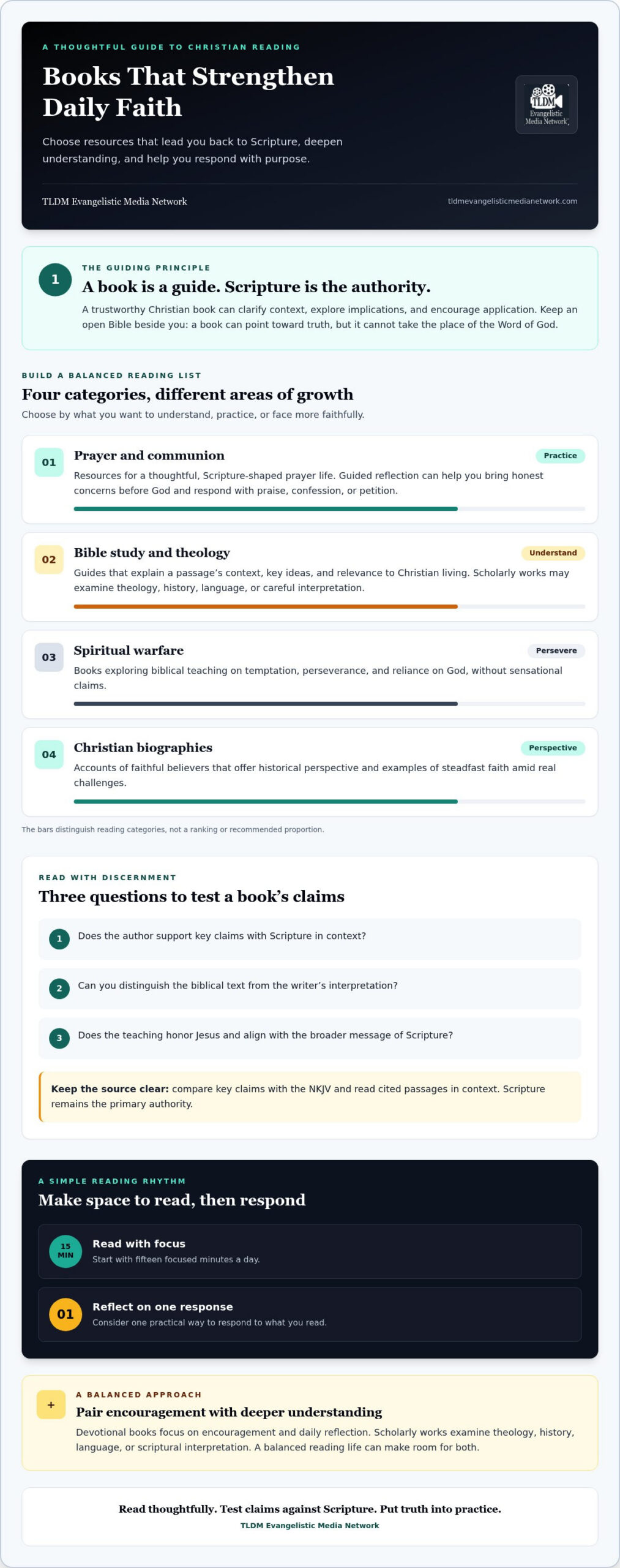
- Does the author support key claims with Scripture in context?
- Can you distinguish the biblical text from the writer’s interpretation?
- Does the teaching honor Jesus and align with the broader message of Scripture?
These questions can help you choose Christian books that encourage reflection without confusing human insight with biblical authority.
Essential Categories of Christian Books Every Believer Needs
A useful reading list supports different parts of your walk with God. Instead of choosing titles by popularity alone, ask what you want to understand, practice, or face more faithfully. Christian books can support prayer, Bible study, perseverance, and a richer understanding of the people who shaped the church.
Christian writing has carried biblical teaching across generations. For historical context on how books and other forms of publishing have shared Christian ideas, see A Short History of Christian Publishing. As you build your reading list, consider these categories:
- Prayer and communion: Resources that help you build a thoughtful, Scripture-shaped prayer life.
- Bible study and theology: Guides that explain a passage’s context, key ideas, and relevance to Christian living.
- Spiritual warfare: Books that explore biblical teaching on temptation, perseverance, and reliance on God, without sensational claims.
- Christian biographies: Accounts of faithful believers that offer historical perspective and examples of steadfast faith amid real challenges.
Foundational Books on Prayer and Communion
Prayer books can give structure to a practice that feels difficult to begin or sustain. The Teach Me To Pray series offers a Scripture-centered framework for communicating with God. Use a guide to reflect on biblical passages, bring honest concerns before God, and respond with praise, confession, or petition. You can also explore the Christian bookstore for resources by Dr. Thomas L. Driver.
Let Scripture shape the words and direction of your prayers. If your routine feels stagnant, a guided reflection can help you return to a passage with fresh attention and make space for honest conversation with God. The goal isn’t to read more pages. It’s to grow in faithful, attentive communion.
Scriptural Education and Bible Study Guides
Study guides help readers unpack theological ideas, historical settings, and the meaning of a passage without losing sight of its place in the Bible as a whole. Look for resources that distinguish the biblical text from the author’s explanation, cite Scripture responsibly, and connect an ancient setting with present-day questions. Choose authors who take biblical authority seriously and invite you to examine their interpretations for yourself.
Build your library with purpose. Pair a prayer resource with a study guide, then add a biography or a biblically grounded book on spiritual perseverance as your interests and needs change.
How to Evaluate Christian Literature for Biblical Integrity
A polished cover or confident tone can’t establish whether a book teaches soundly. With so many Christian books available, examine an author’s claims instead of relying only on endorsements or a publisher’s description. Scripture provides the standard. The Bereans offer a biblical example: Acts 17:11 commends them for examining the Scriptures to test what they heard.
Compare a book’s teaching with the NKJV, reading each cited passage in context. Notice who is speaking, what the surrounding verses say, and how the passage fits the Bible’s wider teaching. A verse used to support a claim may mean something different when read in context.
The Authority of Scripture as the Ultimate Yardstick
No Christian book replaces the Word of God. Mark references as you read, then check the passages in your Bible before accepting an interpretation. The NKJV can serve as a consistent reference text for this practice, but careful reading requires attention to a passage’s context and meaning, not just a matching phrase.
Pause and investigate further if a book:
- Uses isolated verses to support a broad claim without explaining their context.
- Presents a personal impression as a command or promise from God.
- Contradicts clear biblical teaching or discourages readers from testing its claims.
- Centers the author’s authority or a special method instead of pointing readers to Christ and Scripture.
Jesus taught that people can recognize a tree by its fruit (Matthew 7:16, NKJV). Apply that principle thoughtfully: consider whether an author’s public teaching and ministry reflect humility, integrity, service, and faithfulness to Scripture. Don’t treat popularity, strong claims, or credentials alone as proof of biblical soundness. The Holy Spirit guides believers in discernment, while Scripture remains the measure for evaluating teaching.
Understanding the Author’s Perspective and Background
An author’s background can help you understand their training, ministry experience, and perspective, though credentials don’t make every interpretation correct. A scholarly yet pastoral writer can explain difficult ideas with care and connect biblical study to Christian living. Review Dr. Thomas L. Driver’s author biography to learn about his background and work.
As you read, ask whether the book sends you back to the Bible with better questions and a clearer understanding, or asks you to rely on the author instead. Keep what withstands careful study, and approach uncertain claims with patience. Discernment doesn’t require suspicion toward every writer. It calls for a teachable heart, an open Bible, and a willingness to test ideas faithfully.
Building a Purposeful Christian Reading Habit
A meaningful reading habit doesn’t require a free afternoon. It grows through a small, repeatable practice that helps you absorb what you read and respond with faith. Start with fifteen minutes of focused reading each day, then use these steps to make that time purposeful:
- Choose one book and a passage of Scripture. Keep your reading focused rather than jumping between several titles.
- Read attentively. Note the author’s main point and how it connects with the biblical text.
- Write a response. Record one insight, a question to explore, or a practical step to take.
- Pray about what you’ve learned. Ask God to help you carry the truth into your choices and relationships.
Journaling turns reading from a quick intake of ideas into an opportunity to reflect. A few honest lines can help you track questions, remember a verse to revisit, or notice how a teaching shapes your actions over time. Let understanding guide your pace. You don’t need to finish a chapter if one idea deserves more thought.
Creating a Sacred Space for Study
Choose a quiet place where you can give your attention to reading, and silence notifications or set your phone aside. Keep a notebook, Bible, and current book nearby so you can begin without searching for supplies. Return to this routine at a time that fits your day. Consistency creates a steady rhythm and gives reflection and prayer room to take root.
Integrating Audiobooks for Busy Professionals
If sitting down with a book feels difficult, audiobooks can make Christian literature easier to fit into your routine. Listen during a commute or another part of the day when you can focus safely, then jot down a thought or Scripture reference afterward. Listening works best when you give the material your attention rather than treating it as background noise.
Short audio reflections can complement longer reading sessions. Take5 Messages offer another way to engage with a brief faith-based insight during a busy day. Use them as a prompt for prayer or further study, not as a substitute for reading Scripture and examining a book’s claims.
Build a reading rhythm that fits your season of life. Explore the Christian audiobook selection for listening resources that may support your routine.
Discovering Spiritually Enriching Resources at TLDM
A purposeful library grows from resources that keep Scripture central and help you put its teaching into practice. The TLDM Bookstore offers Christian books by Dr. Thomas L. Driver, with a focus on practical scriptural education and spiritual growth. When choosing a title, consider how it will serve your next step in prayer, understanding, or faithful living.
The Teach Me To Pray Series: A Foundational Resource
Teach Me To Pray: Lessons From Scripture focuses on prayer through biblical teaching. The series gives readers a structured way to consider what Scripture teaches about communicating with God, then bring those lessons into personal prayer. Its themes can also provide a starting point for group discussion: return together to the relevant passages and reflect on how they shape daily faith.
Dr. Driver’s work brings scholarly study together with an encouraging, pastoral approach. This can help readers engage with biblical ideas thoughtfully while considering their practical meaning. TLDM offers books in paperback and audiobook formats. Check the current listing for the format available for a specific title, including the Teach Me To Pray series.
Reading with care can be a meaningful investment in spiritual growth. A book can’t promise a particular outcome, but a Scripture-centered resource can prompt deeper reflection, encourage a more consistent prayer life, and help you carry biblical wisdom into everyday choices.
Expanding Your Journey with the Sharing The Word Podcast
Reading and listening can complement each other. A book gives you room to pause, revisit a passage, and mark a question. A podcast offers another way to engage with biblical teaching and related themes. Try listening to an episode, noting a question or idea, then returning to Scripture to consider how it connects with your reading.
Explore the Sharing The Word Podcast to supplement your reading with additional faith-based messages. Books, podcasts, and sermons offer different ways to engage with Scripture while keeping the Bible at the center of your learning.
Keep Growing Through Scripture-Shaped Reading
A thoughtful reading life depends on more than finishing books. Choose Christian books that deepen prayer, build understanding, and point you back to Scripture. Read with discernment, compare an author’s claims with the biblical text, and make space to reflect on what you learn.
Start small and stay consistent. A few focused minutes with a book, the Bible, and a journal can turn reading into a steady practice of spiritual growth. Resources by Dr. Thomas L. Driver bring scholarly education to practical Christian teaching, while TLDM’s podcasts and sermons offer other ways to engage with biblical themes. TLDM Evangelistic Media Network is a 501(c)(3) nonprofit ministry dedicated to the Word.
Explore the Christian books at the TLDM Bookstore and choose a resource that supports your next step in faith. Keep Scripture at the center, remain open to learning, and make time for steady reflection.
Frequently Asked Questions
What are the best Christian books for new believers to start with?
Start with resources that strengthen your understanding of Scripture and help you develop practical habits of faith. A Bible study guide can explain a passage’s context, while a devotional offers a brief prompt for reflection. A prayer resource such as Teach Me To Pray: Lessons From Scripture can help you consider what biblical teaching says about communicating with God. Choose one title that fits your current need, and read it alongside the Bible.
How can I tell if a Christian book is biblically sound and accurate?
Check an author’s claims against Scripture, reading cited verses in context rather than relying on isolated phrases. Ask whether the book distinguishes biblical teaching from the author’s interpretation, points readers back to the Bible, and presents Jesus faithfully. Consider the author’s background and ministry fruit, but don’t treat credentials or popularity as proof by themselves. If a claim seems unclear, pause, study the passage, and consider trusted, Scripture-centered perspectives.
Are audiobooks as effective as paperbacks for spiritual growth and study?
Either format can support spiritual growth when you engage with the material attentively. Audiobooks can fit listening into a commute or another suitable part of your day, while paperbacks make it easy to mark a passage or write notes. For close Bible study, pause the audio to check Scripture and record questions. Choose the format that helps you reflect and apply what you learn, and use both if they suit different settings.
What is the difference between a devotional and a Bible study guide?
A devotional usually offers a short reflection that connects a biblical passage with prayer or a practical response. A Bible study guide focuses more directly on understanding the text, often exploring its context, meaning, and place in Scripture. Both can serve your growth in different ways. Use a devotional to encourage regular reflection, and turn to a study guide when you want to examine a passage more closely.
How many Christian books should I aim to read in a year for growth?
There’s no fixed yearly number that measures spiritual growth. A slower, thoughtful pace may serve you better than rushing through titles without reflection. Set a manageable routine, such as the fifteen minutes of focused reading suggested in this article, and consider how well you understand and apply what you read. Track your progress if it helps, but let Scripture-shaped growth, not a book count, guide your goal.
Can Christian books help me overcome spiritual stagnation or doubt?
Christian books can offer biblical teaching, useful questions, and encouragement during seasons of doubt or spiritual dryness, but a book can’t guarantee those struggles will disappear. Choose a resource that takes your questions seriously, handles Scripture carefully, and directs you toward prayer and deeper engagement with the Bible. Write down what troubles you, examine relevant passages in context, and give yourself time to reflect rather than expecting instant change.
Where can I find scholarly yet encouraging Christian literature online?
TLDM Evangelistic Media Network offers Christian books and scriptural education, including Teach Me To Pray: Lessons From Scripture. Its resources reflect the scholarly background of Dr. Thomas L. Driver while connecting biblical teaching with practical faith. You can also explore the network’s Sharing The Word Podcast, Take5 Messages, and online sermons as complementary forms of Christian media. Check a book’s description and available format before choosing a title.
Is it better to read one book deeply or many books quickly?
For spiritual formation, depth matters more than speed. Reading one book carefully gives you time to test its ideas against Scripture, note questions, and consider how its teaching applies to your life. Reading widely can also introduce useful perspectives, but avoid treating a long reading list as a measure of maturity. You might read one central book slowly while using shorter resources for prayer or reflection, then revisit ideas that deserve closer study.