

What makes the best Christian spiritual warfare books useful is not dramatic language, but clear engagement with Scripture and guidance readers can thoughtfully apply. It’s reasonable to want help understanding spiritual struggle while also feeling cautious about resources that amplify fear or present personal interpretations as settled biblical teaching. A thoughtful choice can support faith without making every difficulty seem like evidence of a spiritual threat.
This guide compares Christian spiritual warfare books through a practical framework: biblical grounding, pastoral balance, and value for Christian growth. You’ll learn what to look for, how different approaches may suit personal study or group discussion, and how to connect reading with Scripture, prayer, and wise Christian practice. The aim is not to create fear, but to help you read with discernment and find encouragement for faithful living.
Key Takeaways
- Evaluate Christian spiritual warfare books by how carefully they use Scripture, explain context, and distinguish biblical teaching from interpretation.
- Match a book’s approach to your goal, whether you’re studying biblical foundations, reflecting personally, or preparing for group discussion.
- Pause over alarming claims and check whether the author supports them with Scripture read in context.
- Choose thoughtfully by clarifying your purpose, reviewing the author’s perspective, assessing Scripture use, and sampling the writing style.
- Explore TLDM’s Christian books and digital teaching, then check the current catalog to see whether a title fits your study needs.
What Christian spiritual warfare books teach, and what they should not claim
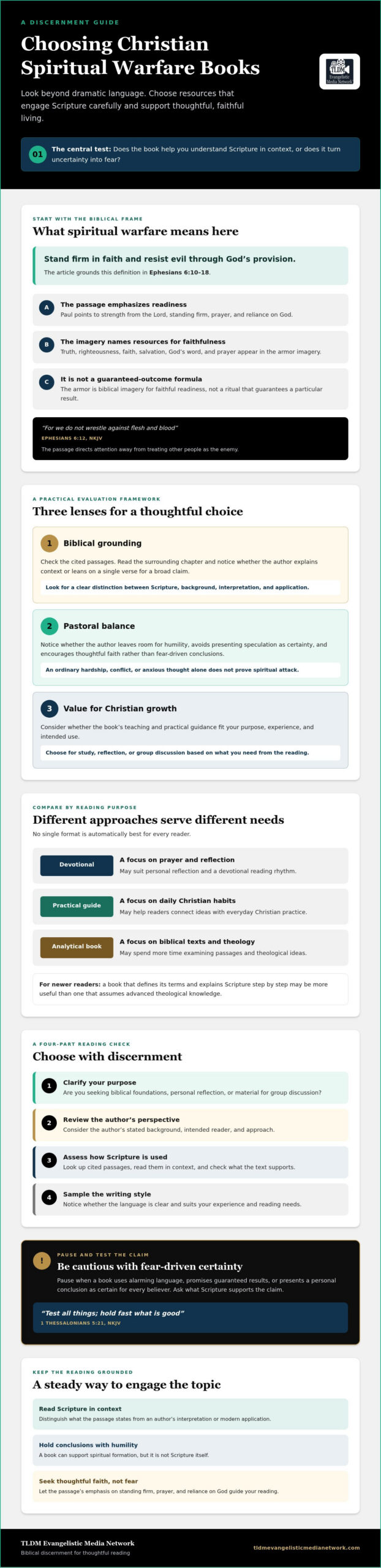
Christian spiritual warfare is the believer’s call to stand firm in faith and resist evil through God’s provision, as described in Ephesians 6:10-18. This definition keeps the focus on Scripture’s language of faithfulness and steadfastness, rather than speculation about hidden threats. The broader Spiritual warfare overview also describes how Christian traditions have understood the concept in different ways.
Books on this subject interpret biblical teaching; they are not Scripture themselves. An author may explain a passage, draw a conclusion, or apply it to modern life. Those are related but distinct steps. Readers can benefit from thoughtful spiritual formation while remembering that one author’s interpretation is not automatically settled Christian doctrine.
How Ephesians 6 frames spiritual warfare
In Ephesians 6:10-18, Paul calls believers to draw strength from the Lord and describes spiritual opposition through the image of God’s armor. He writes, “For we do not wrestle against flesh and blood” (Ephesians 6:12, NKJV), directing attention away from treating other people as the enemy. The passage names truth, righteousness, faith, salvation, God’s word, and prayer as parts of this picture.
The armor is biblical imagery for faithful readiness, not a ritual or formula that guarantees a particular outcome. Read the passage as a whole and notice its emphasis on standing firm, prayer, and reliance on God.
Why a balanced Christian perspective matters
Careful interpretation begins with the text and its context, then separates what Scripture states from how an author applies it. For example, a writer might connect a personal struggle to spiritual opposition. That may be the author’s interpretation, but an ordinary hardship, conflict, or anxious thought alone does not prove spiritual attack.
A responsible book makes room for humility, avoids presenting speculation as certainty, and encourages readers to test claims. First Thessalonians 5:21 says, “Test all things; hold fast what is good” (NKJV). Apply that principle as you read: look up cited passages, consider the surrounding verses, and ask whether the book encourages thoughtful faith rather than fear-driven conclusions.
How to evaluate Christian spiritual warfare books before choosing one
A useful book should help you engage Scripture carefully and apply its teaching with wisdom. Before choosing among Christian spiritual warfare books, look beyond the title or dramatic promises. Consider how the author handles biblical passages, explains their perspective, and guides readers toward faithful practice.
Check biblical grounding and interpretive care
Start with the passages a book cites. Read each one in its surrounding chapter and ask whether the author explains its context or relies on a single verse to support a broad claim. A scholarly biblical approach to spiritual warfare can help readers consider how Paul’s writings frame the subject.
Look for a clear distinction between what the biblical text says, relevant historical background, and the author’s interpretation or application. If a claim is not supported by the cited passage, mark it for further study rather than treating it as established fact.
Consider the author, style, and intended reader
Check the author’s stated background and who the book is written for. A devotional work may emphasize prayer and reflection; a practical guide may focus on daily Christian habits; an analytical book may spend more time examining biblical texts and theological ideas. None is automatically best for every reader. Choose an approach that fits your purpose and experience.
If you’re new to the topic, for example, a book that defines its terms and explains Scripture step by step may be more useful than one that assumes advanced theological knowledge. Readers assessing Dr. Thomas L. Driver’s background can review his author biography.
Notice tone, promises, and practical application
Strong language alone doesn’t make a book unsound, and serious theological discussion may address spiritual opposition directly. Still, pause when an author uses fear-driven language, promises guaranteed results, or presents a personal conclusion as a certainty for every believer. Ask what Scripture supports the claim and whether the passage is being used in context.
Use this short checklist as you read:
- Scripture: Are relevant passages explained in context?
- Perspective: Does the author distinguish biblical teaching from interpretation?
- Audience: Does the book match your knowledge and reading purpose?
- Application: Does it encourage thoughtful Christian practice without relying on alarm or guarantees?
For broader selection guidance, look for the related article Christian Books for Spiritual Growth: Essential Reading. Compare its general reading advice with the specific theological questions raised by each book you consider.
Christian spiritual warfare books compared by reading purpose
The right choice depends on what you hope to learn. Some Christian spiritual warfare books explore biblical and theological ideas, while others use fiction or focus on personal reflection. The examples below represent different approaches, not a ranking. Check each book’s content and intended audience before choosing.
| Reading purpose | Book to consider | Approach and reader fit |
|---|---|---|
| Reflect on temptation through fiction | The Screwtape Letters by C.S. Lewis | A fictional allegory that offers a literary perspective on spiritual struggle. Read it as fiction, not as a direct explanation of doctrine. |
| Explore inner struggles and thought patterns | Battlefield of the Mind by Joyce Meyer | Focuses on battles of the mind. Consider it if you’re looking for a personal reflection approach, and check how its applications relate to Scripture. |
| Study theological ideas about the unseen realm | The Unseen Realm by Michael S. Heiser | A theological and academic approach, suited to readers seeking deeper study rather than a brief devotional introduction. |
| Consider spiritual conflict through Christian fiction | This Present Darkness by Frank E. Peretti | A work of fiction that depicts spiritual conflict. Read it as a story, not as proof that every detail reflects settled biblical teaching. |
Choose a book that serves your purpose
For biblical foundations, look for a study that explains relevant passages in context and clearly identifies where the author is interpreting them. For personal reflection, consider whether the book encourages thoughtful prayer and Christian practice without making universal promises. A theological work may offer depth, but its style and level of detail might not suit every reader.
If you’re considering a group discussion, review the book first and ask whether its claims and examples invite careful conversation. A novel can prompt reflection, but it shouldn’t be the group’s sole source for biblical teaching. The Lausanne Movement’s resource on evaluating spiritual warfare claims offers a theological framework for weighing approaches shaped by experience and interpretation.
Explore options with care
Use this comparison as a starting point, then confirm a title’s content and intended audience through its publisher or a reliable bookseller. The related resource Christian Books for Spiritual Growth: Essential Reading may help broaden your choices.
TLDM Evangelistic Media Network offers Christian books and digital scriptural teaching. Check its current catalog to see whether it includes a title that fits your needs. Explore TLDM’s Christian book selection, then weigh any book alongside Scripture and thoughtful reflection.
How to choose a spiritual warfare book for your season of faith
Your next read depends on the question you’re bringing to it. A new reader may want a clear introduction with Scripture references, while someone pursuing deeper theological study may prefer a more analytical approach. Use this process to choose with purpose, not pressure.
Match the book to your question and experience
Before choosing, write down what you hope to understand. Are you looking for biblical foundations, personal reflection, or material to discuss with others? A focused question makes it easier to tell whether a book serves your needs or simply uses a topic that interests you.
For beginners, look for accessible explanations and clear biblical references. If you want more theological detail, choose a book that gives you room to study its ideas carefully. As you read, note questions to explore on your own or bring to a thoughtful group conversation.
Follow a four-step selection process
- Name your purpose. Decide what you want to learn and whether you’ll read alone or with others.
- Review the author. Check the author’s stated background, perspective, and intended audience.
- Assess Scripture use. Look up the passages cited and read them in context. Compare challenging interpretations with Scripture and trusted Christian perspectives.
- Sample the reading style. Read a section or sample if available. Notice whether the tone and level of detail help you think clearly.
Some spiritual warfare books use alarming language. Serious theological discussion can address spiritual opposition, but fear by itself does not establish that a claim is biblical. If a passage makes a sweeping claim or promises a guaranteed outcome, pause. Check the cited Scripture in context and consider whether the author distinguishes biblical teaching from personal interpretation.
Let reading lead to thoughtful practice. Reflect on what the text says, pray as appropriate, and consider how its teaching might shape faithful daily choices. Don’t expect instant results from a book, and don’t treat it as a substitute for pastoral care when you need support. A book can inform your study, while trusted Christian guidance and Scripture can help you weigh difficult questions.
If your main interest is prayer, a guide to Christian prayer books may be a better fit than a spiritual warfare title. To explore Christian books for further study, browse TLDM’s current Christian book selection and check each title’s content and availability.
Explore Christian books and biblical teaching through TLDM
After comparing approaches and considering what you need from a book, you may want to explore a ministry’s wider resources. TLDM Evangelistic Media Network shares Christian books alongside digital scriptural teaching, including online sermons and the Sharing The Word Podcast. These formats have their own content and purpose, and can be explored alongside your reading.
What readers can explore through TLDM
TLDM offers Christian books, but its selection may change. Check the current listing and description to see whether a book fits your topic, reading level, and purpose before choosing it.
If you’d like to continue learning through spoken teaching, explore the Sharing The Word Podcast or the ministry’s online sermons. These are separate from the book selection. As you listen or read, use the same thoughtful approach: compare interpretations with Scripture and consider the context of the passages discussed.
A thoughtful next step after choosing a book
Before selecting a title, review its description and check its current availability. Consider whether it clearly identifies its subject and intended reader, and whether its use of Scripture gives you a sound basis for further study. A book can support reflection and learning, but you remain responsible for weighing its claims carefully.
Christian spiritual warfare books can serve different needs, from biblical study to personal reflection. Let your purpose guide your choice, and connect what you read with Scripture, prayer, and thoughtful Christian practice. There’s no need to rush or expect a book to guarantee a particular outcome.
When you’re ready, review the TLDM bookstore’s current selection. Take time to compare titles and choose resources that support careful study and steady growth in faith.
Choose your next step with confidence
The strongest Christian spiritual warfare books encourage careful engagement with Scripture, not fear or unsupported certainty. Match a book to your purpose, check how it interprets biblical passages, and choose a style that supports thoughtful study, personal reflection, or group conversation.
Reading can be part of a wider journey of faith. TLDM offers Christian books and digital Christian teaching, including online sermons and the Sharing The Word Podcast. Review the current book selection and descriptions to decide what fits your interests.
Explore TLDM’s Christian book selection and continue learning at a pace that serves your spiritual growth. May your reading deepen your understanding of Scripture and encourage steady, hope-filled Christian living.
Frequently Asked Questions
What are Christian spiritual warfare books about?
Christian spiritual warfare books explore biblical teaching about resisting evil, standing firm in faith, and relying on God. Depending on the author, a book may offer biblical study, devotional reflection, practical guidance, or fictional storytelling. These approaches aren’t interchangeable: fiction can prompt reflection, but it isn’t a source of doctrine. Read Christian spiritual warfare books alongside Scripture, and distinguish what the Bible says from an author’s interpretation or application.
How can I tell whether a spiritual warfare book is biblically grounded?
Check whether the author explains Scripture in context, supports key claims with relevant passages, and clearly separates biblical teaching from personal interpretation. Look up cited verses and read the surrounding chapter. Notice whether the book acknowledges that Christians may interpret some passages differently. A thoughtful resource invites readers to test its ideas against Scripture rather than accept sweeping claims without examination.
Are Christian spiritual warfare books suitable for new believers?
Yes, some can suit new believers, especially books that explain terms clearly, cite Scripture, and avoid assuming extensive theological knowledge. Before choosing, check the author’s intended audience and sample a few pages if possible. A devotional or introductory approach may feel more accessible than a dense theological study. New readers can also keep a list of questions and discuss them with a trusted Christian guide.
Can spiritual warfare books help with prayer and daily Christian life?
They can encourage reflection on prayer, faith, and daily Christian practice, depending on the book’s focus. Use a book as a study aid, not as a guarantee that a particular prayer or practice will produce a specific outcome. Read the cited passages, reflect on their meaning, and consider how they apply to ordinary decisions and relationships. For resources centered specifically on prayer, seek a Christian prayer guide.
What Bible passages should I read alongside a spiritual warfare book?
Begin with Ephesians 6:10-18, which describes the armor of God and calls believers to stand firm in the Lord. You might also read James 4:7-8, 1 Peter 5:8-9, and 2 Corinthians 10:3-5. Read each passage in its surrounding context, not as an isolated proof text. Compare the book’s interpretation with the passage itself and note questions for further study.
How do I avoid fear-based or misleading spiritual warfare teachings?
Pause when a book treats ordinary hardship as definite proof of spiritual attack, makes sweeping promises, or presents speculation as biblical certainty. Ask which passage supports the claim, then read that passage in context. Consider whether the author distinguishes Scripture from personal interpretation and encourages thoughtful faith rather than fear. If a teaching troubles or confuses you, set it aside while you seek careful study and a trusted Christian perspective.
Does TLDM Evangelistic Media Network sell spiritual warfare books?
TLDM Evangelistic Media Network offers Christian books, and its current catalog may change. Check the bookstore’s listings and descriptions to see whether a spiritual warfare title is available. TLDM also provides digital Christian teaching through online sermons and the Sharing The Word Podcast. These are separate resources that you can explore alongside your reading.