

How can you tell whether a fasting guide is rooted in Scripture rather than simply offering a schedule to follow? Fasting and prayer books take different approaches: some provide practical plans, while others focus on devotion or theology. Knowing what each type offers can help you choose a resource that supports your faith and gives you a useful place to begin.
If you’re looking for guidance that is spiritually meaningful and useful in daily life, start by checking how the book engages with Scripture. Consider whether it recognizes that fasting isn’t the same experience for everyone, and whether it distinguishes biblical teaching from an author’s advice. This guide compares books by their use of Scripture, the help they offer, and the readers they are intended to serve.
You’ll also find ways to assess a book’s claims, separate biblical teaching from historical context and personal application, and read with reflection rather than pressure. Whether you want a devotional companion, a practical guide, or a deeper theological study, you can compare options with care. Your health circumstances matter, too, so choose an approach that respects your needs as you explore a thoughtful, Scripture-centered practice of prayer.
Key Takeaways
- Decide whether you need a devotional, biblical study, practical guide, or theological discussion before choosing a book.
- Assess how authors explain Scripture, including whether they read passages in context rather than relying on isolated verses.
- Compare Fasting and prayer books by their biblical grounding, practical guidance, and intended audience.
- Distinguish biblical examples of fasting from an author’s recommendations, and consider whether the guidance fits your circumstances.
- Preview a book’s contents and confirm current availability before purchasing or relying on it as a resource.
What Should Fasting and Prayer Books Help You Understand?
Fasting and prayer books explore how spiritual practices relate to biblical teaching. They may take the form of devotionals for reflection, Bible studies focused on relevant passages, practical guides with questions for personal study, or theological discussions about fasting and prayer.
A useful book helps you examine Scripture carefully rather than simply follow an author’s preferred routine. Biblical teaching refers to what a passage communicates in its literary and historical context. An author’s interpretation explains that teaching, and you can assess it by checking the cited passages and considering how they fit the surrounding text.
These books may also help readers understand fasting’s wider religious history. For neutral background on fasting in world religions, see the overview from Wikipedia, while keeping in mind that a broad survey is not a substitute for studying Christian Scripture. No single book or method should be treated as suitable for every believer or circumstance.
What is the purpose of a Christian book on fasting and prayer?
A Christian book can provide biblical context, prompts for reflection, and practical questions to guide personal study. As you read a passage, for example, ask what it says about the purpose of fasting, who is speaking, and how the author connects that text to a present-day application.
Instruction about prayer and guidance about fasting are related, but they are not identical. A book may teach prayer habits without explaining fasting, or discuss fasting without offering a broader guide to prayer. Compare the author’s interpretation with the cited Scripture, and notice whether the book separates what the passage says from how the author applies it.
How do fasting books differ from general prayer books?
A fasting-focused book gives sustained attention to fasting, such as its place in spiritual practice, biblical examples, or questions readers may consider. A general prayer book is more likely to address prayer habits, devotional reflection, or spiritual growth across a wider range of topics. Fasting may appear in one chapter or section without being the book’s main subject.
Check the table of contents and sample pages, if available, to see how much attention the book gives fasting. If your main interest is developing a broader prayer life, look for resources that focus on prayer habits and spiritual growth. Keep a Bible nearby and use the passages to guide your reflection.
How to Compare Fasting and Prayer Books for Biblical Grounding
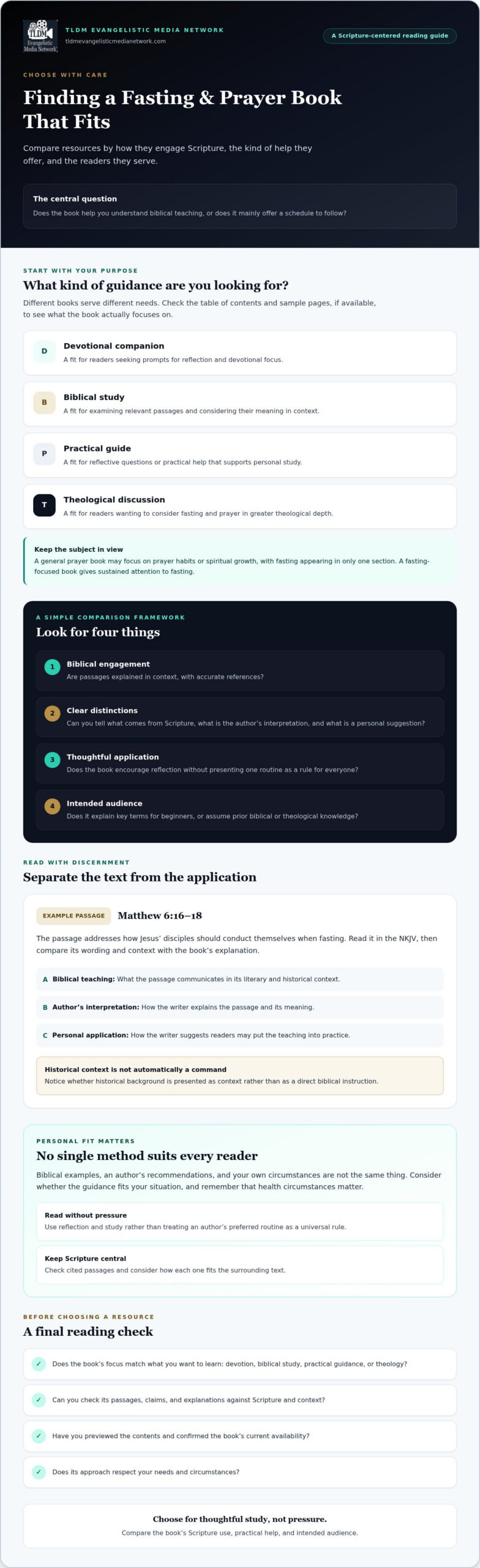
A title or devotional tone alone can’t show whether a book handles Scripture responsibly. Compare how it uses biblical passages, explains its claims, and turns study into practice. This approach helps you assess Fasting and prayer books without relying on an unsupported ranking or recommendation.
| What to assess | Questions to ask |
|---|---|
| Biblical engagement | Does the author explain passages in context and give accurate references? |
| Clarity | Can you tell which points come from Scripture, which are the author’s interpretation, and which are personal suggestions? |
| Practical application | Does the book offer reflective questions or steps that help you study thoughtfully, without presenting one routine as a rule for all? |
| Intended audience | Does it explain key terms for beginners, or assume prior biblical or theological knowledge? |
What signs suggest a book handles Scripture carefully?
Look for more than a list of verses. A careful author explains how a passage fits its chapter and purpose, then distinguishes the biblical text from the author’s conclusions. For example, Matthew 6:16-18 addresses how Jesus’ disciples should conduct themselves when fasting. Read the passage in the NKJV and compare its wording and context with the book’s explanation.
Check historical claims separately. Notice whether the author presents historical background as context rather than as a direct biblical command. A Christian resource such as Focus on the Family’s overview of the spiritual discipline of fasting can offer another perspective, but Scripture remains central to your own study.
Which kind of book fits your questions and experience?
Choose according to your purpose. A devotional may suit readers seeking prompts for reflection, while a biblical study may examine passages in greater depth. A practical guide may focus on applying ideas, so check whether its recommendations are clearly distinguished from biblical instructions.
Preview the contents and sample pages, if available, to see whether the writing fits your experience and questions. You can browse the TLDM bookstore for Christian books, then check the current catalog and each title’s scope before choosing a resource. Let your questions guide further study.
Do Fasting and Prayer Books Promote One Method for All?
They shouldn’t assume every Christian must follow one prescribed fasting method. Biblical accounts describe people fasting in particular circumstances, but an account of what someone did is not automatically a command for every believer. Authors may draw practical guidance from those examples, so notice where the biblical text ends and an author’s application begins.
A book’s recommendation may offer one way to practice, but it isn’t automatically a universal biblical command. This distinction matters when a writer presents a specific schedule or approach as the only faithful choice. A helpful resource explains its reasoning and leaves room for readers to study Scripture and consider their own circumstances.
How should readers assess claims about biblical fasting?
Ask what the cited passage says, what happens around it, and how the author connects it to a recommendation. For instance, Acts 13:2-3 describes prayer and fasting in the setting of the church at Antioch commissioning Barnabas and Saul. That account gives context for a particular event. Any broader application should be identified as interpretation, not presented as a direct instruction to every Christian.
As you read, separate three kinds of claims: what the biblical text explicitly states, what an author infers from it, and what the author shares as personal experience. Historical details and disputed interpretations also deserve careful wording. A discussion of the biblical role of fasting can provide another perspective, but weigh its explanations alongside the passages themselves rather than treating a secondary source as Scripture.
What if a fasting practice is not suitable for your circumstances?
Your health and personal circumstances deserve care, not guilt or spiritual pressure. If fasting could affect your health, consult a qualified medical professional before changing your eating habits. A book can offer spiritual reflection, but it can’t assess your individual medical needs.
Prayer, Scripture reading, and reflection can support spiritual growth without making food restriction a measure of faith. If a book suggests otherwise, pause and examine its biblical reasoning. Let Fasting and prayer books support thoughtful study, not serve as tests of devotion or substitutes for wise personal judgment.
How to Choose and Use a Fasting and Prayer Book
Begin with a clear purpose so you can choose a book that serves your study. Before purchasing, preview the table of contents or sample pages, if available, and confirm that the title is currently offered. Then use the book as a companion to Scripture, not a substitute for it.
What questions should you ask before choosing a book?
Start by naming what you hope to learn. Are you looking for biblical context, devotional encouragement, or practical reflection? Check the author’s stated purpose, intended audience, and approach to Scripture. If fasting is your main concern, confirm that the book addresses it directly rather than mentioning it only briefly.
How can you read with reflection instead of pressure?
Move through the material thoughtfully. After reading a passage, consider what it says, what it doesn’t say, and how the author applies it. Keep the biblical text distinct from the author’s interpretation and your own response.
Use this simple process to guide your choice and reading:
- 1. Name your question. Write down what you want the book to help you understand.
- 2. Inspect its scope. Review the contents and intended audience to see whether the book fits your purpose and experience.
- 3. Check its Scripture use. Read the cited passages in context and note where the author offers interpretation or application.
- 4. Reflect and record. Keep a short list of passages, questions, and insights to revisit in your own study.
A simple reading record can be enough: note the passage, the author’s main point, what you understand from the text, and what you still want to explore. This helps you engage with Fasting and prayer books thoughtfully, without treating a personal impression or an author’s recommendation as universal doctrine.
For a complementary focus on prayer, explore Christian books in the TLDM bookstore. Check the current catalog to confirm which titles are available and whether a specific book fits your study needs.
Where to Find Trustworthy Fasting and Prayer Resources
A trustworthy resource is clear about what it teaches and what it doesn’t claim to cover. TLDM Evangelistic Media Network offers Christian books, but check its current catalog before naming or recommending a fasting title. The ministry also offers Teach Me To Pray: Lessons From Scripture as a prayer resource, but its contents have not been verified as addressing fasting specifically.
You can explore the online Christian bookstore and review individual listings. A book’s presence in a ministry bookstore does not by itself confirm that it focuses on fasting or fits every reader’s needs. Check the details before deciding.
How can readers evaluate a ministry bookstore listing?
Read the current product page rather than relying on a title alone or an older recommendation. Confirm the exact title, description, format, and availability, then check whether the listing says the book addresses fasting directly. If it describes prayer more broadly, don’t assume that fasting receives focused treatment.
Transparent recommendations make their limits clear. If a resource’s contents haven’t been checked, treat its relevance to fasting as unconfirmed. This helps you compare Fasting and prayer books without turning an assumption about a title into a claim about its contents.
When might a broader prayer resource be more useful?
If your central goal is to strengthen your prayer life, a broader prayer book may serve you better than a guide focused on fasting. It can support reflection on prayer without suggesting that it offers detailed fasting instruction. Look for a resource whose description and contents match the questions you want to explore.
Before choosing, review relevant catalog descriptions, identify the question you want a book to address, and compare that purpose with the resource’s stated scope. Keep Scripture at the center of your learning, and choose materials that support thoughtful reflection without assuming one resource suits everyone.
Choose a Resource That Supports Your Next Step
The right book helps you study with care rather than pressuring you to adopt a single approach. Compare its use of Scripture, intended audience, and practical guidance. Then check cited passages and distinguish biblical teaching from an author’s interpretation.
Fasting and prayer books can support reflection, but no book replaces Scripture or fits every reader. Consider your purpose, read at a thoughtful pace, and choose practices that respect your circumstances. If fasting could affect your health, seek advice from a qualified medical professional.
TLDM Evangelistic Media Network offers Christian books through its online platform. It also offers Teach Me To Pray: Lessons From Scripture, an instructional series about prayer. Review its contents before deciding whether it relates to your particular study of fasting.
Explore Christian books and resources available through TLDM, and consider which materials best support your Scripture-centered learning. May each step deepen your understanding and encourage a thoughtful, steady walk of faith.
Frequently Asked Questions
What should I look for in a Christian book about fasting and prayer?
Look for clear engagement with Scripture, explanations of passages in context, and a distinction between biblical teaching and the author’s interpretation. Useful Fasting and prayer books also make their purpose clear, whether devotional, theological, or practical. Check the intended audience and preview the contents if possible. A thoughtful book should encourage reflection and further study, not pressure you to treat one author’s recommendations as rules for every Christian.
Are fasting and prayer books suitable for beginners?
Yes, if the book matches your experience and explains its terms clearly. Look for an introduction that gives biblical context, defines unfamiliar ideas, and guides you through Scripture without assuming prior theological study. A more advanced book may suit readers who want detailed analysis, but its scope should be clear. Preview the description, table of contents, or sample pages to judge whether the approach is understandable and relevant to your questions.
Does the Bible require every Christian to fast in the same way?
No single fasting method should be assumed to apply to every Christian. Biblical passages describe particular people and circumstances, and a narrative example isn’t automatically a universal command. Read the passage in context and notice whether an author is stating what Scripture says or offering an application. If fasting could affect your health, speak with a qualified medical professional. Prayer, Scripture reading, and reflection can support faith without food restriction.
Can a prayer book also help me learn about fasting?
It can, but a general prayer book may mention fasting only briefly or not address it at all. Check the description and table of contents for a section devoted to fasting, and see whether it explains relevant Scripture or simply offers a suggested practice. If you want specific guidance on fasting, choose a resource that clearly states that purpose. For broader prayer growth, a prayer book may still be useful.
How can I tell whether a fasting book is biblically grounded?
Check whether the author gives accurate Scripture references and explains each passage in context. Read the cited verses in the NKJV, then compare the text with the author’s explanation. A careful resource distinguishes what the passage explicitly says from interpretation, historical background, personal testimony, and practical advice. Be cautious if it presents a debated interpretation as unquestioned fact or treats a personal recommendation as a command for all believers.
Where can I find fasting and prayer books from TLDM Evangelistic Media Network?
TLDM Evangelistic Media Network offers Christian books through its online platform, but check the current catalog for titles and availability. The ministry also offers Teach Me To Pray: Lessons From Scripture, an instructional series about prayer. Its relevance to fasting hasn’t been confirmed, so review its description before treating it as a fasting resource. Don’t assume that a prayer-focused title gives specific instruction about fasting unless its contents say so.