

The best Christian Bible study books aren’t necessarily the most popular or detailed. They’re resources that guide you back to Scripture with care and help you understand what you read. When several guides cover similar themes, compare their approach, structure, and fit with your experience and available time.
You may be looking for a study to use on your own, a workbook for group discussion, or a practical way to connect biblical teaching with everyday choices. Each format serves a different purpose, and a study that fits one season of faith may not fit another. Look for a resource that offers sound guidance while leaving room for your own reading and reflection.
This guide explains how to assess a study’s focus, decide whether it suits individual or group use, and choose a rhythm you can maintain. Use these criteria to find a book that encourages careful reading, deeper understanding, and faithful Christian living.
Key Takeaways
- Choose Christian Bible study books that guide you into the biblical text and help you understand its context.
- Look for questions that encourage close reading and thoughtful reflection rather than unsupported conclusions.
- Match the study format to your goal, whether you’re studying alone, meeting with a group, exploring a topic, or working through a Bible book.
- Build a realistic study rhythm that leaves space to read, reflect, and return to challenging passages.
- Explore TLDM Evangelistic Media Network’s Christian books and scriptural learning, including the instructional series Teach Me To Pray: Lessons From Scripture.
Christian Bible Study Books: What Makes a Study Worth Choosing?
A Bible study book is a structured guide that helps readers examine Scripture, understand its meaning, and consider how to respond. It should support your reading of the biblical text, not take its place. Before choosing one, ask what you want to study and whether you prefer a guided workbook, explanatory commentary, or a discussion-based resource.
Christian Bible study books may focus on a passage, an entire biblical book, or a theme drawn from Scripture. A commentary usually concentrates on explaining biblical passages, while a general Christian living book may discuss faith and practice without guiding readers through specific passages. These resources can complement Bible study, but they serve different purposes.
How Is a Bible Study Book Different From a Devotional?
A Bible study typically invites closer examination of a passage, book, or theme through reading, context, and questions. A devotional often offers a shorter reading and reflection for daily encouragement. Both can nurture faith, but a study generally asks you to spend more time observing what the text says and considering what it means. Readers comparing formats may also find it helpful to explore a guide to Christian devotional books.
What Should a Scripture-Centered Study Help You Do?
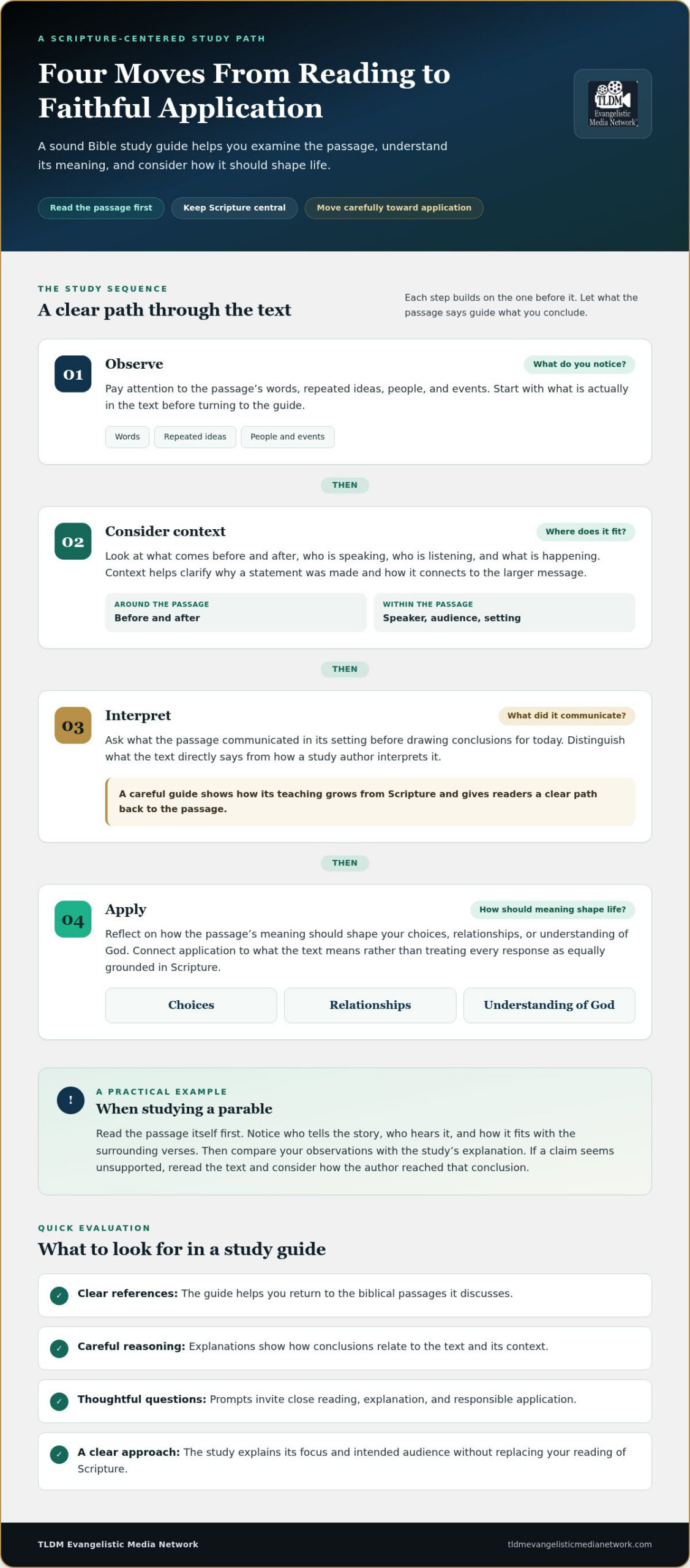
A sound study gives you a clear path from reading to thoughtful application. It should help you:
- Observe: Notice the passage’s words, repeated ideas, people, and events.
- Consider context: Look at what comes before and after, who is speaking, and what is happening.
- Interpret: Ask what the passage communicated in its setting before drawing conclusions for today.
- Apply: Reflect on how its meaning should shape your choices, relationships, or understanding of God.
For example, when studying a parable, read the passage itself before turning to the guide. Note who tells the story, who hears it, and how it fits with the surrounding verses. Then compare your observations with the study’s explanation. If a claim seems unsupported by the passage, reread the text and consider how the author reached that conclusion instead of accepting it without examination.
Academic approaches to the Bible include disciplines that examine its historical, literary, and textual features. An overview of academic biblical studies can introduce these approaches, though a study guide need not use technical methods to help readers attend carefully to context and meaning. Keep the biblical passage central, and use commentary to deepen, not replace, your reading.
How to Evaluate Christian Bible Study Books for Biblical Depth
A thoughtful guide does more than offer interesting reflections. It shows how its teaching grows from Scripture, makes its approach clear, and helps readers see how a passage fits within the Bible as a whole. As you compare Christian Bible study books, look for clear references, careful reasoning, and questions that prompt you to engage with the text.
Context gives a passage its setting, helping readers understand its meaning before drawing conclusions about how it speaks to life today. A study that explains context helps you read with care instead of relying on a verse pulled from its surroundings.
Does the Study Guide Readers Through Scripture in Context?
Look for explanations of the passage’s surrounding verses, speaker, audience, and biblical setting. These details can clarify why a statement was made and how it connects to the larger message. A verse read apart from its context may seem to say something different from what the full passage communicates.
Notice how the author presents conclusions, too. A guide should help you distinguish between what the passage directly says, how the author interprets it, and how the author applies that interpretation to Christian life. That distinction encourages careful thought, especially when readers may understand an application differently.
Do the Questions Encourage Understanding and Application?
Strong questions invite you to examine a passage before moving toward a personal response. Consider whether the prompts ask you to notice details, explain meaning, and reflect on a responsible application. Be cautious if they move quickly to a conclusion that the text hasn’t established.
- For personal study: Look for questions that allow honest reflection and invite you to return to the passage.
- For group discussion: Choose prompts that encourage people to share observations and explain their reasoning from Scripture.
- For either setting: Favor questions that connect application to the passage’s meaning rather than treating every response as equally grounded in the text.
The author’s stated approach and intended audience matter, too. A guide might focus on one biblical book, a theme, or a particular group of readers. Check how it uses biblical references and whether its explanations give you a clear path back to the passages themselves. A study does not need to answer every theological or personal question to be useful.
If you’re ready to compare resources, explore the Christian books in the TLDM bookstore as one place to find faith-centered reading.
Which Christian Bible Study Book Format Fits Your Needs?
Study formats describe different things. “Personal” and “group” refer to how you’ll study, while “topical” and “book-by-book” describe what you’ll study. A resource can combine them, such as a topical guide designed for a small group. Use the comparison below to identify a starting point, then check the book’s description for its format, materials, and intended setting.
| Format | Purpose | Useful setting | Likely structure |
|---|---|---|---|
| Personal | Support individual reading and reflection | Solo study at a pace that suits you | Prompts or readings for independent use |
| Group | Encourage shared learning and discussion | Small groups or study gatherings | Discussion questions, sometimes paired with individual preparation |
| Topical | Explore a subject through related passages | Personal study or group discussion | Organized around a theme rather than one biblical book |
| Book-by-book | Follow a biblical book across its passages | Readers seeking sustained study of a specific book | Progresses through sections of that book |
Personal Study, Small-Group Study, or Church Curriculum?
Individual guides often leave room for private reflection and flexible pacing. Group studies may include open-ended prompts that help participants compare observations and discuss how a passage speaks to them. Church curriculum can be more structured, with materials intended for an organized ministry setting. These categories can overlap, so choose according to where you’ll study and what support you’ll have.
If you’ll study alone, look for instructions and questions that work without a discussion leader. If you’re joining a group, consider whether the guide gives everyone something to read or reflect on between meetings. A curriculum built around group sessions may be less suited to independent use, while a personal workbook may offer fewer tools for leading discussion.
Topical Study or Book-by-Book Bible Study?
A topical study gathers passages related to a subject, such as prayer, and can help you explore a focused question across different parts of Scripture. A book-by-book study follows one biblical book, helping you trace its flow and consider passages in sequence. Choose a topic when you have a specific area to explore. Choose a book study when you want sustained attention to one text.
Neither approach is best for every reader or season. If prayer is your specific focus, a guide to Christian prayer books may also help you compare resources. As you review Christian Bible study books, match the format to your goal, available time, and study setting rather than choosing by label alone.
How to Choose and Use a Bible Study Book Consistently
A study becomes useful through steady engagement, not by adding more tasks to an already full schedule. Start with a clear purpose, select a format that fits your setting, review the study’s approach, and begin with a rhythm you can maintain.
How Can You Match a Study to Your Spiritual Goal?
First, name what you hope to learn. You may want a broad overview of a biblical book, closer study of a specific passage, or focused reflection on a subject in Scripture. Your goal narrows the options and helps you avoid choosing a resource simply because its topic sounds appealing.
Consider your experience and preferred way of learning, too. If you’re newer to structured study, clear explanations and guided questions may help you get started. If you enjoy writing, a workbook with space to record observations may suit you. Choose a manageable starting point rather than trying to fit several studies into the same week.
- Name your goal: Decide what you want to understand or explore.
- Choose a format: Match personal, group, topical, or book-by-book study to your needs.
- Assess the approach: Check how the guide uses Scripture and what it asks you to do.
- Begin simply: Set aside a realistic time to read, reflect, and return to the passage.
How Can You Stay Engaged When a Passage Feels Difficult?
Don’t rush past a challenging passage. Read it again, note what you understand and what remains unclear, then consult the guide’s explanation. This order helps you distinguish the biblical text from the author’s interpretation. Prayerful reflection and patience can make room for careful learning, even when a question takes time to consider.
Keep your Bible, study questions, and written reflections together. Returning to your notes can show how your understanding develops and help you pick up where you left off. You don’t need a complicated system. A notebook or a few observations beside each passage can provide continuity.
For wider guidance on choosing faith-focused reading, see the article on Christian books for spiritual growth. Then explore the Christian books in the TLDM bookstore as you consider resources for your next season of study.
Explore Christian Bible Study Books and Scripture-Based Learning
Choosing a study is one part of building a lasting practice of reading Scripture. Christian books and learning resources can support reflection beyond a single study guide. TLDM Evangelistic Media Network offers Christian books through its online bookstore and scriptural education designed to encourage thoughtful faith.
Where Can Readers Explore Christian Books From TLDM?
The TLDM Christian bookstore is a place to explore the ministry’s Christian books. As you browse, use the same care you’d bring to choosing any Bible study resource: consider what you hope to learn, read descriptions closely, and look for material that supports your engagement with Scripture.
If you prefer print, you can also browse the paperback Christian books category. Format is a practical part of choosing a resource. A physical book may suit readers who like to underline, write notes in a journal, or keep reading and reflections together.
How Does Scripture-Based Instruction Complement Book Study?
Teach Me To Pray: Lessons From Scripture is an instructional series focused on learning about prayer through Scripture. It is not a Bible study book, but it can complement one by giving focused attention to prayer as part of Christian life. Readers can use prayerful reflection alongside careful study while keeping the biblical text central.
Christian Bible study books serve different goals and study styles, so choose a resource that fits your present needs and leaves room to return to Scripture with patience. A study guide, a Christian book, and scriptural instruction can each contribute in a different way to learning and reflection.
Continue your study at a pace that fits your season, and explore Christian books in the TLDM bookstore for resources to accompany your faith journey.
Choose a Study That Leads You Back to Scripture
The right Christian Bible study books fit your goals, experience, and study setting while keeping Scripture at the center. Look for guides that explain context, ask thoughtful questions, and help you move from reading to faithful application. Then choose a steady rhythm that leaves room to reflect and revisit passages that take time to understand.
TLDM Evangelistic Media Network offers Christian books through its online bookstore. Its Teach Me To Pray: Lessons From Scripture instructional series offers another way to engage with scriptural learning, especially around prayer.
Take the next step at a pace that fits your season of faith. Explore Christian books in the TLDM bookstore and continue growing in understanding, reflection, and thoughtful Christian living.
Frequently Asked Questions
What is the difference between a Bible study book and a devotional?
A Bible study book usually guides closer examination of a passage, biblical book, or theme through reading and questions. A devotional often offers a brief reading and reflection for daily encouragement. The formats can overlap, but a study generally invites you to spend more time observing and understanding Scripture. Choose a devotional for a short reflective reading, or a study guide when you want a more structured path through the text.
How do I choose a good Christian Bible study book?
Choose Christian Bible study books that match your goal, study setting, experience, and available time. Read the description to see whether the resource focuses on a biblical book, a topic, personal reflection, or group discussion. Look for clear Scripture references, attention to context, and questions that lead you back to the passage. A useful study should support your reading of the Bible, not replace it.
Are Bible study books suitable for beginners?
Yes. Beginners can start with a guide that explains how to approach the passage and uses clear, manageable questions. Look for a study that defines unfamiliar terms, provides helpful context, and doesn’t assume extensive prior knowledge. You don’t need to understand everything before you begin. Read the biblical text at your own pace, note questions, and let the guide help you explore them thoughtfully.
Can I use a Bible study book on my own?
Yes, many study guides work well for individual use, especially those with clear instructions and questions for personal reflection. Before beginning, consider whether the material expects group discussion or a leader’s guidance. Keep your Bible and notes nearby, and write down observations or questions as you study. If a prompt is designed for conversation, you can still reflect on it privately and record your response.
What is the difference between topical and book-by-book Bible studies?
A topical study gathers passages from different parts of the Bible around a subject, such as prayer or forgiveness. A book-by-book study follows one biblical book through its passages, helping you consider its themes and flow in sequence. Choose a topical resource to explore a focused question across Scripture. Choose a book study when you want sustained attention to a particular biblical text.
How can I tell whether a Bible study book is grounded in Scripture?
Check whether the guide identifies the passages it discusses and encourages you to read them in context. Its questions should help you observe details, consider meaning, and reflect on application rather than lead you to unsupported conclusions. Notice whether the author distinguishes the biblical text from personal interpretation. As you read, compare explanations with the passage itself and consider how each claim follows from Scripture.
Can a Bible study book help me understand difficult passages?
Yes, a thoughtful guide can offer context, explain unfamiliar details, and raise questions that help you examine a difficult passage. Read the passage more than once and note what puzzles you before consulting the explanation. Then compare the author’s interpretation with the text and its surrounding verses. Some questions may take continued study, so use the guide as support rather than expecting it to settle every difficulty.