
Can a podcast help you understand the headlines without letting them set the terms of your faith? Choosing among christian podcasts on current events can be difficult when directories offer little context about a show’s format, viewpoint, or use of Scripture. A confident Christian perspective, however, isn’t the same as straight news reporting.
If you want thoughtful coverage without confusing biblical teaching with political opinion, first consider what each program is designed to do. Some offer news summaries and interviews, while others focus on cultural commentary or explore how current issues connect with Christian convictions. Their approaches differ, so the right fit depends on what you want from your listening.
This guide compares The World and Everything In It, The Russell Moore Show, and The Bulletin by format and emphasis. It also offers practical ways to listen with discernment. For Scripture-centered teaching and reflection alongside the news, TLDM Evangelistic Media Network’s Sharing The Word Podcast can serve as a companion, not a current-events news program.
Key Takeaways
- Learn how to distinguish news reporting, cultural commentary, and theological reflection in christian podcasts on current events.
- Compare programs by format, stated focus, and the kind of listening experience they offer.
- Use a simple process to check claims and sources before accepting or sharing a segment.
- Pair news listening with Scripture-centered teaching while keeping biblical principles distinct from political opinion.
- Find a thoughtful way to stay informed without letting urgent or emotionally charged coverage rush your response.
What to Look for in Christian Podcasts on Current Events
You can want a clear account of the news and a thoughtful Christian perspective at the same time. Christian podcasts on current events discuss public events, culture, policy, or the ethical questions those subjects raise. They sit within the wider field of Christian media, but a host’s faith identity alone doesn’t tell you how a particular show handles its subject.
One program may emphasize reporting and interviews; another may focus on cultural commentary or biblical teaching. Some combine these approaches, moving from a factual update to a host’s analysis and then to reflection on Christian convictions. Knowing which mode you’re hearing helps you assess what a show offers without expecting every episode to serve the same purpose.
Reporting, commentary, and biblical reflection are different
Reporting describes what can be verified; commentary interprets what those developments may mean. Biblical reflection considers how Scripture and Christian principles inform a response. That takes careful interpretation, not simply attaching a verse to every headline or treating a host’s opinion as a settled biblical conclusion.
Listen for signals that mark a change in mode. A host may summarize an official statement, then offer an evaluation or draw a moral lesson. Ask whether the program identifies its sources, distinguishes confirmed details from uncertainty, and makes clear when the speaker is offering personal analysis. These habits help you weigh a claim fairly, even when you share the host’s convictions.
Why listeners may want a Christian perspective on the news
Public developments affect real people and raise questions about responsibility, justice, compassion, and the common good. A Christian perspective can invite listeners to consider those human and moral consequences alongside the basic facts, rather than treating the news as a string of disconnected events.
Still, no single podcast can provide a complete account of every issue or a view untouched by editorial choices. Treat an episode as one contribution to understanding: notice its focus, consider what it leaves outside the discussion, and consult other reliable information when needed. The goal isn’t to surrender judgment to a host, but to grow in knowledge and wisdom.
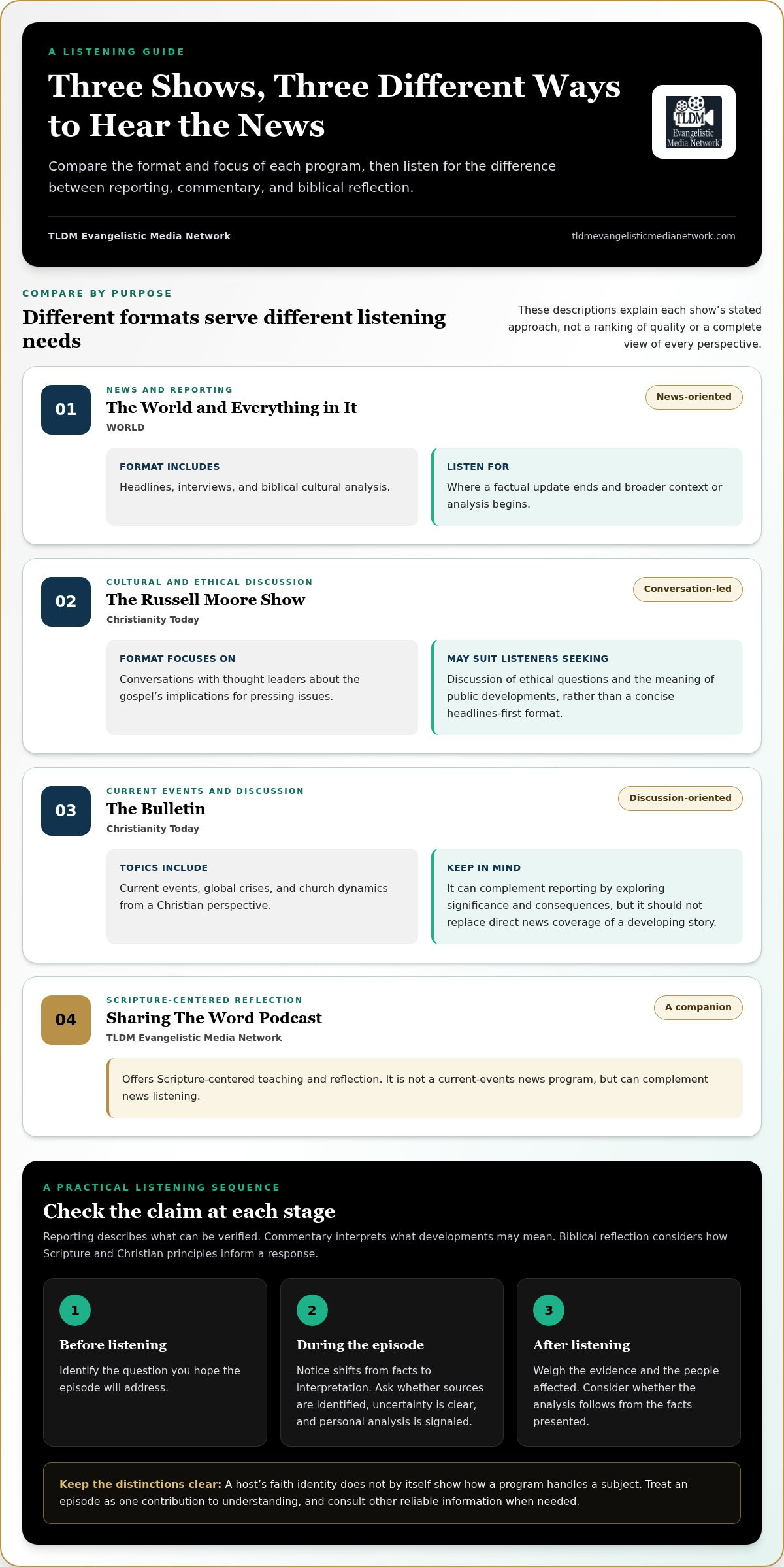
- Before listening: Identify the question you hope the episode will address.
- During the episode: Notice when the host shifts from reporting facts to interpreting them.
- After listening: Consider the evidence, the people affected, and whether the analysis follows from the facts presented.
This approach makes listening an opportunity for learning, reflection, and measured conversation. A show’s value rests not only on the perspective it offers, but also on how clearly it separates information, interpretation, and faith-based reflection.
Christian Current-Events Podcasts to Explore in 2026
The right program depends on whether you want a news update, a cultural conversation, or space to consider faith and public life. These examples represent different approaches to christian podcasts on current events. Treat each description as a guide to the show’s focus, not a ranking of its quality or a claim that one program can cover every perspective.
For listeners seeking news and reporting
The World and Everything in It from WORLD is a news-oriented option. Its 2026 program description includes headlines, interviews, and biblical cultural analysis, and an episode dated October 14, 2026, confirms that it was publishing at that time. The mix can help listeners move from a news update to broader context, though those elements still serve different purposes.
Sample an episode and notice how it handles sourcing, separates confirmed details from analysis, and signals uncertainty. You can value a show’s Christian perspective while still asking what evidence supports a particular claim.
For cultural and ethical discussion
The Russell Moore Show from Christianity Today explores the gospel’s implications for pressing issues through conversations with thought leaders. It may suit listeners interested in ethical questions and the meaning of public developments, rather than a concise, headlines-first format.
Christianity Today’s The Bulletin offers a Christian perspective on current events, including global crises and church dynamics. Its discussion-oriented approach can complement reporting by helping listeners consider significance and consequences. It shouldn’t replace direct news coverage when you need to establish what happened or follow a developing story.
For a wider directory
Reasonable Theology’s current-events and political podcasts category can help you discover additional programs. Think of it as a directory, not an endorsement of every listed show. A category label identifies a subject area, but it doesn’t tell you whether a show emphasizes interviews, news summaries, political commentary, or biblical teaching.
Compare individual programs by their stated focus, format, and approach to faith. Episode descriptions can show whether an installment reports developments, offers interpretation, or explores a theological question. That distinction makes a directory more useful: it helps you choose what to sample instead of asking you to trust a label alone.
For Scripture-centered reflection
Current-events analysis and Bible teaching can serve related but distinct purposes. TLDM Evangelistic Media Network’s Sharing The Word Podcast offers Scripture-centered teaching and reflection, not a current-events news program. It can complement news listening by giving you room to engage biblical teaching apart from the pace of the headlines. Explore the Sharing The Word Podcast for that kind of reflection.
How to Compare Christian Podcasts on Current Events
A clear comparison starts with purpose, not popularity. A Christian label tells you something about a program’s perspective, but it doesn’t automatically guarantee careful reporting or sound biblical interpretation. Discernment means weighing evidence fairly, including when a program challenges assumptions you already hold.
The comparison below summarizes the shows’ stated formats and focuses. Listener fit is a practical guide based on those descriptions, not an endorsement or a judgment of overall quality.
Show: The World and Everything in It
Primary format: News, headlines, and interviews
Stated focus: News with biblical cultural analysis, as described by WORLD
May fit listeners who: Want a news-centered program with additional cultural context
Show: The Russell Moore Show
Primary format: Interviews and conversations
Stated focus: The gospel’s implications for pressing issues, as described by Christianity Today
May fit listeners who: Want discussion of ethical and public questions
Show: The Bulletin
Primary format: Current-events discussion
Stated focus: A Christian perspective on current events, including global crises and church dynamics, as described by Christianity Today
May fit listeners who: Want faith-oriented discussion of public developments and church life
Show: Sharing The Word Podcast
Primary format: Scripture-centered teaching and reflection
Stated focus: Biblical teaching
May fit listeners who: Want Bible teaching as a companion to news coverage, not a news report
Compare format, focus, and depth
A news program, an interview, and a teaching episode ask different things of a listener. News-oriented formats can help you follow developments; longer conversations may allow more room for context, while teaching episodes focus on Scripture and application. Check episode descriptions for subject range, such as domestic news, international events, culture, ethics, or theology. Episode length and presentation also matter: a concise update may suit a commute, while a detailed discussion may call for more focused attention.
Assess sourcing and the use of Scripture
Notice whether factual claims point to identifiable reporting, documents, or other primary sources. Listen for language that marks a host’s opinion, interpretation, or uncertainty. When a speaker applies Scripture, consider the passage in context rather than relying on an isolated quotation to settle a complex public question. Applying biblical principles carefully takes study and reflection, not just a quick connection to a headline.
Match the podcast to your listening purpose
Decide whether you want news awareness, cultural analysis, or deeper biblical teaching. Try more than one format before building a routine, then notice which programs help you understand the topic without blurring fact, interpretation, and faith application. A show that challenges your first reaction can still be useful; assess its evidence before accepting or rejecting its conclusions.
For further reflection on applying Scripture in Christian life, explore these Scripture-centered podcast resources. Keep the distinction clear: biblical teaching can guide reflection, while reporting establishes and investigates news claims.
Listen to Current Events with Discernment and Peace
Thoughtful listening doesn’t require you to ignore difficult news or accept every interpretation you hear. A steady process can help you consider a report carefully, respond with compassion, and avoid passing along a claim before you understand it. This matters especially when a segment creates urgency or stirs strong emotion. Pause, then examine the underlying claim.
A simple listening routine for difficult headlines
Use this sequence when an episode raises a serious or fast-moving question:
- Choose one question. Focus on a specific point you want to understand, such as what a policy changes or who is affected. You don’t have to follow every developing story at once.
- Listen for the main claim. Write down the factual statement in plain language. Then note the host’s explanation or conclusion separately.
- Check consequential details. Look for the original document, public statement, or other primary source when available. Compare it with independent reporting that identifies its sources and provides context.
- Reflect before sharing. Consider what is established, what remains uncertain, and whether the episode’s interpretation follows from the evidence.
Verify the claim before you repeat it; a pause can protect both truth and neighborly trust. If a host uses urgent language, let the intensity of the moment prompt closer attention, not an immediate repost. Ask what information supports the claim and whether the source describes the same event the host is discussing.
Bring biblical wisdom into public conversations
Scripture can shape how Christians consider justice, mercy, truth, responsibility, and care for others. Applying those principles to a public question still calls for careful reading. Consider a passage in its surrounding context, including its audience and purpose, before drawing a connection to a current event.
Keep three things distinct: what a biblical text teaches, how a person applies that teaching to a particular situation, and which political position that person favors. A speaker may hold a sincere conviction without every detail of that conviction being a direct biblical command. Naming the difference allows Christians to discuss hard questions with clarity and humility.
Believers may agree on a scriptural principle yet differ about how it applies to complex circumstances. Listen for the reasons behind another person’s conclusion, and be willing to reconsider your own when evidence or careful study warrants it. Discernment isn’t a way to dismiss coverage that challenges your assumptions. It’s a practice of testing claims and interpretations fairly.
Listeners of christian podcasts on current events can pair a news episode with slower Scripture-centered listening, giving both public facts and biblical teaching the attention they deserve. TLDM’s online sermons offer another way to spend time with Scripture beyond the pace of news discussion.
Pair Current-Events Listening with Scripture-Centered Teaching
News coverage and Bible teaching can inform one another, but they serve different purposes. A current-events program helps you follow and examine public developments. Scripture-centered teaching gives you space to study the Bible and reflect on its meaning for Christian life. Keeping those roles distinct helps you avoid treating a host’s political analysis as biblical instruction, or expecting a Bible-teaching podcast to function as a news desk.
For listeners exploring christian podcasts on current events, this distinction can create a more balanced media rhythm. Listen to understand what happened, then make time for thoughtful engagement with Scripture. Neither practice has to replace the other.
Where Sharing The Word Podcast fits
Sharing The Word Podcast is TLDM Evangelistic Media Network’s podcast for sharing biblical teaching and reflection. It is a Scripture-centered resource, not a breaking-news or political-analysis program. Listening can provide an opportunity to focus on biblical ideas apart from the pace and debate of daily headlines, without promising a particular personal or political outcome.
If you’d like to include Bible teaching in your listening, explore the Sharing The Word Podcast and choose an episode that speaks to your interest in Scripture. Give its subject your attention on its own terms, rather than expecting it to explain a specific news story.
Build a balanced listening rhythm
A sustainable routine doesn’t need to be complicated or rigid. You might listen to a news program when you want to understand a public issue, set aside another time for Scripture-centered teaching, and leave a quiet moment afterward to reflect. Let your schedule and responsibilities guide the pace. The goal is thoughtful engagement, not keeping up with every show or headline.
- For news awareness: Choose a program whose format helps you follow the developments you care about.
- For biblical learning: Make room for Scripture teaching without tying every lesson to a current political debate.
- For reflection: Consider what you’ve learned, what remains unclear, and how you want to respond with care.
TLDM’s online sermons offer another Scripture-focused resource for listeners who want to continue learning through Christian media. Together, news listening, Bible teaching, and quiet reflection can help you stay informed while giving Scripture the attention it deserves. Choose an episode of Sharing The Word Podcast that interests you, listen reflectively, and keep approaching public conversations with patience and discernment.
Let Your Listening Lead to Thoughtful Action
Choose one episode that speaks to a question you’re carrying, then give yourself room to listen without rushing toward a conclusion. The best christian podcasts on current events can open useful questions, but careful listening also leaves space for prayer, further learning, and gracious conversation.
For a quieter focus on Scripture, explore Sharing The Word Podcast. Let each step deepen your understanding and strengthen the care you bring to conversations about public life. Stay curious, test what you hear, and move forward with wisdom and peace.
Frequently Asked Questions
What are the best Christian podcasts on current events?
The best fit is a program whose ongoing subjects and pace match what you want to follow. Before subscribing, scan episode titles from different weeks rather than choosing from one striking headline. Notice recurring topics, guest perspectives, and whether the show returns to developing stories. That quick review can help you judge whether a program will remain relevant to your interests over time.
Are Christian current-events podcasts news sources?
Some provide news updates, but a podcast’s label alone doesn’t tell you how complete its coverage is. Check when an episode was recorded or published, especially if the event is still unfolding. A story may change after production, so an older episode can offer context without reflecting the latest developments. Use the episode description and publication date to understand what it can reasonably tell you.
How can I tell whether a Christian podcast is trustworthy?
Look for clear information about the host, producer, and guests, including relevant experience or affiliations. You can also review older episodes to see whether the program follows up on earlier claims or acknowledges corrections. A show that explains its perspective and treats people it disagrees with fairly gives you more to evaluate than one that relies on confident language alone.
Can Christian podcasts help me understand current events biblically?
They can introduce Christian perspectives and raise questions you may want to consider more deeply. Pay attention to the tradition or theological outlook shaping a program’s approach, particularly if it differs from your own. You might keep a note of questions raised by an episode and discuss them with people you trust. That turns listening into a starting point for learning rather than a substitute for your own considered judgment.
What is the difference between Christian news podcasts and Christian commentary podcasts?
The practical difference is what you can expect an episode to help you do. A news-focused installment is usually organized around learning what happened; a commentary-focused one gives more time to arguments about its meaning or consequences. If you’re unsure, review the episode title and description before pressing play. That can help you choose an episode suited to whether you want an update or a discussion.
Does Sharing The Word Podcast cover current events?
Sharing The Word Podcast offers Scripture-centered biblical teaching and reflection, not current-events reporting or political analysis. Explore an episode for time focused on Scripture apart from the pace of the headlines.