

What if a tense conversation with your teenager could become a doorway to deeper trust, rather than another standoff? Seeking biblical advice for raising teenagers often begins with a familiar struggle: you want to listen patiently, correct what needs attention, and respect your teen’s growing independence.
Those goals can be hard to hold together when a conversation shuts down before you understand what is troubling your child. Scripture offers steady wisdom for these moments. It does not promise conflict-free parenting, but it can guide you toward love, self-control, and hope.
This guide explores ways to keep communication open, set clear and caring boundaries, and apply biblical principles to everyday family situations. You’ll find practical approaches to conflict, faith conversations, and your teenager’s growing responsibility. The aim is a relationship where truth and love can take root together.
Key Takeaways
- Strengthen your relationship with your teenager through faithful guidance, patient listening, and loving responsibility.
- Use biblical advice for raising teenagers to support thoughtful conversations, gradual growth, and increasing personal responsibility.
- Pair grace with clear, proportionate boundaries so your teen understands expectations and consequences.
- When tension rises, pause, listen, clarify the concern, respond calmly, and return to the conversation if needed.
- Build a flexible family rhythm of Scripture, reflection, and prayer that welcomes sincere conversation without forcing it.
Biblical Advice for Raising Teenagers Begins with Relationship
The transition into the teenage years can feel like navigating a dense fog. Approaches that worked during childhood may no longer work as well, and the emotional demands on parents can feel overwhelming. Both parent and child are adjusting. Finding a balance between protection and growing independence takes care and discernment.
Seeking biblical advice for raising teenagers begins with the heart. Biblical parenting means guiding your teen with Scripture, love, wisdom, and responsibility. It is not a set of rigid rules that guarantees a particular result. It is a way of living that reflects God’s grace to the next generation. Offer steady direction while recognizing that your teenager is learning to take greater responsibility.
Connection is not permissiveness. A relationship-centered approach does not mean ignoring harmful choices or avoiding correction. It means addressing a choice while showing your teen that your care does not disappear when you disagree. Biblical parenting guides a child toward God through consistent love and scriptural truth, without treating any particular outcome as guaranteed.
What does the Bible teach parents about teenagers?
Scripture offers enduring principles for family life, not a formula for controlling another person. Proverbs 1:8-9 (NKJV) says, “My son, hear the instruction of your father, and do not forsake the law of your mother; for they will be a graceful ornament on your head, and chains about your neck.” The passage presents parental instruction as something valuable for a child to receive.
A practical application is to offer guidance with care and explain why it matters, rather than relying only on commands. For broader context about parenting styles and child development, consider how family relationships and a young person’s development can shape everyday decisions. Bible-centered media, such as the Sharing the Word Podcast, can also support your own Scripture reflection.
Why connection matters during disagreement
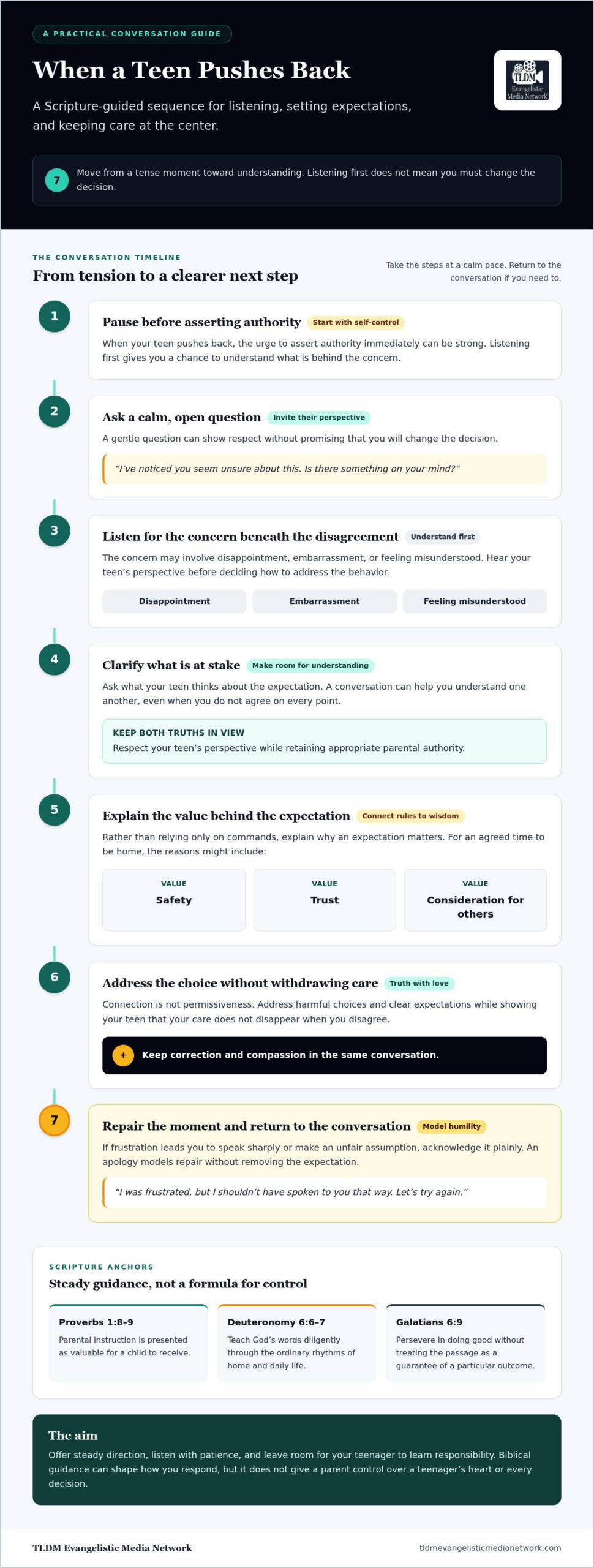
When a teenager pushes back, you may feel pressure to assert your authority immediately. Listening first can help you understand whether the concern involves disappointment, embarrassment, or feeling misunderstood. Ask a calm question before deciding how to address the behavior.
Imagine your teen hesitates to join a family tradition. Instead of starting with a lecture, you might ask, “I’ve noticed you seem unsure about this. Is there something on your mind?” The question does not mean you will change the decision. It shows respect for your teen’s perspective while leaving room for appropriate parental authority. Truth and care can both have a place in the conversation.
Use Scripture to Guide Teen Growth with Wisdom and Patience
Teenagers are still learning to weigh choices, manage strong feelings, and take responsibility. Growth rarely follows a straight line. A young person may show maturity in one area and need steady guidance in another. Disagreement about faith or family expectations does not, by itself, prove that a teen has failed spiritually or that a parent has failed in their role.
Scripture gives parents a foundation for patient formation, not a timetable for visible change. Biblical wisdom means seeing a situation in light of God’s character, then choosing what is right, loving, and responsible. It shapes how parents teach and respond while leaving room for a teenager to make choices and learn from them.
Faithful guidance helps a teenager learn to choose wisely; it does not give a parent control over the teenager’s heart or every decision.
Teach biblical wisdom through example and conversation
Deuteronomy 6:6-7 (NKJV) describes Israel’s responsibility to keep God’s words in the heart and teach them diligently to their children, speaking of them in the ordinary rhythms of home and daily life. The passage calls for ongoing instruction rooted in devotion to God. One way to apply it is to connect household expectations with the values behind them, rather than presenting rules as unexplained commands.
For example, if you ask your teen to be home at an agreed time, explain how the expectation relates to safety, trust, and consideration for others. Everyday moments can also open a conversation: returning something that does not belong to you can prompt a discussion about honesty, while following through on a shared task can illustrate responsibility. Ask what your teen thinks, then explain your reasoning. Conversation makes room for understanding, even when you do not agree on every point.
Practice patience when growth is uneven
Patience is not indifference. You can stay calm and compassionate while still addressing choices that cause harm or break clear expectations. Galatians 6:9 (NKJV) encourages believers not to grow weary in doing good, with the promise that they will reap in due season if they do not lose heart. In context, Paul urges perseverance in doing good. Parents can draw encouragement from that call to steady faithfulness without treating the verse as a guarantee of a particular outcome in a teenager’s life.
Steady guidance also means owning your mistakes. If you answer sharply or make an unfair assumption, acknowledge it plainly: “I was frustrated, but I shouldn’t have spoken to you that way. Let’s try again.” An apology does not erase the expectation or put your teen in charge. It models humility, repair, and the responsibility to make things right.
To keep Scripture present in your own reflection, listen to the Sharing the Word Podcast and consider how biblical principles could shape your next conversation. Then take one small step: explain the value behind an expectation, ask an open question, or return to a difficult discussion with a calmer spirit. Growth takes teaching, example, conversation, and room for increasing responsibility.
Does Grace Mean Avoiding Boundaries? Biblical Advice for Raising Teenagers
Grace and boundaries are not opposing ideas. Grace means responding with love and patience, while boundaries clarify what is safe, responsible, and expected. Avoiding every consequence may leave a teenager without needed guidance. Responding harshly can turn correction into shame. A loving boundary holds care and responsibility together.
You can keep a boundary firm without withdrawing your love: address the choice, explain the consequence, and remind your teen that the relationship remains secure.
Consequences work best when they relate to the choice, fit the situation, and are explained calmly. If a teen misses an agreed-upon check-in, for example, you might temporarily adjust the plan for future outings while rebuilding confidence through reliable communication. That differs from imposing an unrelated punishment in anger. No single consequence fits every family or circumstance. Scripture offers principles for wise, loving correction, and parents must apply them with care.
Set clear expectations without shaming your teen
State what you expect in direct, age-appropriate language, then explain why it matters. “I expect you to let me know if your plans change because I need to know you’re safe” gives a teen more to understand than a rule with no explanation. Correct the action, not the young person’s worth: “You didn’t follow our agreement” is clearer and less damaging than “You’re irresponsible.”
Ephesians 6:4 (NKJV) says, “And you, fathers, do not provoke your children to wrath, but bring them up in the training and admonition of the Lord.” In its family-instruction context, the verse cautions fathers against provoking their children and calls them to nurture them in the Lord’s instruction. A practical application is to correct without needless humiliation or anger while still giving guidance. The verse does not remove parental responsibility or prescribe one consequence for every conflict.
Repair trust after conflict or a broken agreement
After a disagreement, slow the exchange down. Name the specific concern, invite your teen to explain what happened, and agree on a reasonable next step. If your teen broke an agreement about borrowing the car, for instance, discuss the missed expectation and what needs to happen before driving privileges resume. Keep the consequence connected to the concern instead of adding penalties as frustration rises.
Trust grows through consistent actions over time, not an instant promise that everything will change. A teenager can show reliability by following the revised agreement, while a parent can show consistency by applying expectations fairly. Both sides may need to repair the relationship.
If you spoke harshly, apologize for your words without abandoning the boundary: “I shouldn’t have raised my voice. The agreement still matters, and I want us to talk about how to move forward.” An apology models humility; it does not erase the concern. Biblical advice for raising teenagers calls parents to combine compassion with wise correction, leaving room for honesty, accountability, and renewed trust.
Practical Biblical Advice for Raising Teenagers in Everyday Situations
Biblical principles become practical when plans change, frustration rises, or a shared responsibility is ignored. A simple conversation framework can help you respond with patience and clarity instead of reacting in the heat of the moment. James 1:19 (NKJV) urges believers to be “swift to hear, slow to speak, slow to wrath.” Let that principle guide the pace of a difficult exchange.
- Pause. If everyone is safe, take a breath before answering. A brief pause can help you choose a response instead of adding heat to the disagreement.
- Listen. Give your teen room to explain what happened and what matters to them. Listening does not mean agreeing. It helps you understand the situation before deciding what to address.
- Clarify the issue. Separate the specific choice from assumptions about attitude or intent. Ask yourself whether the concern is an unmet responsibility, a change in plans, or a misunderstanding.
- Respond. State the expectation and the reason behind it, then explain a reasonable next step. Keep your words focused on the issue and the responsibility involved.
- Revisit the conversation. Return to the matter once emotions settle, especially if you need to repair your response or review an agreement. A follow-up can turn a tense moment into continued guidance.
How should parents respond when a teenager gets angry?
If your teen raises their voice over a household task, avoid trying to settle every part of the disagreement while tempers are high. When circumstances allow, pause and say, “I want to understand what’s frustrating you. Let’s take a moment, then talk.” Invite your teen to explain before offering advice or correction. If either of you needs time to regain composure, agree to return to the discussion rather than leaving the issue unresolved.
How can parents talk about rules and responsibility?
Make the expectation, its purpose, and the next step clear. If a teen has agreed to take care of a shared chore, explain how the task affects the household and discuss what should happen if it is missed. Ask open questions such as, “What made this difficult today?” or “How can we make this agreement workable?” You can review expectations as schedules or responsibilities change while still making the final parental decision when needed.
This framework can help with ordinary disagreements, but a general article cannot address every family’s circumstances. If a concern involves safety, ongoing harm, or a serious crisis, seek situation-specific support from appropriate qualified sources. For your own Scripture reflection as you prepare for hard conversations, listen to the Sharing the Word Podcast. Let biblical wisdom shape both your words and your next faithful step.
Build a Scripture-Centered Family Rhythm and Keep Growing
A steady family faith rhythm does not need to be long or elaborate. It might be as simple as reading a few verses, sharing one thought, and praying together when the moment feels right. The purpose is not to create a perfect routine or measure anyone’s faith. It is to make room for Scripture and honest reflection in ordinary family life.
Make room for prayer and Scripture without pressure
Invite your teenager to take part in an age-appropriate way. You might read a short passage at dinner, ask what stands out, and offer a brief prayer. If your teen is not ready to talk, respect that while keeping the door open. A sincere conversation can mean more than a long discussion that feels forced.
Choose a passage that connects naturally to a real question or decision. For example, after reading Psalm 19:14 (NKJV), “Let the words of my mouth and the meditation of my heart Be acceptable in Your sight, O LORD, my strength and my Redeemer,” you could ask what it might look like to speak with care during a disagreement. Read the verse as Scripture, then offer the question as an invitation, not a test. Teach Me To Pray: Lessons From Scripture offers another way to explore biblical teaching about prayer.
Keep the rhythm flexible. Some evenings may allow for a shared reading; on others, you might pray quietly or reflect on a passage alone. The point is faithful attention, not checking off a daily requirement.
Continue your own growth as a parent
Parents also need time to learn, reflect, and seek wisdom. A quiet moment with Scripture, a written prayer, or a conversation with a trusted person can help you examine your reactions and return to family life with greater care. These practices support your own faith journey; they do not guarantee a particular response or outcome from your teenager.
Bible-centered audio can support personal reflection during a walk, commute, or quiet part of the day. The Sharing the Word Podcast provides Bible-centered listening for parents who want to keep engaging with biblical teaching. Use it to encourage your own reflection, then consider how what you have heard might shape your patience, words, and choices at home.
The teenage years bring new questions and changing family rhythms. Keep learning, listening, and returning to Scripture with humility. If you would like Bible-centered audio for personal reflection, explore the Sharing the Word Podcast as a resource for continued engagement with God’s Word.
Take One Faithful Step Forward
You do not have to solve every challenge in one conversation. Choose one faithful next step: make space to listen, pray for wisdom before responding, or invite your teenager to share what is on their mind. The biblical advice for raising teenagers you put into practice can begin with a small, steady choice, offered with love and grounded in hope.
Parents need encouragement in their own walk with God, too. The Sharing the Word Podcast, hosted by Dr. Thomas L. Driver, Ph.D., DMIN, reflects TLDM Evangelistic Media Network’s mission to share the Gospel through Bible-centered media. Let its biblical messages support your personal reflection as you continue learning and growing as a parent.
Explore Bible-centered encouragement through the Sharing the Word Podcast, and keep moving forward with patience, prayer, and hope.
Frequently Asked Questions
What does the Bible say about raising teenagers?
The Bible presents parenting as a responsibility to teach children God’s ways and treat them with care. Deuteronomy 6 places instruction within household life, not only formal teaching moments. This biblical advice for raising teenagers points parents toward a life shaped by faith, while recognizing that Scripture does not promise parents control over a child’s beliefs or choices. Teenagers remain accountable to God as they mature.
How can I discipline my teenager in a biblical way?
Think of discipline as instruction that helps a teenager understand responsibility, rather than punishment meant to cause fear or embarrassment. Before choosing a response, consider what the situation calls for: making amends, restoring something damaged, or learning a neglected skill. Avoid using a Bible verse to end discussion or label your teen. Scripture should guide your judgment, not serve as a weapon in an argument.
How do I talk to my teenager when they will not listen?
Try changing the timing or format instead of repeating the same speech. You might ask whether your teen would rather talk during a walk, after dinner, or by writing down their thoughts first. Keep the opening focused on one concern, not a list of past frustrations. If they decline to engage, say when you will be available again and follow through calmly. A different setting can make a hard topic feel less like a confrontation.
Should Christian parents let teenagers make their own decisions?
Match decision-making freedom to the impact of the choice and your teenager’s readiness. Choices such as how to organize a study schedule can offer practice with limited risk, while decisions affecting health or safety call for closer parental involvement. Set boundaries before the choice arises so your teen understands which decisions are theirs, which require discussion, and which remain a parent’s responsibility.
How can I help my teenager grow in faith without forcing it?
Do not treat visible participation as the only measure of faith. A teen may be thinking deeply even when quiet, uncertain, or not eager to join a family activity. Offer meaningful options, such as choosing a passage to read or raising a question for family discussion, and let your teenager respond honestly. Your example of practicing faith with humility can speak more clearly than pressure to display belief.
What should I do after a serious argument with my teenager?
If an argument includes threats, physical aggression, or a credible risk of harm, focus first on immediate safety and seek appropriate situation-specific support. If everyone is safe, allow time to settle before making major decisions about the relationship or consequences. Later, identify what needs attention, such as hurtful words, a broken agreement, or a recurring source of tension. Do not require instant closeness; a respectful next step can begin the repair.
How can parents stay patient while raising teenagers?
Look for patterns in your own stress, such as topics or times of day that leave you more reactive. You can prepare by deciding what you want to communicate before raising a recurring concern, or by asking a trusted adult to help you reflect on your responses. Patience does not mean never feeling frustrated. It means continuing to seek a wise response and returning to your values after a difficult moment.