
What if the best devotional for this season isn’t the one labeled “young adult,” but the one that helps you meet Scripture with honesty and purpose? With so many devotional books for young adults to choose from, it can be hard to know where to begin. A title may sound relevant, yet the reading may feel too general, too narrow, or difficult to fit into your routine.
That hesitation makes sense. Young adulthood brings real questions about relationships, identity, work, faith, and what comes next. A helpful devotional takes those concerns seriously while keeping God’s Word at the center. Look for enough depth to invite reflection, with language and a reading rhythm that fit your life.
This guide will help you choose a Scripture-centered devotional by looking beyond its title or age label. You’ll learn how to match a book’s focus to your questions, assess its biblical grounding and accessibility, and find a manageable pattern for reflection and application. The goal isn’t to finish a book as quickly as possible. It’s to make space for steady engagement with Scripture and carry its wisdom into daily life.
Key Takeaways
- Choose devotional books for young adults by the questions and season of life you want the book to address, not by its age label alone.
- Look for a resource that leads you to engage Scripture, reflect on its meaning, and consider how to respond.
- Compare a devotional’s topic, approach to Scripture, reading format, and depth to find a better fit for your needs.
- Build a reading rhythm you can return to, rather than relying on a rigid schedule or daily streak.
- Explore relationship-focused resources such as Living By The Word: Devotional Teachings On Christian Relationships if that subject fits your current season.
What makes devotional books for young adults worth choosing carefully?
Young adulthood doesn’t follow one script. Questions about faith, relationships, work, identity, and responsibility vary from person to person, as do available time and established spiritual habits. A book labeled for young adults can help narrow your options, but its audience label alone won’t tell you whether its subject, approach, or pace fits your life.
A devotional guides readers to reflect on Scripture and consider how its meaning speaks to daily life. Put simply, devotional reading connects a passage of Scripture with thoughtful reflection and a response of faith; an inspirational thought may encourage you without guiding you back to the biblical text. Daily devotionals take different forms and approaches, as this overview of What is a Daily Devotional? describes.
That distinction matters. A brief reading can still be Scripture-centered if it helps you attend to a passage instead of using a verse as a springboard for unrelated advice. Look beyond the cover and ask what the book invites you to read, understand, and carry into your choices.
What should a young adult devotional help you do?
A useful devotional directs your attention to Scripture, offers a clear point for reflection, and leaves room to consider lived faith. It might address decisions, relationships, uncertainty, or another subject on your mind. The right focus depends on your questions, not assumptions about what every young adult needs.
As you consider a title, look for a clear connection between the biblical passage and the reflection. Ask whether the prompts give you something meaningful to think about and whether the suggested application follows from the passage. A devotional can support reflection, but no book can promise to resolve personal or spiritual struggles.
How is a devotional different from a Bible study book?
Devotionals generally guide a reader toward reflection and personal response. Bible study resources may give more space to a passage’s context, close observation, and interpretation. These are not strict categories: some devotionals include study questions, and some study books invite prayer and application.
Choose based on the kind of engagement you want right now. If you want a guided reflection that connects Scripture with daily life, a devotional may suit you. If you want to examine what a passage says and how its meaning develops, a study-focused resource may be a better fit. Both can help you approach Scripture with care.
In either format, evaluate more than the age label or a promise of quick inspiration. Notice whether Scripture shapes the reading, whether the topic speaks to your actual concerns, and whether the language helps you think without feeling inaccessible. Those details give you a clearer basis for choosing than a broad category alone.
How Scripture, reflection, and application shape a devotional
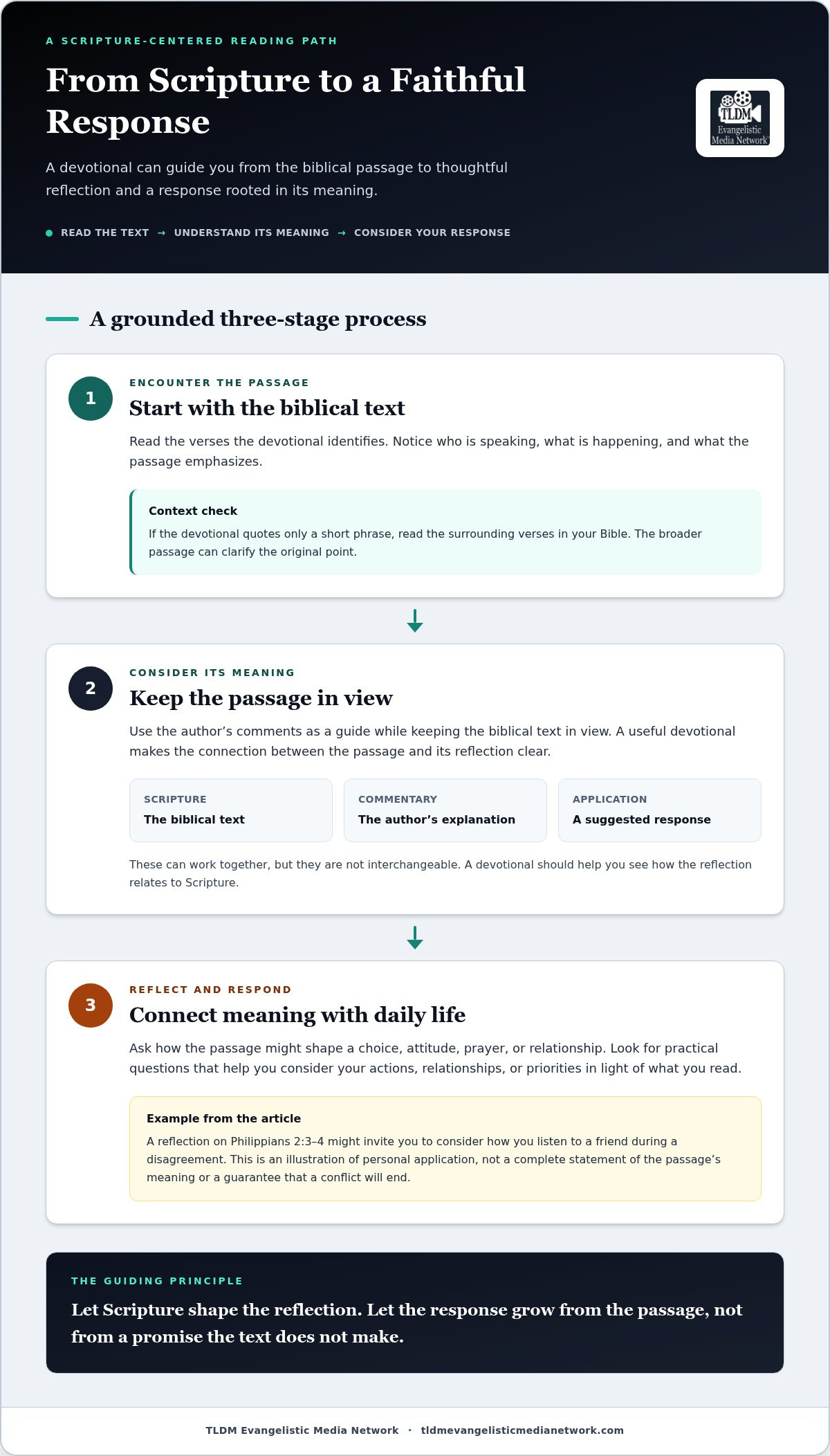
A strong devotional reading moves from the biblical text toward thoughtful response. First, encounter a passage. Then consider what it says in context and how the author explains it. Finally, reflect on what a faithful response might look like in ordinary life. This sequence keeps the reading rooted in Scripture instead of treating a verse as a decorative opening to a general message.
Sound devotional reflection begins with Scripture in context, not with a lesson imposed on an isolated phrase. That principle matters whether a book offers a short reading, themed reflections, or prompts for guided study. The format can change, but readers should be able to tell which ideas come from the biblical passage and which are the writer’s explanation or application.
- Encounter the passage: Read the verses the devotional identifies, and notice who is speaking, what is happening, and what the passage emphasizes.
- Consider its meaning: Use the author’s comments as a guide while keeping the biblical text in view.
- Reflect and respond: Ask how the passage might shape a choice, attitude, prayer, or relationship.
Does the devotional engage Scripture in context?
Look for a clear connection between the reflection and the passage it discusses. If the book quotes only a short phrase, read the surrounding verses in your Bible. The broader passage can clarify the original point and help you avoid drawing a conclusion from words separated from their context.
Pay attention to how the author presents the material. Scripture is the biblical text; commentary is the author’s explanation, and application is a suggested way to respond. These can work together, but they aren’t interchangeable. A useful devotional helps you see the connection rather than asking you to treat every reflection as if it were part of the Bible.
What makes reflection practical without becoming shallow?
Useful questions connect the passage to real decisions without claiming that one reflection will solve a complex struggle. Consider whether the prompts help you examine your actions, relationships, or priorities in light of what you read. A practical response should grow from the passage, not from a promise the text doesn’t make.
For example, a reflection on Philippians 2:3-4 might invite you to consider how you listen to a friend during a disagreement. That’s an illustration of personal application, not a complete statement of the passage’s meaning or a guarantee that a conflict will end. The distinction helps devotional reading stay honest and grounded.
Formats vary, so choose the level of guidance that helps you engage with care. A brief reading may offer a focused thought; a themed reflection may connect several passages around a subject; guided study may invite closer examination. As you compare devotional books for young adults, notice whether the format gives Scripture enough space to shape reflection and response. TLDM’s Bible-centered Christian books offer another place to explore resources for spiritual growth.
How to compare devotional books for young adults
A clear comparison starts with your needs, not a universal ranking. Before browsing, name the subject you want to explore, the kind of reading experience you prefer, and how much depth you’re ready for. Then compare titles using the same criteria. This makes it easier to see which book fits your current season instead of choosing by an appealing cover or age label alone.
Scripture engagement: Does the book point you to biblical passages, or does it mainly offer general reflections about faith?
Topic: Does its focus connect with a question or area of growth that matters to you now?
Reading format: Does it offer brief reflections, a reading plan, prompts, or another clearly described approach?
Desired depth: Are you looking for a focused thought or more sustained explanation and reflection?
Which devotional topic fits your current questions?
Write down the concern or interest you want to bring to your reading before you browse. Broad themes such as prayer or spiritual growth may suit readers seeking a wider foundation, while a focused subject can offer a closer look at one area of life. Neither choice is automatically better, and no single topic fits every young adult.
For example, someone hoping to reflect on Christian relationships might consider Living By The Word: Devotional Teachings On Christian Relationships, a TLDM book whose subject may align with that reader’s interest. The title alone doesn’t establish that it was written specifically for young adults. Explore the Christian books in the bookstore with your own topic in mind.
How do you judge format and depth?
Brief readings may fit a full schedule, while longer explanations or study prompts may suit readers who want to linger over a topic. Think about whether you prefer direct questions, extended commentary, or a structured reading plan. A format that fits your attention and available time is more useful than one that sounds impressive but feels difficult to sustain.
Use the book description and a sample, when available, to understand what a particular title offers. Don’t assume every devotional includes a daily schedule, journal prompts, or a particular length of reading. Compare formats based on the details provided for each title.
As you assess devotional books for young adults, look for alignment across all four criteria. A relationship-focused book may match your topic but not your preferred depth; a broader devotional may fit your reading rhythm while addressing a wider range of spiritual concerns. Choose the resource that best supports the engagement you want now, rather than treating any title as the best fit for everyone.
How to make a devotional reading rhythm realistic and meaningful
A reading habit should support your life with God, not become another measure of performance. Work, study, family responsibilities, health, and changing schedules can all affect when you have time to read. Instead of aiming for a perfect streak, choose a rhythm that leaves space for attention and can bend when life gets busy.
A simple Scripture-centered routine is to choose a passage, read it attentively, reflect on its meaning, and respond with prayer or a thoughtful action. You might spend a short time with one passage or take longer when your schedule allows. The goal is meaningful engagement, not racing through pages to finish a section.
Try this flexible sequence:
- Choose: Select the passage or reading you’re ready to explore.
- Read: Give the text your attention, without rushing to the reflection questions.
- Reflect: Consider what stands out and what the passage is saying.
- Respond: Pray, write a brief note, or identify one practical response.
How can readers begin without setting an unrealistic goal?
Start with an amount of reading that feels manageable alongside your present responsibilities. You could read a single entry or divide a longer passage across more than one sitting. A regular moment, such as a quiet break or time before bed, may help if it naturally fits your routine. If that moment becomes inconvenient, adjust it rather than abandoning the practice.
Give yourself enough time to think. Finishing several pages matters less than understanding what you read and making room to respond. A modest beginning can help you discover whether the book’s pace and structure work for you.
What can you do when a devotional feels hard to sustain?
Pause and consider what feels difficult. The subject may no longer connect with your questions, the reading may feel too long, or the format may not invite the kind of reflection you want. You can shorten a session, change the time, or choose a different portion of the book. Adjusting your approach is a practical way to make the habit serve reflection.
If a writer’s explanation feels unclear, return to the biblical passage and read it directly, including the surrounding verses. You can also set the book aside and come back when you’re ready. A missed reading doesn’t mean the habit has failed. Resume with the next passage, without trying to make up every entry or treating a pause as a reason for guilt.
For readers exploring devotional books for young adults, a flexible routine can reveal whether a title fits not only a topic, but also real life. Let your rhythm grow through practice. To find Bible-centered resources for continued reflection, explore the Christian books in our bookstore.
Explore Bible-centered devotional resources from TLDM
TLDM Evangelistic Media Network shares Bible-centered books and media to encourage faith and spiritual growth. Its resources include Christian books, the Sharing The Word Podcast, Take5 Messages, online sermons, and the Teach Me To Pray: Lessons From Scripture series. These formats offer different ways to engage with Christian teaching and explore what may support your ongoing learning.
When might a relationship-focused devotional be relevant?
Living By The Word: Devotional Teachings On Christian Relationships is a TLDM title focused on a specific subject. Readers interested in Christian relationships can consider its stated focus when choosing what to read. Browse TLDM’s Christian books and devotional resources, and decide whether this subject fits your questions and reading plans.
How can audio teaching complement devotional reading?
TLDM’s Sharing The Word Podcast offers another way to engage with Bible-centered media. Audio and books are different forms of learning, and each can have a place in a reader’s broader spiritual life. Visit the Sharing The Word Podcast to explore this resource alongside your reading.
TLDM’s mission is to share the Gospel through Bible-centered media. If you’d like to continue exploring books and other resources, visit the TLDM bookstore and choose a next step that fits your interests and season of life.
Choose a resource that helps you keep growing
Your next step doesn’t need to be finding a perfect book. Start with a question you’re carrying, then choose a resource that can help you bring that question honestly to Scripture. As you read, notice what invites deeper thought and what you may want to explore further. Your understanding can grow over time, one passage and one thoughtful response at a time.
The right devotional books for young adults won’t look the same for everyone. Let your present season guide your choice, and give yourself permission to adjust as your needs change. A meaningful faith journey isn’t measured by how quickly you finish a book, but by the care with which you make space for God’s Word in your life.
For a next step, explore TLDM’s Bible-centered books and media, and choose a resource that supports the questions you’re reflecting on. Explore TLDM’s Bible-centered books and media, and continue growing in Scripture with patience, openness, and hope.
Frequently Asked Questions
Are devotional books for young adults different from devotionals for other Christians?
Not necessarily. Some titles address transitions that may interest younger readers, but the label doesn’t guarantee a particular perspective or level of depth. Consider your familiarity with Christian teaching, the questions you’re exploring, and whether the author’s language feels clear and respectful. The best fit may be written for a broader audience. Read a sample or a few pages to see whether the author’s approach connects with you.
Can a young adult use a devotional book without following it every day?
Yes. Check the book’s contents to see whether entries stand alone or build on one another. If each reading has its own passage and theme, you can select the subject that interests you. If the entries form a series, keeping a bookmark or note of your place can make it easier to continue later. The book’s structure, rather than its day-by-day label, can guide how you use it.
How do I know if a devotional book is biblically grounded?
Look at how carefully the author handles passages that may be difficult or open to more than one interpretation. A helpful resource makes clear when it is offering the author’s perspective, and it may point readers to related passages or explain key terms. You can also note the Bible translation used and whether the author’s conclusions seem connected to the text. These details help you assess the book’s approach.
What is the difference between a devotional and a Bible study?
A devotional generally gives readers a guided reflection, while a Bible study often supports a more focused learning goal, such as tracing a theme across several chapters or examining a book of the Bible. The formats can overlap. If you want a resource for group discussion, look for questions that invite different readers to share observations. For personal reading, consider whether you want a brief meditation or a more structured lesson.
Is a short devotional enough for meaningful spiritual reflection?
It can be a valuable starting point, especially if a concise entry helps you remember one idea or question. Shortness alone doesn’t show whether a book offers enough substance for your needs. Consider whether you can connect its central thought with a topic you want to understand more deeply, perhaps by writing down questions to explore later or discussing them with someone you trust.
Can I use a devotional book alongside a podcast or sermon?
Yes. Different formats can serve different moments: a podcast may suit a commute, while a book may work better when you have room to read quietly. To make the combination useful, note a theme or question that stands out in each format and compare how each presents it. Treat both as teaching resources to consider thoughtfully, rather than assuming that hearing the same idea in more than one place makes it correct.
What should I do if I miss several days in a devotional?
You don’t need to treat a gap as a debt to repay. First, check whether the entries connect in a sequence or focus on separate topics. For a connected series, a brief glance at the previous reading may help you follow the thread. For stand-alone entries, choose the next subject that interests you. A bookmark or short note can help you return without turning missed pages into a source of pressure.
Are devotional books a substitute for reading the Bible?
No. A devotional presents an author’s selected reflections, while the Bible contains the larger body of Scripture those reflections draw from. A book can direct attention to a theme, but it can’t offer every passage or perspective related to it. Keep a Bible as your primary reference, and use devotional writing as one aid to learning. This distinction helps readers value helpful commentary without confusing it with Scripture itself.