

God’s sovereignty doesn’t erase human responsibility; it helps us understand both within God’s purposes. Understanding God’s sovereignty means recognizing that God has supreme authority over creation, perfect knowledge, and the power to accomplish his will. Scripture also presents people as morally responsible for their choices.
If you’ve wondered how God can govern all things while people remain accountable for what they do, you’re engaging a profound question at the heart of Christian theology. The Bible holds these truths together, even when their relationship is difficult to grasp fully. This article explains sovereignty and how it reflects God’s power, knowledge, and authority. It also considers how divine rule relates to human choices, sin, and responsibility. These passages offer a foundation for thoughtful faith and trust in God’s wisdom.
Key Takeaways
- See how Scripture presents God’s rule over creation without reducing sovereignty to a vague idea of control.
- Connect God’s power, knowledge, and authority to the way he works through human actions and circumstances.
- Understand why divine sovereignty and personal moral responsibility are both important themes in the Bible.
- Distinguish God’s sovereignty from predestination and recognize how the two concepts relate.
- Continue exploring biblical teaching through the Sharing The Word Podcast and other Christian media from TLDM Evangelistic Media Network.
Divine sovereignty and human moral responsibility
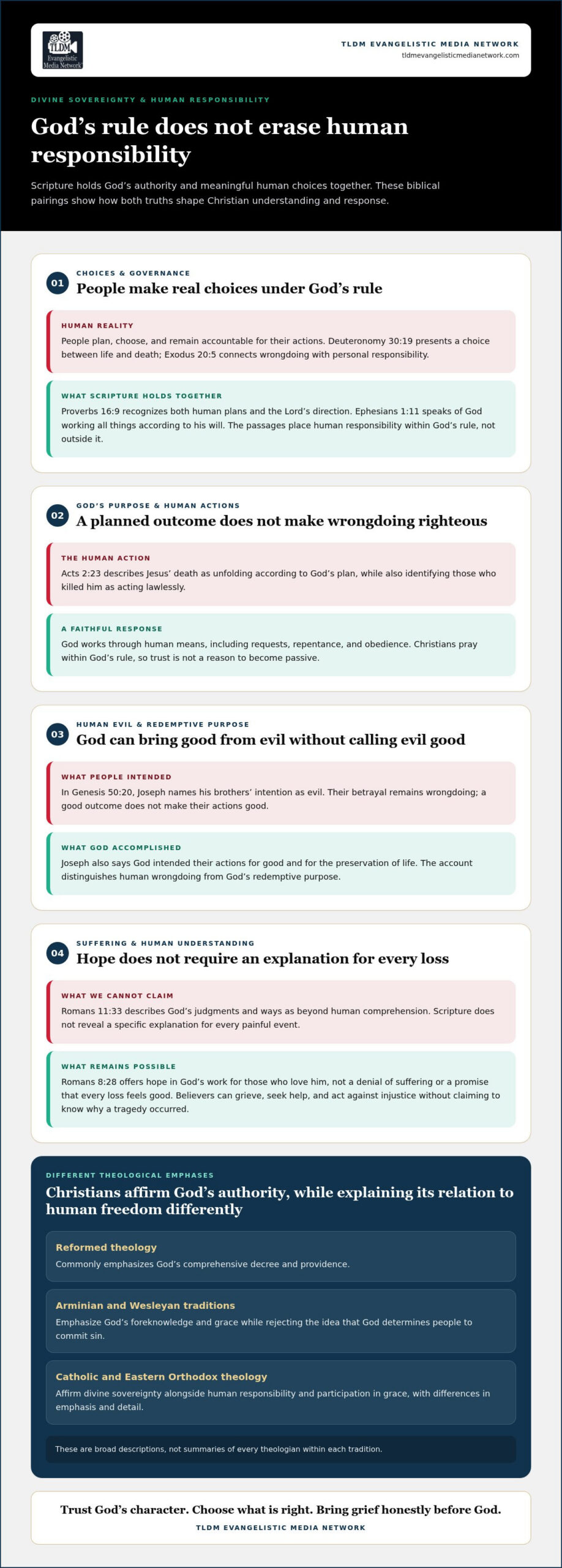
Scripture places God’s rule and human accountability together, not in competition. Ephesians 1:11 speaks of God working all things according to his will, while Proverbs 16:9 recognizes human plans and the Lord’s direction.
Sovereignty and Human Freedom
Divine sovereignty means God governs creation and human history while people make meaningful choices and remain accountable for them. Deuteronomy 30:19 presents a real choice between life and death, and Exodus 20:5 connects wrongdoing with personal responsibility. These passages call readers to choose what is right, rather than treating their decisions as meaningless.
Acts 2:23 offers a striking example: Jesus’ death unfolded according to God’s plan, yet those who killed him acted lawlessly. Prayer also matters within God’s rule. Christians pray because God works through human means, including requests, repentance, and obedience; prayer is not a reason to become passive.
Suffering and Human Understanding
Suffering is real harm and grief, not proof that a person understands God’s hidden purposes. In Genesis 50:20, Joseph tells his brothers that they intended evil, while God intended their actions for good and the preservation of life. The verse distinguishes human wrongdoing from God’s redemptive purpose; it does not call the brothers’ betrayal good.
Romans 11:33 describes God’s judgments and ways as beyond human comprehension. That limit matters when pain has no clear explanation: believers can grieve, seek help, and act against injustice without claiming to know why a specific tragedy occurred. Romans 8:28 offers hope in God’s work for those who love him, not a denial of suffering or a promise that every loss feels good.
Christian Traditions on Sovereignty
Christian traditions affirm God’s supreme authority but explain its relationship to human freedom in different ways. Reformed theology commonly emphasizes God’s comprehensive decree and providence. Arminian and Wesleyan traditions emphasize God’s foreknowledge and grace while rejecting the idea that God determines people to commit sin.
Catholic and Eastern Orthodox theology also affirm divine sovereignty alongside human responsibility and participation in grace, though their teachings differ in emphasis and detail. These broad descriptions do not capture every theologian within each tradition. They help explain why Christians may share Scripture yet understand God’s governance differently.
Purpose and Human Events
Does God’s sovereignty mean everything happens for a reason? Scripture teaches that events remain under God’s providence, but it does not reveal a specific explanation for every painful event. Genesis 50:20 shows God bringing good from human evil; it does not say every action is good or that people can identify God’s purpose in each hardship.
Proverbs 16:9 holds human planning beside God’s direction, giving believers reason to act responsibly and trust beyond what they can see. That balance offers a grounded response: pursue justice, make wise choices, and bring grief honestly before God. Trust rests in God’s character, not in a claim to know the reason behind every event.
God’s sovereignty as an expression of divine attributes
Common misconceptions include assuming sovereignty makes God the author of evil or renders human choices meaningless. Scripture instead portrays God as wise and just, working through events without treating every human action as righteous.
Direct and Indirect Divine Control
Direct divine action is God’s immediate work; indirect action operates through created beings and ordinary causes. This distinction helps readers recognize God’s authority without confusing his purpose with every creature’s intention.
Scripture shows God acting through human rulers, natural processes, and choices. Isaiah 45:5 identifies Cyrus as an instrument of God’s purpose, although Cyrus did not know him. The account distinguishes God’s ability to accomplish his will from the ruler’s understanding. In theology, these are often described as primary and secondary causes: God governs, while created agents act according to their nature.
Divine Action and Natural Consequences
Divine action refers to God’s governance of events; natural consequences follow from how actions and created processes unfold. A painful outcome does not, by itself, prove that God directly caused it as punishment.
Proverbs 16:33 says that the outcome of a lot rests with the Lord, while ordinary decisions still have real effects. A reckless choice can harm a neighbor through its foreseeable consequences. Scripture’s account of providence allows believers to recognize God’s rule without labeling every harm a direct act of judgment. It also supports taking responsibility and working to prevent further injury.
Scriptural Examples and Romans 9
Scripture presents sovereignty alongside God’s justice, wisdom, and knowledge. Isaiah 45:6-7 describes the Lord as forming light, creating darkness, and exercising rule over well-being and calamity. This passage presents his authority over what people experience, not permission to call evil good.
Romans 9:14 rejects the charge that injustice belongs to God. Paul then points to Pharaoh in Romans 9:17-18, describing God’s purpose to display divine power and proclaim his name. Christians interpret this passage differently, especially regarding election and human response. Romans 11:33 acknowledges the limits of human understanding, while Romans 11:36 locates all things in relation to God. Read together, these texts invite careful theology rather than easy claims about every event.
Sovereignty and Predestination
God’s sovereignty is his comprehensive rule over creation; predestination concerns his purpose for particular outcomes, especially salvation. The terms are related but not interchangeable. Sovereignty describes the wider reality of God’s authority, while predestination names a specific aspect of his purpose.
Christian traditions differ over how predestination relates to foreknowledge and human response. Ephesians 1:11 speaks of God working according to the counsel of his will, while Romans 9 addresses election and mercy. These passages shape debate, but the broader doctrine also includes God’s ongoing governance. Keeping the terms distinct helps readers discuss Scripture precisely and avoid assuming that every Christian tradition defines predestination alike.
God’s power, knowledge, and authority
Job 42:2 declares that God can do all things and that no purpose of his can be thwarted. Daniel 4:35 adds that no one can stop his will in heaven or on earth.
Worldly Power and God’s Purposes
Worldly power is the authority people exercise within creation, while God’s authority extends over the universe and its history. This distinction matters because rulers can wield influence without becoming ultimate or acting outside God’s knowledge.
Isaiah 46:9-10 presents God’s counsel as standing and his purpose as accomplished. Isaiah 45:5 identifies Cyrus as someone God would use, even though Cyrus did not know him. The example shows that God can work through a ruler’s decisions without making that ruler divine or suggesting the ruler understands God’s plan.
Second Chronicles 20:6 describes God as ruling over the kingdoms of the nations, with no one able to withstand him. Psalm 33:10-11 contrasts the changing plans of nations with the Lord’s counsel, which stands forever. These passages do not tell believers to treat political power as harmless. They place human authority under God’s greater rule and offer a reason to resist injustice without giving rulers final authority over hope.
Power Over Life and Death
God’s power over life and death means that life remains under his authority, not that people can explain every death. In grief, Scripture’s claims about God’s power call for compassion and humility.
Deuteronomy 32:39 presents God as the one who gives life, puts to death, wounds, and heals. Job 1:21 records Job blessing the Lord after losing what he had. Neither passage invites readers to minimize bereavement or accuse a grieving person of weak faith.
God’s power is joined to complete knowledge, not limited by what lies outside human sight. Psalm 147:5 describes the Lord as mighty in power and understanding. Jeremiah 32:27 asks whether anything is too hard for him. Together, these texts present a powerful God whose authority includes both ability and knowing. They also distinguish divine power from human control: people cannot command life’s course, but they can care for one another, seek help, and lament honestly.
For Christian theology, God’s sovereignty does not make every event easy to interpret. Psalm 115:3 says God does what he pleases, while Isaiah 6:1 portrays him enthroned as King. These images direct attention to God himself, not to worldly appearances as the measure of his rule. Believers can act faithfully within their responsibilities while recognizing that the universe does not rest on their shoulders.
Definition of God’s sovereignty
God’s sovereignty is his supreme authority over creation, history, and every creature. Psalm 115:3 describes the Lord as reigning in heaven and doing what pleases him. This doesn’t mean people become puppets or that wrongdoing becomes good. Christian theology understands God as ruling with wisdom and purpose, while people remain accountable for their actions.
Scripture connects sovereignty with providence, God’s purposeful governance of creation toward the goal of his glory. Genesis 1:1 presents God as Creator, bringing the world into being. Psalm 24:1-2 says the earth belongs to the Lord, who founded it. Creation depends on its Maker, rather than existing independently of him.
God’s rule includes events people can see and purposes they may not understand. Proverbs 19:21 recognizes that people make plans, yet the Lord’s purpose stands. This teaching helps Christians face a difficult situation without claiming to know exactly why it happens. Trust in providence doesn’t bypass grief, careful thought, or responsible action.
Divine sovereignty concerns nations and rulers as well as private spiritual life. Romans 13 describes governing authority in relation to God, while Romans 9 addresses divine mercy and election. These passages call the church to distinguish human power from God’s ultimate authority and to consider how faithfulness applies within public life.
Sovereignty doesn’t require believers to wait passively for God to act. Jeremiah 10:23 acknowledges that people need the Lord’s direction. Christians can seek wisdom, pray, and respond to circumstances through ordinary means, including counsel and acts of compassion. God’s governance encompasses both the ends he purposes and the means through which events unfold.
For a grounded understanding, hold together three biblical truths: God rules, people make meaningful choices, and human understanding has limits. Psalm 29:10 portrays the Lord as King forever. This vision presents sovereignty not merely as intervention in isolated events, but as God’s enduring authority over life and creation.
Providence is purposeful sovereignty, directing all things toward the goal of God’s glory. It gathers creation, history, and human responsibility under God’s rule.
What is the difference between God’s sovereignty and predestination?
God’s sovereignty describes the scope of his rule; predestination refers to a particular purpose within that rule. This distinction helps readers avoid treating every biblical statement about God’s authority as a statement about individual salvation. Sovereignty concerns God’s governance of creation and history. Predestination focuses on God’s purpose for people and their final destiny, especially as Scripture discusses salvation in Christ.
Romans 8:29-30 links being conformed to the image of God’s Son with calling, justification, and glorification. Paul’s sequence directs attention to God’s saving work, rather than offering a complete explanation of every event in a person’s life. Second Timothy 1:9 likewise speaks of God’s purpose and grace given in Christ before time began. These passages illustrate why predestination is discussed within salvation theology.
The distinction also guides how readers interpret a passage. If a text addresses creation, rulers, or human history, its subject may be God’s sovereignty without directly explaining predestination. If it describes God’s purpose for those who belong to Christ, predestination may be central. John 6:37-40, for example, connects those given to the Son with coming to him and receiving eternal life. Read the surrounding verses before drawing conclusions.
Predestination should not be used as a synonym for fate. Fate suggests an impersonal force or fixed sequence detached from relationship and character. Biblical passages present God as acting purposefully, and they call people to faith, love, and obedience. In John 6, Jesus speaks both of the Father’s will and of people coming to him. The passage invites readers to attend to both divine purpose and the response described in the text.
Christians interpret the scope and mechanics of predestination differently, so careful wording matters. Instead of assuming one verse settles every question, compare related passages, note whom each addresses, and distinguish what the text states from theological conclusions drawn from it. This approach supports honest study without collapsing sovereignty and predestination into one idea. It also keeps discussion connected to the Bible’s central concern: God’s saving purpose through Christ and the life of faith that follows.
TLDM Evangelistic Media Network: Sharing The Word Podcast
TLDM Evangelistic Media Network offers the Sharing The Word Podcast for readers who want to continue reflecting on Scripture and God’s rule. Listening can help you revisit biblical teaching beyond this article and consider how it shapes faith in everyday life. The Sharing The Word Podcast is a natural next step when you want further Christian teaching in an audio format.
For other ways to explore Scripture, TLDM also offers Take5 Messages, Teach Me To Pray: Lessons From Scripture, and Online Sermons. Choose the format that best supports your study, whether you want to focus on prayer, hear a sermon, or continue with a podcast. Visit the TLDM Evangelistic Media Network website to explore its Christian media.
Let Your Study Shape Your Next Step
A deeper understanding of God’s sovereignty can become more than an idea to consider. Let it shape how you pray, respond to uncertainty, and care for people facing hardship. When difficult questions arise, return to Scripture with patience, read passages in context, and make room for honest reflection. Faithful study doesn’t require you to resolve every mystery before taking the next step.
You can continue exploring Christian teaching through TLDM Evangelistic Media Network’s Sharing The Word Podcast, Take5 Messages, and Teach Me To Pray: Lessons From Scripture. Choose a resource that fits the question you’re carrying or the practice you want to strengthen.
If you’d like to connect with the ministry, contact TLDM Evangelistic Media Network. Keep seeking God with humility and hope, trusting that thoughtful reflection can deepen your walk of faith.
Frequently Asked Questions
What does God’s sovereignty mean in Christian theology?
In Christian theology, sovereignty means God possesses rightful authority over all creation, not merely greater power than other beings. Power describes ability, while authority also concerns rightful rule. For example, Christian worship treats God as worthy of trust and obedience, not simply as a force people hope will influence events. The doctrine shapes how believers understand God’s place in worship, teaching, and church life.
What Bible verses teach that God is sovereign?
Psalm 103:19 says the Lord established his throne in heaven and rules over all. Daniel 2:21 describes God as changing times and seasons, removing kings, and establishing kings. Together, these passages show sovereignty through images of rule over both the course of history and political leadership. As you read them, notice what each passage emphasizes, then consider how its original setting shapes its message.
How do Christians reconcile God’s sovereignty with human free will?
Christians offer different accounts, partly because they define freedom differently. Compatibilists hold that God’s governance can coexist with choices people make willingly, without external compulsion. Libertarian accounts usually argue that genuine freedom requires the ability to choose otherwise in some circumstances. These labels describe theological approaches, not separate Bible verses. Knowing the distinction can help you follow a discussion or see where Christians agree on Scripture but differ in interpretation.
How does God’s sovereignty relate to suffering and evil?
John 9:1-3 cautions against assuming that a person’s disability resulted from that person’s sin or their parents’ sin. In the passage, Jesus rejects that proposed explanation and redirects attention to God’s work. The account offers a useful guard against assigning blame when someone suffers. A caring response begins by listening and meeting needs, rather than claiming to know the hidden cause of another person’s pain.
How should belief in God’s sovereignty affect daily life and decision-making?
Belief in God’s rule can shape the purpose behind ordinary work, not only major decisions. First Corinthians 10:31 directs readers to do everything for God’s glory, including eating and drinking. At work, at home, or in public, ask whether your words and conduct reflect gratitude and love of neighbor. This offers a practical measure for choices whose outcomes remain uncertain: consider not only what you gain, but whom your decision serves.