

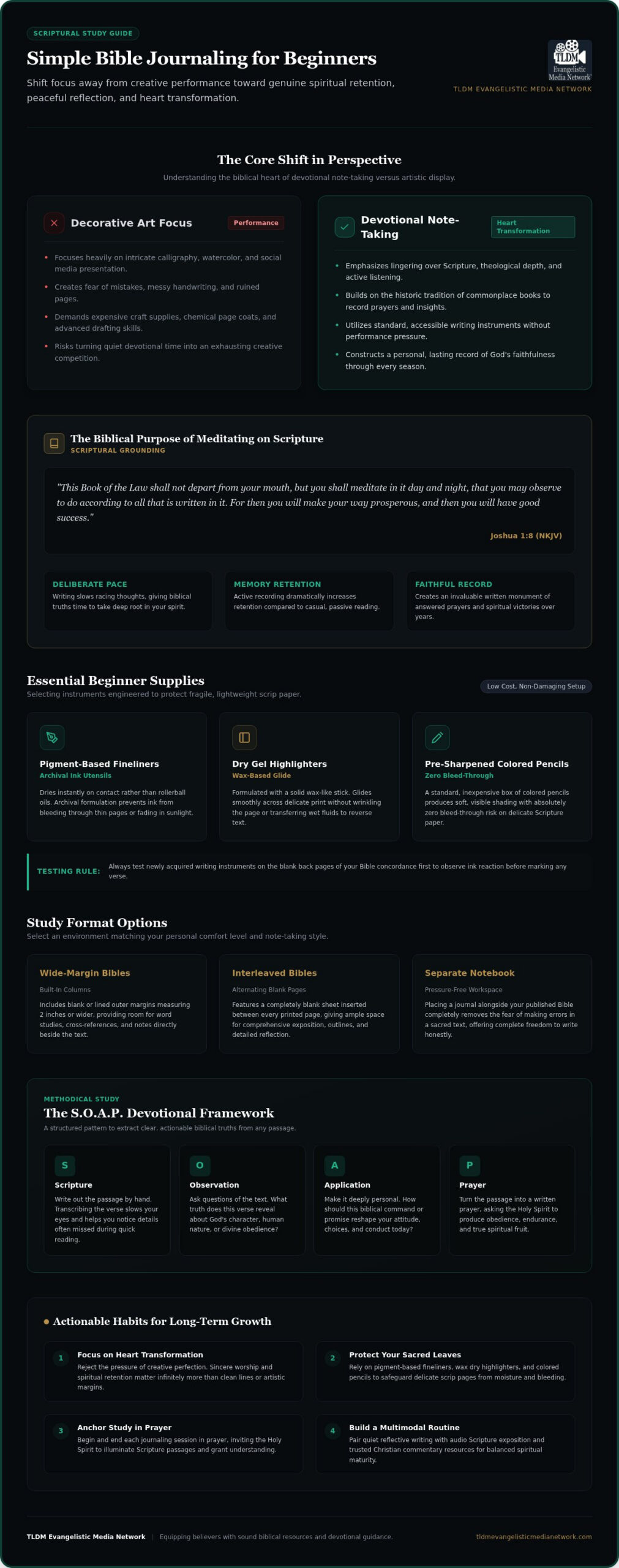
What if Bible journaling was never meant to be an art showcase, but a quiet sanctuary for your soul? It is easy to feel intimidated by the intricate calligraphy and colorful illustrations filling social media, especially when you worry about messy handwriting or ink bleeding through delicate Scripture pages. You don’t need drafting skills or artistic talent to engage deeply with God’s Word. By exploring simple bible journaling ideas for beginners, you can shift your attention away from creative performance and redirect it toward genuine spiritual growth.
You can discover practical, non-intimidating Bible journaling techniques to deepen your daily Scripture study with quiet confidence. This guide explores accessible note-taking methods, reflective prayer habits, and gentle study frameworks like the S.O.A.P. pattern. You will also learn about dependable, low-cost supplies that protect your pages, helping you establish a peaceful, sustainable devotional routine that lasts.
Key Takeaways
- Explore non-artistic bible journaling ideas for beginners that emphasize spiritual retention and heart transformation rather than creative perfection.
- Protect delicate Bible pages by selecting the right bleed-resistant pens and highlighters for an inexpensive, durable study setup.
- Apply structured frameworks like the S.O.A.P. method to extract clear, actionable biblical truths from any Scripture passage.
- Follow a step-by-step entry guide that anchors your study in prayer, allowing the Holy Spirit to illuminate each verse you read.
- Establish a consistent devotional habit by pairing quiet writing time with audio Scripture exposition and trusted Christian study resources.
What Is Bible Journaling and Why Should Beginners Start?
Bible journaling is the intentional practice of lingering over Scripture to understand, internalize, and pray through God’s Word. While social media often displays elaborate watercolor paintings and intricate calligraphy, true biblical journaling is not an art competition. It is a quiet discipline focused on spiritual retention and personal transformation. Many of the most rewarding bible journaling ideas for beginners draw inspiration from the historical practice of commonplace books, where believers and scholars preserved meaningful insights, answered questions, and recorded prayers for daily guidance.
Devotional note-taking differs significantly from decorative art journaling. Instead of emphasizing aesthetic perfection, reflective journaling prioritizes theological depth and active listening. Marking a passage helps you interact directly with the biblical text, converting passive reading into a dynamic conversation with your Creator.
The Biblical Purpose of Meditating on Scripture
Scripture commands us to engage the text deeply rather than skimming it casually. In Joshua 1:8, the Lord instructs Joshua, “This Book of the Law shall not depart from your mouth, but you shall meditate in it day and night, that you may observe to do according to all that is written in it. For then you will make your way prosperous, and then you will have good success.” Writing helps slow your racing thoughts, giving biblical truths time to take root in your spirit.
This deliberate pace dramatically improves your memory retention. Over months and years, your journal entries also create an invaluable record of God’s faithfulness through trials, answered prayers, and spiritual victories.
Overcoming the Fear of the Blank Page
Many believers hesitate to begin because they worry about making mistakes in a sacred volume. Messy handwriting, uneven margins, and crossed-out words do not diminish the sincerity of your worship. Scripture reminds us that while man looks at the outward appearance, the Lord looks upon the heart.
If marking a published text feels uncomfortable, keep a separate notebook alongside your Bible. This simple adjustment removes performance pressure entirely. Exploring practical bible journaling ideas for beginners should liberate your devotional life, giving you freedom to reflect honestly without fear.
Essential Beginner Supplies: Keeping Your Setup Simple and Inexpensive
Starting a meaningful study routine does not require an investment in expensive studio equipment. You don’t need acrylic paints, chemical page prep coats, or imported calligraphy sets to hear from God. Many of the most enduring bible journaling ideas for beginners rely on modest, functional stationery items you likely already own, such as a standard graphite pencil, a clear ruler, and a notebook. Engaging in regular expressive writing can help you control your symptoms and improve your mood, proving that the psychological and spiritual benefits come from your mental focus, not an elaborate craft stash.
Bible pages are uniquely fragile. Known as lightweight scrip paper, this delicate print surface absorbs moisture rapidly, which makes heavy wet inks seep through to the reverse text. Choosing the right everyday instruments protects your pages while keeping your personal devotional space peaceful and clutter-free.
Choosing the Right Pens and Highlighters
Selecting reliable utensils makes a huge difference in preserving thin Scripture leaves. When purchasing pens, look for pigment-based fineliners that dry instantly on contact rather than standard oil rollerballs. For highlighting, skip wet neon ink pens entirely:
- Pigment-based fineliners: These feature archival ink that will not bleed through thin paper or fade when exposed to sunlight.
- Dry gel highlighters: Formulated with a solid wax-like stick, these glide across delicate print without wrinkling the page.
- Colored pencils: A simple, inexpensive box of pre-sharpened colored pencils offers soft shading with zero bleed-through risk.
Always test newly acquired writing instruments on the blank back pages of your concordance first. This quick test reveals how the ink reacts to your specific paper weight before you mark a single verse.
Wide-Margin Bibles Versus Separate Study Notebooks
Wide-margin editions feature blank or lined outer columns that are two inches or wider, giving students ample room to record cross-references, word studies, and personal reflections directly beside the text. Interleaved Bibles take this further by inserting a completely blank sheet between every printed page. Both styles serve serious readers well.
If purchasing a specialized volume feels unnecessary right now, a simple college-ruled notebook works wonderfully. Writing beside your standard Bible removes all fear of page damage while leaving plenty of room for extended prayers and sermon outlines. When you are ready to expand your study with sound doctrine, explore the TLDM Bookstore for faith-building literature that enriches your daily notes.
Simple Bible Journaling Styles That Require Zero Artistic Skill
You do not have to be an illustrator to engage meaningfully with sacred text. Analytical readers often thrive by approaching the page through structured thinking rather than freehand drawing. When exploring bible journaling ideas for beginners, consider using structured methods that channel your natural curiosity into systematic observation. Scholarly research from the Harvard Gazette highlights profound connections between artistic expression and spirituality, demonstrating how intentional creative acts foster transcendence. For many believers, that creative expression takes the form of careful words, organized outlines, and focused questions.
Approaching your daily passage with an organized system removes guesswork. Instead of wondering what to write, these non-artistic frameworks guide your attention directly to the text, grounding your spiritual reflections in sound biblical interpretation.
The SOAP Method: Scripture, Observation, Application, Prayer
The SOAP acronym offers a repeatable, four-part framework that keeps your study focused and manageable in fifteen minutes or less:
- Scripture: Write out the selected passage word for word. Slow down to absorb every phrase.
- Observation: Note what stands out in the passage. What does the text teach about God, humanity, or obedience?
- Application: Determine how this truth affects your conduct today. Make it personal and actionable.
- Prayer: Compose a heartfelt prayer asking the Lord to help you live out this revelation.
Consider applying this approach to Philippians 4:6-7: “Be anxious for nothing, but in everything by prayer and supplication, with thanksgiving, let your requests be made known to God; and the peace of God, which surpasses all understanding, will guard your hearts and minds through Christ Jesus.” By observing Paul’s instruction to replace anxiety with thankful prayer, you can write an application identifying specific worries to surrender before concluding with a prayer for divine peace.
Verse Mapping for Deeper Scriptural Context
Verse mapping breaks down a single sentence to uncover its deeper linguistic and theological architecture. Start by writing one verse across the center of your page. Circle keywords, underline unfamiliar terms, and consult a concordance to explore original Hebrew or Greek nuances. Note relevant cross-references in the margins to see how Scripture interprets Scripture.
This systematic method builds scriptural literacy without requiring a single sketch. It also pairs naturally with structured prayer guides, helping you discover fresh ways on how to pray with scripture as you turn ancient truths into living dialogue.
Written Prayers and Margin Reflection
Transforming biblical commands and promises into personal petitions is one of the gentlest ways to fill your margins. When you encounter a verse that convicts your spirit or offers comfort, write out a conversational prayer right beside it. Include the current date next to your note.
Dating these marginal reflections turns your Bible or notebook into an enduring record of answered prayer. Over time, you can look back across these dated entries to see how God sustained you through seasons of uncertainty, building steady confidence in His lasting grace.
Step-by-Step Guide to Completing Your Very First Journal Entry
Sitting down to write your first entry should bring quiet refreshment rather than stress. Having a systematic path forward ensures you never stare blankly at the page wondering where to begin. By establishing an orderly four-step flow, you can easily implement bible journaling ideas for beginners while focusing completely on Christ rather than artistic performance.
Treat this process as an intentional sanctuary in your busy schedule. Moving methodically from initial prayer to active obedience helps transform biblical study into lifelong spiritual growth.
The Four-Step Routine from Prayer to Application
Follow this disciplined sequence during your initial journaling sessions to keep your thoughts organized and your heart receptive:
- Step 1: Pray for Illumination. Ask the Holy Spirit to open your eyes to the truths contained in the passage. Pray Psalm 119:18 in your own words, asking God to reveal wonders from His law.
- Step 2: Read Slowly and Repeatedly. Read your selected passage at least two or three times. Pay close attention to repetitive phrasing, contrasting ideas, or commands given by the author.
- Step 3: Record Key Observations. Pick up your pen and write down what the verses teach about God’s character. Note any specific promises, warnings, or personal prayers directly in your journal margin.
- Step 4: Establish One Action Step. Close your entry by writing one concrete response for your day. Decide how this truth will change your attitudes, speech, or decisions over the next twenty-four hours.
Best Scripture Passages for Beginners to Journal First
Beginning with complex prophetic imagery or deep genealogical records can overwhelm a newcomer. Starting with short, foundational passages yields immediate spiritual encouragement and builds steady momentum. Here are several passages well suited for your initial entries:
- Psalm 23: Meditate on the Lord as your personal shepherd, resting in His sovereign provision, peace, and restorative care.
- Proverbs 3:5-6: Reflect on what it truly means to trust God with your entire heart instead of leaning on finite human understanding.
- Romans 8:38-39: Record Paul’s triumphant declaration that neither death nor life can separate you from God’s unbreakable love.
- Matthew 6:25-34: Journal Christ’s tender reassurance regarding worry, resting in your Heavenly Father’s faithful daily provision.
- Lamentations 3:22-23: Celebrate the unfailing compassions of the Lord, which renew every single morning.
Gaining historical context around these verses enriches your study tremendously. Listen to the Sharing The Word Podcast for structured verse-by-verse biblical exposition that provides solid doctrinal background before you set pen to paper.
Building a Consistent Bible Journaling Habit for Long-Term Growth
Establishing a spiritual habit requires grace rather than rigid perfection. When life becomes frantic, your devotional time should serve as an anchor of peace rather than another demanding chore on your checklist. Implementing sustainable bible journaling ideas for beginners means cultivating steady consistency over sporadic marathons.
Spiritual dryness happens to every believer at times. If you miss a day or even several weeks, don’t let guilt derail your commitment. Simply open your notebook to the next clean page and resume. Daily spiritual growth is a lifelong journey of discipleship, built through humble, repeated returns to the feet of Christ.
Fitting Journaling into a Packed Daily Schedule
You don’t need sixty uninterrupted minutes to commune with the Lord. Ten focused minutes in the morning can steady your mind and anchor your priorities for the entire day. Creating a frictionless environment makes consistency almost effortless:
- Assemble a dedicated quiet time basket: Keep your Bible, journal, and pens together in one accessible spot so you can sit down and study immediately without hunting for supplies.
- Prioritize frequency over duration: Ten minutes spent reflecting on a single verse each morning produces more spiritual fruit than an exhausting two-hour session attempted once a month.
- Embrace quiet margins: Use lunch breaks, early mornings, or evening wind-downs to jot down a sentence of gratitude or ponder a passage you read earlier.
Enhancing Your Quiet Time with Audio Ministry
Pairing audio exposition with personal note-taking accelerates your biblical comprehension. Listening to solid verse-by-verse teaching provides the historical and doctrinal foundation you need to interpret challenging passages accurately.
When you study Scripture alongside trusted teachings on biblical principles for spiritual victory in 2026, you gain practical insights that directly inform your daily written reflections. Short daily audio devotions like Take5 Messages offer five-minute Scripture reflections that easily spark meaningful writing prompts. Combining these audio insights with practical bible journaling ideas for beginners equips you to internalize God’s Word deeply, transforming everyday routines into lasting spiritual strength.
Step Forward into a Deeper Walk with God
Meaningful Bible study does not require flawless artistry or hours of free time. By letting go of comparison and embracing practical bible journaling ideas for beginners, you turn quiet study into a personal sanctuary of worship. Whether you use the SOAP framework, record conversational prayers in the margin, or map key verses in a separate notebook, the true purpose remains unchanged: drawing near to the heart of God through His living Word.
As you build this daily discipline, you don’t have to study in isolation. Deepen your Scripture study by listening to the Sharing The Word Podcast, which offers expository teachings grounded in sound biblical scholarship. These convenient digital audio messages fit seamlessly into busy routines, providing rich verse-by-verse insights that will inspire your written notes. Pick up your pen today, open the Scriptures with expectation, and let the Lord refresh your soul on every page.
Frequently Asked Questions
What is the easiest Bible journaling method for someone who cannot draw?
The SOAP method remains the most straightforward, accessible approach for non-artists. You simply write out the Scripture passage, record a direct observation about what it says, write a personal application for your life, and conclude with a short prayer. It requires zero artistic talent, keeps your study organized, and centers your attention entirely on biblical comprehension and personal spiritual growth.
Will standard pens and highlighters bleed through delicate Bible pages?
Most common liquid highlighters, rollerball pens, and heavy markers will soak through lightweight Bible paper. Standard Scripture leaves are thin and absorb wet inks quickly, causing noticeable ghosting or bleeding on reverse pages. To protect your text, choose pigment-based archival fineliners, dry wax gel highlighters, or standard colored pencils that lay down color gently without penetrating the paper fibers.
Is it disrespectful to write or underline in a holy Bible?
Marking a Bible with reverence is an act of active engagement rather than disrespect. Historically, believers have annotated text margins to highlight timeless promises, record insights, and document spiritual growth. The physical ink honors the message by treating Scripture as living truth for daily guidance. If you still feel hesitant, keeping a separate notebook alongside your Bible offers a peaceful alternative.
What translation should I use for beginner Bible journaling?
The New King James Version (NKJV) is an exceptional choice for devotional journaling because it balances traditional lyrical beauty with clear, modern sentence structure. Selecting a translation that remains faithful to original texts while offering high readability ensures your observations stay doctrinally sound. Choosing a reliable, formal-equivalence translation helps you explore deep theological themes with clarity when testing new bible journaling ideas for beginners.
How much time does a daily Bible journaling session take?
A productive Bible journaling session takes as little as ten to fifteen minutes. You don’t need hours of open time to hear from God or process truth. Setting a brief, structured window to read three or four verses, write a two-sentence reflection, and record a focused prayer produces consistent fruit without overwhelming your packed schedule or demanding unreasonable energy.
What should I do if I make a spelling mistake in my Bible margin?
Simply draw a clean, neat line through the misspelled word and continue writing your thought. Bible journaling is personal worship rather than a published manuscript. Minor mistakes, messy handwriting, and imperfect margins serve as humble reminders that God values an honest, seeking heart over flawless visual presentation. Focus your mind on receiving the Word instead of perfecting the page.
Do I need to buy an expensive journaling Bible to start?
You do not need a specialized or costly Bible to begin meaningful study. While wide-margin editions offer extra room for extensive notes, a basic lined notebook kept beside your current Bible works just as effectively. The primary goal is active, prayerful engagement with God’s truth. Starting with simple tools allows you to explore practical bible journaling ideas for beginners without any financial burden.