

What if a steadier prayer life begins not with a perfect routine, but with a more honest relationship with God? Prayer can feel repetitive or unfocused, and biblical examples may seem distant from everyday pressures. Yet biblical prayer strategies aren’t formulas to master. They offer Scripture-rooted ways to bring your needs, gratitude, questions, and hopes before God.
If you’ve missed a day or are still waiting for an answer, it’s understandable to feel discouraged. Scripture shows prayer taking many forms, from praise and confession to lament and persistent requests. These patterns can guide your own words without requiring a rigid script or asking you to hide what you truly feel.
In this article, you’ll explore biblical patterns of prayer and practical ways to build a flexible, sustainable practice. You’ll also consider how to approach prayer with honesty, humility, and hope, whether you have a set routine or are simply beginning again. For further Scripture-focused guidance, TLDM Evangelistic Media Network’s Teach Me To Pray: Lessons From Scripture offers a structured study of prayer.
Key Takeaways
- Use biblical prayer strategies as helpful patterns for sincere prayer, not as formulas for controlling outcomes.
- Explore how Scripture makes room for praise, confession, gratitude, personal requests, and prayer for others.
- Build a flexible prayer practice with a simple sequence you can adapt to your day.
- Draw guidance from Jesus’ teaching and the Psalms while bringing your honest concerns before God.
- Return to prayer with humility and hope, even when your routine falters or answers take time.
What Biblical Prayer Strategies Are, and Why They Matter
Biblical prayer strategies are Scripture-informed practices that help believers approach God with reverence, honesty, and trust. They draw on ways prayer appears in the Bible, including praise, confession, thanksgiving, requests, and intercession. These patterns can give prayer direction, but they aren’t techniques for controlling God or guarantees that a request will be answered in a particular way.
The distinction matters. Scripture teaches believers to pray and provides examples they can learn from; a chosen routine is a practical aid, not a command that every Christian must follow in the same way. The goal isn’t to perform prayer perfectly, but to turn toward God sincerely.
How Scripture portrays prayer as relationship
Jesus begins His teaching on prayer with relationship: “Our Father in heaven, Hallowed be Your name” (Matthew 6:9, NKJV). The words hold reverence and closeness together. Prayer is communication with God, shaped by trust in His character and dependence on Him, not a way to make Him obey our wishes.
Scripture also makes room for honest need. Hebrews 4:16 invites believers to “come boldly to the throne of grace” (NKJV), while Philippians 4:6 encourages them to bring requests to God with thanksgiving. These passages offer assurance and instruction, not a promise that every circumstance will change as requested. For broader context on Christian prayer practices, readers can explore how different traditions have expressed prayer through spoken forms and personal devotion.
Why a flexible structure can help
When words feel difficult, a simple pattern can offer a starting point: pause, read a short passage, respond to what it says, and bring a concern or person to God. This is a practical suggestion, not a biblical rule. Some days, you may spend more time reflecting on Scripture; at other times, a few honest words may be what you can offer.
Adapt the practice to your circumstances and spiritual season. A parent with a busy morning, someone facing grief, and a person with more quiet time may each find a different rhythm. As you pray from a passage, consider its context, notice what it reveals about God, and respond in your own words. Keep the structure light enough to serve the relationship, not replace it.
Biblical Prayer Strategies Found in the Lives and Words of Scripture
Scripture offers a rich range of ways to pray. Across Jesus’ teaching, the Psalms, and the letters of the New Testament, believers find praise that honors God, confession that acknowledges sin, gratitude for His care, petition for needs, and intercession for others. These patterns can shape prayer without guaranteeing a particular answer or outcome.
What the Lord’s Prayer teaches about priorities
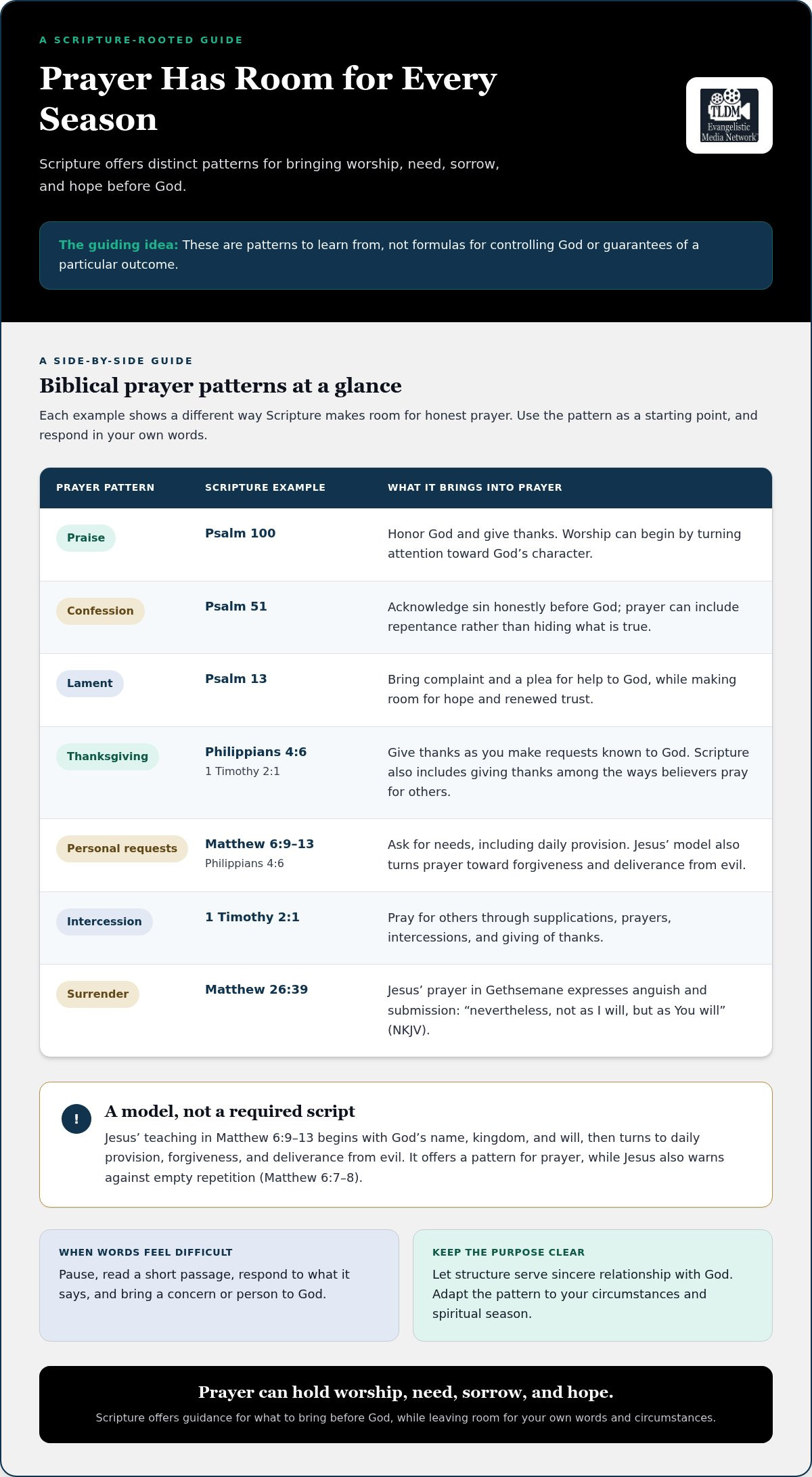
In Matthew 6:9-13, Jesus gives His disciples a model that begins with God’s name, kingdom, and will, then turns to daily provision, forgiveness, and deliverance from evil. Its sequence helps orient prayer toward God before bringing personal needs, but Jesus presents it as a model, not a required script. In the surrounding verses, Matthew 6:7-8, He also warns against empty repetition.
Each movement can inform personal prayer. Honor God’s character, ask for what you need, seek and extend forgiveness, and ask for guidance amid temptation. The model holds dependence and worship together. It doesn’t suggest that the right words compel God to act; it teaches disciples to pray in trust and submission.
What the Psalms and biblical examples add
The Psalms show that prayer can speak from changing circumstances. Psalm 100 calls worshipers to give thanks; Psalm 51 is a prayer of confession; Psalm 13 brings a complaint and a plea for help before turning toward hope. Together, these prayers make room for joy, sorrow, repentance, and renewed trust. They don’t require believers to sound cheerful in every season.
Jesus’ own prayers also reveal honest dependence on the Father. In Gethsemane, facing arrest and crucifixion, He prayed, “nevertheless, not as I will, but as You will” (Matthew 26:39, NKJV). His words express anguish and submission, not detachment from suffering. Paul likewise urges prayer “with thanksgiving” as believers make their requests known to God (Philippians 4:6, NKJV), and calls for “supplications, prayers, intercessions, and giving of thanks” for others (1 Timothy 2:1, NKJV).
These biblical prayer strategies can guide what you bring to God while leaving room for your own words and circumstances. To put this into practice, choose a short passage, read it in context, and consider what it shows about God before responding. For continued Scripture-based study, TLDM Evangelistic Media Network’s Teach Me To Pray: Lessons From Scripture offers focused teaching on prayer.
Do Prayer Strategies Make Prayer Mechanical? Addressing a Common Concern
No. A prayer practice can help you focus, but Scripture doesn’t require one rigid formula. A written list, a passage to reflect on, or a simple order for prayer can offer a starting point when your thoughts feel scattered. The structure serves the conversation; it doesn’t replace sincerity or earn God’s attention.
Structure versus empty repetition
In Matthew 6:7-8, Jesus warns against using “vain repetitions” as though many words could make God hear. The surrounding passage contrasts that practice with trusting the Father, who knows what His children need. Jesus then teaches a model prayer, showing that thoughtful guidance and a set pattern can coexist.
A prompt such as “What am I thankful for?” may help you begin, but you’re free to answer in your own words. If a routine starts to feel like reciting without attention, pause, change the order, or pray from a passage that speaks to what you’re facing. Biblical prayer strategies should support attentive prayer, not become a test you must pass.
When prayer feels difficult or unanswered
Distraction, a missed routine, or a request that remains unresolved can weigh on the heart. None of these, by itself, proves that you lack faith or have failed at prayer. Begin again with honesty. A brief prayer offered sincerely can be more helpful than forcing yourself through a long routine while feeling ashamed.
Jesus’ parable of the persistent widow encourages His disciples to “always pray and not lose heart” (Luke 18:1, NKJV). Its point is to encourage persistence, not to compare God to the unjust judge in the story or promise that every request will be granted on our preferred timetable. Scripture calls believers to bring their needs to God, but it doesn’t give them control over His response.
Paul’s account of asking for his “thorn in the flesh” to depart offers another perspective. In 2 Corinthians 12:8-9, he describes asking the Lord three times and receiving this answer: “My grace is sufficient for you” (NKJV). The passage doesn’t explain every hardship or settle every question about unanswered prayer. It does show Paul continuing in faith while facing a difficulty that remained.
If your prayer rhythm has fallen away, you don’t need to make up for missed days. Return with a simple, truthful prayer, and let the practice fit your present circumstances. Teach Me To Pray: Lessons From Scripture offers continued Scripture-based teaching as you reflect on prayer with patience and hope.
How to Build a Sustainable Biblical Prayer Practice
A steady prayer practice doesn’t need to be lengthy or elaborate. Choose a time and place that fit your life, then use a light framework to help turn your attention to God. The aim isn’t to complete every step perfectly, but to make room for Scripture, an honest response, and care for others.
A simple pattern for daily prayer
Try this adaptable sequence. The steps are a practical tool, not a required biblical formula:
- Pause. Set aside distractions as you’re able, and become attentive to God.
- Read. Choose a short passage. Consider its context and central idea before applying it to your own life.
- Respond. Pray with praise, confession, gratitude, or a personal request, as the passage and your circumstances lead.
- Pray for others. Name people or needs you want to bring before God without assuming a particular outcome.
- Reflect. Notice what you’re carrying into the rest of the day, and consider how the passage may guide your choices.
Example prompt, not a biblical quotation: “What does this passage show me about God, and how can I respond honestly today?” A prompt like this can help you begin without dictating what your prayer must sound like.
Adapting prayer when life changes
Your practice can change with your circumstances. A quiet place may help, but it isn’t the only place to pray. If health, work, caregiving, or other responsibilities disrupt your usual rhythm, shorten the reading or pray one sincere sentence during a pause in the day.
If you miss a day, return without shame. You don’t need to make up for lost time or wait for the ideal moment. These biblical prayer strategies are meant to support a life of trust, not add another burden to carry.
For guided Scripture-based learning, explore Teach Me To Pray: Lessons From Scripture. If you’d like additional reading for continued study, browse Christian books and study resources.
Continue Growing Through Scripture-Based Prayer Teaching
Scripture offers patterns that can give prayer direction, but no pattern is a formula for controlling God or securing a specific result. Praise, confession, gratitude, requests, and prayer for others help believers bring their whole lives before God with humility and trust. The purpose of these biblical prayer strategies is faithful relationship, not flawless performance.
Growth in prayer often comes through returning to Scripture, reflecting on what it says, and practicing prayer in the circumstances of ordinary life. A routine may serve you for a season and then need to change. That doesn’t mean you’ve failed. Your practice can adapt while remaining rooted in the biblical invitation to seek God.
Choose a next step that supports continued reflection
Choose one pattern from Scripture to revisit. You might read a psalm of thanksgiving and name what you’re grateful for, or use a passage about compassion to remember someone who needs prayer. Take time to notice what the text says in context, then respond in your own words. Let the practice guide your attention rather than dictate every sentence.
If you’d like structured guidance for studying prayer in Scripture, explore Teach Me To Pray: Lessons From Scripture. The Sharing The Word Podcast is another way to continue engaging with biblical teaching. These resources can accompany personal reflection as you keep learning at a pace that suits you.
Carry a Scripture-shaped approach into daily life
Prayer can shape how you meet the day: with gratitude for what you’ve received, humility about what you don’t control, and care for the people around you. You might return to a brief prayer at a quiet moment, read a few lines of Scripture, or hold a person’s need in mind as you go about daily responsibilities. These are practical choices, not rules for every believer.
Let your approach grow gradually. Some seasons allow more time for reflection; others call for simpler practices. What matters isn’t keeping an unbroken routine, but returning to God with sincerity and allowing Scripture to guide your words and attention.
Reflect: Which biblical prayer pattern would help you draw near to God today? For deeper guidance, explore Teach Me To Pray: Lessons From Scripture and continue learning how Scripture can shape a prayer life marked by honesty, gratitude, humility, and hope.
Carry Scripture-Shaped Prayer Into Your Daily Life
Biblical prayer strategies offer patterns for approaching God with honesty, reverence, and trust, not formulas for controlling outcomes. Scripture makes room for praise, confession, gratitude, personal requests, and prayer for others. A simple, flexible practice can help you return to prayer without treating missed routines or unanswered requests as proof of failure.
Choose one pattern to reflect on today. Read a passage, consider what it means in context, and respond in your own words. Let your practice adjust as life changes, keeping humility, gratitude, and care for others at its heart.
For continued Scripture-focused guidance, explore Teach Me To Pray: Lessons From Scripture, a prayer teaching series from TLDM Evangelistic Media Network. Explore Teach Me To Pray: Lessons From Scripture and keep growing in a steady, hope-filled life of prayer.
Frequently Asked Questions
What are biblical prayer strategies?
Biblical prayer strategies are Scripture-informed ways to approach God, including praise, confession, thanksgiving, petition, and intercession. These patterns appear in passages such as the Lord’s Prayer (Matthew 6:9-13) and the Psalms, and they help believers bring life honestly before God. Scripture offers guidance, not a formula that guarantees a particular outcome. A personal routine, such as praying at a chosen time or keeping a list, can support prayer but isn’t required for every believer.
How can I pray according to the Bible?
Begin with a passage such as the Lord’s Prayer in Matthew 6:9-13 or a Psalm, and read it in context. Notice what the passage says about God and prayer, then respond honestly. You might praise God, confess something, express gratitude, bring a personal need, or pray for another person. You don’t need to include every element each time. Use the passage to guide your own words rather than treating a sample prayer as Scripture.
Is there a right way to pray according to Scripture?
Scripture offers models and instructions, not one required format for every person. Jesus teaches His disciples to pray in Matthew 6:5-13, emphasizing sincere prayer rather than seeking attention or relying on empty repetition. Luke 18:1 encourages persistence through Jesus’ parable of the persistent widow. These passages support humility, trust, and perseverance, but they don’t promise a particular answer through a particular method. Simple, honest words are welcome; prayer isn’t a performance to perfect.
How do I stay consistent with prayer when I feel distracted?
Start with a modest practice, such as reading a short passage and offering one focused prayer about what stood out. If practical, set aside a quieter moment or move away from a distraction, but don’t treat perfect focus as a requirement. When responsibilities interrupt your routine, return without shame rather than trying to make up for missed time. Patient practice can help you build a rhythm, and honest communication with God matters more than keeping a flawless schedule.
Can I use the Lord’s Prayer as a daily prayer strategy?
Yes. You can pray the Lord’s Prayer directly or use its themes to shape your own words. In Matthew 6:9-13, Jesus’ model turns attention to God’s name and kingdom, then addresses daily provision, forgiveness, and deliverance. Its value lies not only in the words themselves, but also in the priorities they express. You don’t have to treat it as a mechanical checklist. Let its pattern guide your prayer with attention and sincerity.
What should I do when my prayers seem unanswered?
Waiting or disappointment can be painful, and you can bring those feelings honestly to God. Scripture encourages prayer and trust, but it doesn’t give believers control over the timing or specific outcome of every request. Don’t assume that an unanswered prayer proves weak faith or personal failure. Continue reflecting on Scripture and praying as you’re able. For focused biblical teaching about prayer, explore TLDM Evangelistic Media Network’s Teach Me To Pray: Lessons From Scripture series.
How can Scripture help me know what to pray?
Scripture gives language for praise, lament, confession, gratitude, requests for wisdom, and prayer for others. Read a passage in context, notice what it reveals, and respond in your own words rather than forcing a personal meaning onto the text. A Psalm, for example, may give words for sorrow or hope. To put this into practice, choose a passage, reflect on its meaning, and let it shape your prayer.