

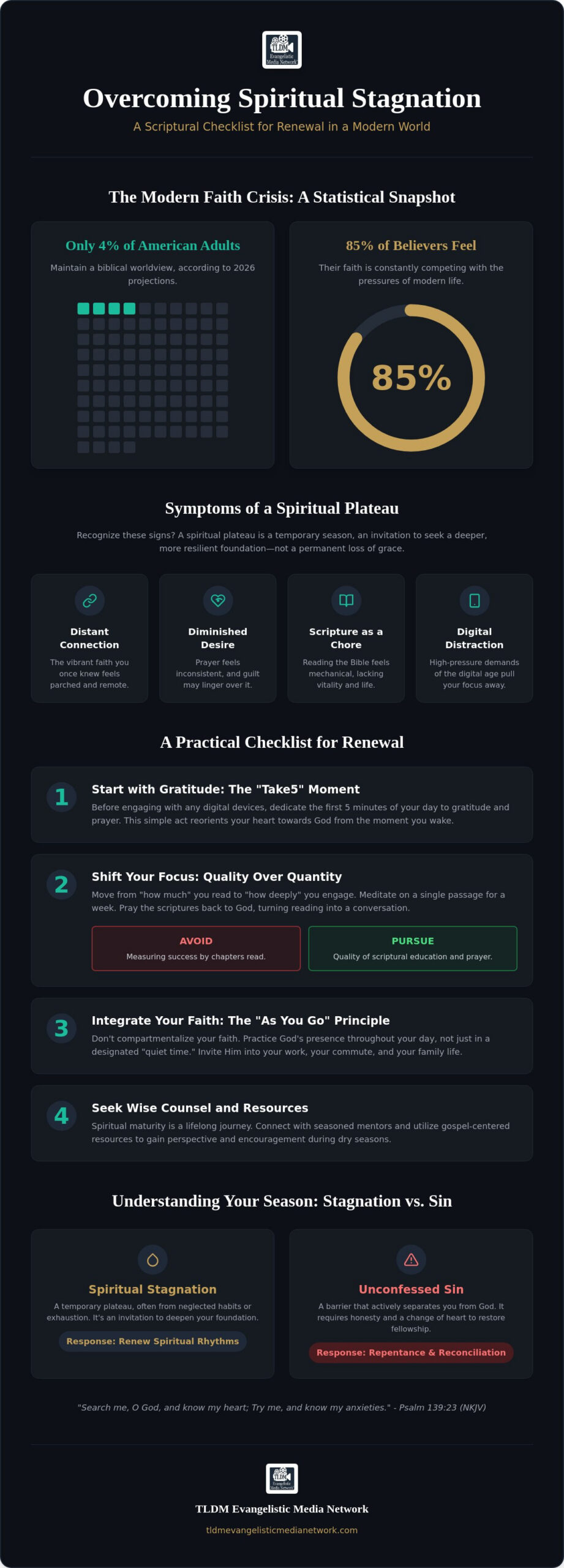
Did you know that in 2026, only 4% of American adults maintain a biblical worldview, while 85% find their faith constantly competing with the pressures of modern world citizenship? This cultural drift often mirrors our internal struggles, where the vibrant faith we once knew feels distant and parched. You might feel a lingering sense of guilt over inconsistent prayer or find that reading the Scripture has become a chore rather than a source of vitality. It’s common to feel distracted by the high-pressure demands of a digital age, yet this dryness doesn’t have to be your permanent state. Finding effective overcoming spiritual stagnation tips shouldn’t feel like adding another burden to an already heavy load.
We understand the deep desire for a more intimate walk with the Lord that fits into your actual life. This guide offers a scriptural checklist for renewal designed to bridge the gap between ancient wisdom and your daily routine. We will explore biblical strategies that invite a renewed sense of God’s presence and provide simple, sustainable habits for growth. Prepare to move from spiritual exhaustion into a season of light and steady purpose. Let’s begin the journey toward a more profound and rhythmic connection with your Creator.
Key Takeaways
- Identify the common symptoms of a spiritual plateau and learn why dryness is often a temporary season rather than a permanent loss of grace.
- Implement practical overcoming spiritual stagnation tips by starting your morning with a “Take5” moment of gratitude before engaging with digital distractions.
- Transform your relationship with Scripture by shifting your focus from the quantity of chapters read to the quality of scriptural education and prayer.
- Master the biblical “as you go” principle to maintain consistent spiritual growth even when navigating a high-pressure, modern schedule.
- Discover how to sustain long-term renewal by viewing spiritual maturity as a lifelong journey supported by the wisdom of seasoned mentors.
Understanding the Nature of Spiritual Stagnation
Spiritual stagnation often feels like an invisible wall that separates you from the joy of your salvation. It’s a state where the vibrant connection you once enjoyed feels replaced by a dull, heavy silence. It is crucial to define this experience correctly. Stagnation is a temporary plateau in your faith journey rather than a permanent loss of grace. Many believers encounter spiritual dryness, which is a recognized phase in the life of even the most devoted saints. This season serves as an invitation to seek a deeper, more resilient foundation for your relationship with God.
Identifying the symptoms is the first step toward recovery. You might notice a persistent lack of desire for prayer or find that your time in the Word feels entirely mechanical. This isn’t necessarily a sign of failure. It is often a signal that your current spiritual rhythms are no longer sufficient for the growth God has planned for you. While some might mistake this for a “dark night of the soul,” which is a profound theological trial of faith, simple complacency is often the culprit. Regardless of the cause, remember that these dry spells often precede a significant breakthrough in spiritual maturity. They’re the quiet moments before the soul expands to hold more of God’s light.
The Biblical Perspective on Dry Seasons
The scriptures are filled with accounts of faithful men and women who navigated times of perceived silence. David frequently cried out in the Psalms, asking why God seemed so far from his groaning. The prophets also experienced the “wilderness,” a symbolic and literal place of testing and isolation. In the biblical narrative, the wilderness is never a place of abandonment. It is a place of preparation. God uses these seasons to refine our dependence on His Word. He strips away our reliance on emotional highs so we can learn to stand on the immutable truth of His promises. These periods are essential for overcoming spiritual stagnation tips that focus on lasting transformation.
Distinguishing Between Sin and Stagnation
It’s important to distinguish between the distance caused by unconfessed sin and the plateau of stagnation. Sin creates a barrier that requires repentance. Stagnation, however, is often the result of neglected spiritual habits or the exhaustion of a high-pressure lifestyle. You can find clarity through gentle self-reflection. Consider the words of Psalm 139:23 from the NKJV: “Search me, O God, and know my heart; Try me, and know my anxieties.” If your conscience is clear, don’t let guilt weigh you down. Shift your focus from your own performance to the unchanging character of God. Seeking guidance from a seasoned spiritual mentor like Dr. Thomas L. Driver can provide the scholarly and pastoral perspective needed to navigate these nuances with confidence.
Rekindling Your Love for the Word
When your faith feels like a parched land, the solution isn’t necessarily to read more chapters, but to read more deeply. Many believers fall into the trap of measuring spiritual success by the number of pages turned. This quantitative approach can lead to a mechanical relationship with God, where the Bible becomes a task to complete rather than a person to encounter. Shifting your focus toward the quality of your scriptural education allows the Word to penetrate the heart. One of the most vital overcoming spiritual stagnation tips is to prioritize depth over distance in your daily study.
Integrating the practice of “Praying the Word” transforms a passive reading session into an active dialogue with the Creator. By speaking the scriptures back to God, you align your heart with His will and internalize the truth of His promises. It is essential to use a reliable translation that maintains the majesty and accuracy of the original texts, such as the New King James Version (NKJV). As you study, remember that the Holy Spirit is the ultimate teacher. He illuminates the ancient text, turning black ink on white paper into a living voice that speaks directly to your stagnant heart. If you are looking for a place to begin this deeper study, you can find helpful guides in our online bookstore.
Moving Beyond Surface-Level Reading
Rather than rushing through an entire book of the Bible, try focusing on a single passage for an entire week. This slow, intentional pace allows you to meditate on specific attributes of God, such as His faithfulness or His sovereignty. You might find it helpful to use guided resources like Teach Me To Pray: Lessons From Scripture to structure your reflections. This method ensures that the truths you encounter move from your head to your heart, providing the spiritual nourishment you need to thrive during dry seasons.
The Power of Audio Scripture and Teaching
Sometimes, the mental fatigue of a high-pressure lifestyle makes physical reading feel like an impossible chore. In these seasons, hearing the Word can bypass the mental blocks created by spiritual dryness. Audio scripture and expository teaching provide a steady stream of truth that requires less initial cognitive effort than deep study. Listening to the Sharing The Word Podcast during your daily commute or while performing household tasks can keep your mind stayed on Christ. Spiritual growth is a cumulative process. Every moment of listening and reflecting adds up, slowly breaking the chains of stagnation and restoring your joy in the Lord.
A Daily Checklist for Overcoming Spiritual Dryness
Recovery from a spiritual plateau is rarely the result of a single emotional experience. Instead, it flows from the steady, intentional rhythms of a life stayed on Christ. While feelings of dryness can be overwhelming, establishing a simple structure for your day provides the scaffolding your soul needs to climb toward the light. These overcoming spiritual stagnation tips focus on transforming your routine into a series of meaningful encounters with the Divine. By following a scriptural checklist, you create space for the Holy Spirit to work within the margins of your busy life.
- The Take5 Start: Begin each morning with five minutes of focused gratitude before you reach for a phone or digital device.
- Scriptural Prayer: Dedicate at least five minutes to intentional prayer using the NKJV to guide your words and thoughts.
- The Gospel Commute: Use your travel time to listen to a gospel-centered message or a podcast episode that challenges your intellect and warms your heart.
- Grace Identification: Conclude your day by identifying one specific instance where you witnessed God’s grace at work in your circumstances.
- The Sabbath Hour: Schedule one hour each week for uninterrupted reflection, deep study, and rest from the pressures of modern life.
Consistency in these small habits builds a foundation that can withstand the pressures of a high-pressure lifestyle. You aren’t merely performing tasks. You are cultivating a relationship that requires presence and attention. Over time, these daily actions shift your perspective from your own struggles to the sufficiency of God’s power.
Morning Rhythms for Success
The first five minutes of your day often dictate your spiritual posture for the remaining sixteen hours. If you begin with the noise of the world, your soul will likely feel cluttered and anxious. Using Take5 Messages allows you to ground your thoughts in scriptural truth before the day’s demands take hold. A morning offering is a simple, one-sentence prayer where you consciously surrender the day’s potential anxieties into the hands of the Father. This act of early surrender invites a sense of peace that persists through even the most chaotic schedules.
Mid-Day Resets and Reminders
It’s easy to lose your spiritual focus in the heat of mid-day responsibilities. Use your technology as a tool for growth by setting smartphone reminders to prompt brief moments of silent prayer or reflection. Carrying a small scriptural reference or a book from the TLDM Bookstore provides a physical anchor for your mind when distractions arise. Short audio clips or scriptural meditations can also serve as effective tools to combat stress. These brief resets ensure that your connection to God remains a continuous thread throughout your entire day rather than just a morning or evening event.
Breaking the Chains of a Busy Schedule
One of the most persistent barriers to spiritual growth is the misconception that you must find hours of uninterrupted solitude to connect with God. While dedicated quiet time is a beautiful goal, this standard often feels impossible for the busy professional or the parent navigating a high-pressure schedule. In reality, consistency is far more impactful than intensity when you are searching for overcoming spiritual stagnation tips. A steady, daily drip of scriptural truth sustains the soul more effectively than an occasional, overwhelming flood of study that is impossible to maintain over the long term.
To break the cycle of stagnation, you must identify the “time leaks” in your typical day. These are the small pockets of ten or fifteen minutes often spent scrolling through digital feeds or waiting in transit. Reclaiming these moments for the Lord transforms your day from a frantic series of tasks into a continuous act of worship. This shift in perspective allows you to realize that spiritual discipline is not about adding more to your already full plate. It is about infusing every activity with a conscious awareness of His presence and His Word. Exploring daily walk with god resources can help you identify the right tools to fill those reclaimed moments with intentional, faith-building content.
The ‘As You Go’ Theology
In Deuteronomy 6:7, we are instructed to teach God’s words to our children and talk of them when we sit in our houses, when we walk by the way, when we lie down, and when we rise up. This “as you go” principle teaches us that God is deeply present in the ordinary, mundane moments of life, not just in the sanctuary. You can offer prayers of intercession while driving or meditate on a verse while performing household chores. Filling the background of your day with online sermons or scriptural teaching ensures your mind remains focused on Christ even when your hands are busy with the demands of the world.
Prioritizing What Matters
True renewal requires a disciplined framework for saying “no” to good things to make room for the “best” thing. We often confuse being busy with being spiritually productive, but spiritual vitality is closely linked to physical and mental rest. Even Jesus withdrew to quiet places to pray, demonstrating that creating margin is a necessity for the human soul. If your schedule feels suffocating, start by identifying one non-essential activity you can release to create a space for reflection. To help you integrate these rhythms into your life, consider listening to the Sharing The Word Podcast during your next commute for scriptural education that fits your pace.
Sustaining Growth with Gospel-Centered Resources
True spiritual vitality is rarely a destination we reach and then abandon. It’s a lifelong process of becoming, requiring a steady commitment to scriptural education that transcends a simple quick fix. When you’re seeking overcoming spiritual stagnation tips, it’s vital to remember that your soul needs consistent nourishment just as your body does. Relying on a single sermon or a one-time prayer won’t sustain a heart through the complexities of modern life. Instead, we must look to the wisdom of seasoned spiritual mentors who can provide scholarly and pastoral guidance.
Dr. Thomas L. Driver offers a wealth of insight through his academic and pastoral background, serving as a trusted companion on this long-term journey. You can deepen your understanding by exploring his bio and teachings at Dr. Thomas L. Driver. Alongside mentorship, building a personal library of Christian literature provides a physical reservoir of truth you can return to whenever the path feels dry. These resources act as anchors, keeping your mind stayed on biblical principles when the pressures of the world attempt to pull you away.
Building a Spiritual Toolkit
A well-rounded spiritual toolkit utilizes every available medium to keep the heart engaged. In 2026, we have unprecedented access to truth through podcasts, audiobooks, and digital messages. Incorporating the Sharing The Word Podcast into your weekly routine ensures a consistent flow of expository teaching that challenges the intellect and encourages the spirit. To maintain momentum, schedule a monthly check-in to evaluate your progress against the scriptural checklist discussed earlier. This intentional reflection helps you identify where you’re growing and where you might need to adjust your rhythms to continue overcoming spiritual stagnation tips for the long haul.
The Role of Community and Outreach
Stagnation often sets in when our faith becomes entirely self-focused. When we shift our attention toward the needs of others, we find that the dry well of our own souls begins to overflow. Whether through local service or by appreciating the beauty of God’s creation through organizations like We LOVE Arabian Horses, focusing on something beyond ourselves is a key step in recovery. Sharing the insights you’ve gained from Scripture with a friend or colleague solidifies that truth in your own heart. It’s a spiritual law that as we pour into the lives of others through evangelism and service, we are ourselves replenished. Trust in the promise found in Philippians 1:6 from the NKJV: “being confident of this very thing, that He who has begun a good work in you will complete it until the day of Jesus Christ.” God isn’t finished with you yet. His grace is sufficient to carry you through every season of dryness into a future of vibrant, growing faith.
Stepping Into Your Season of Renewal
The path from spiritual dryness to a vibrant relationship with the Father is paved with intentionality rather than intensity. By recognizing that a plateau is merely a preparation for breakthrough, you can approach your faith with quiet confidence. We’ve explored how shifting toward quality scriptural education and adopting “as you go” prayer rhythms can transform even the busiest schedule. These overcoming spiritual stagnation tips are designed to move you toward a deeper state of reflection and inner strength. Consistency remains your greatest ally in this journey of becoming.
To sustain this momentum, you don’t have to walk alone. Engaging with resources rooted in the New King James Version provides the scholarly accuracy and pastoral warmth needed for modern life. Under the leadership of Dr. Thomas L. Driver, PhD, DMin, our network offers practical applications that bridge the gap between ancient texts and your daily experience. We invite you to subscribe to the Sharing The Word Podcast for daily scriptural encouragement. As you cultivate these simple habits, trust that the light of God’s presence will continue to illuminate your way. Your season of growth is just beginning.
Frequently Asked Questions
What is the primary cause of spiritual stagnation in the modern world?
The primary cause is often the relentless distraction of a high-pressure modern lifestyle. In 2026, research indicates that 85% of Americans are categorized as “World Citizens,” where biblical principles constantly compete with secular behaviors. This digital noise and the constant demand for our attention create a state of spiritual exhaustion. Stagnation occurs when our internal rhythms are overtaken by the external pace of society, leaving little room for the quiet voice of the Spirit.
Can I overcome spiritual dryness without spending hours in prayer?
You can absolutely experience renewal without dedicating hours to solitary prayer. Consistency is far more impactful than intensity when you are applying overcoming spiritual stagnation tips. By utilizing the “as you go” principle, you integrate faith into your daily commute and household tasks. Five minutes of intentional, scriptural prayer is often more sustainable and transformative for a busy professional than a rare hour of distracted silence.
Is it a sin to feel distant from God or uninspired by Scripture?
Feeling distant from God or uninspired by Scripture is not inherently a sin. It is often a natural plateau or a “dry season” intended for your spiritual refinement. While unconfessed sin can cause distance, stagnation frequently results from neglected habits or physical exhaustion. Focus on God’s unchanging character rather than your fluctuating emotions. This season is an invitation to seek a deeper foundation for your relationship with the Creator.
How do I know if my spiritual stagnation is actually a ‘dark night of the soul’?
A “dark night of the soul” is a profound theological trial where God feels absent to facilitate deeper spiritual purgation. In contrast, spiritual stagnation is typically a result of complacency or a busy schedule. If you find that your habits have simply slipped, it is likely stagnation. However, if you are diligently seeking God but feel a deep, painful emptiness, you may be in a season of divine refinement that requires seasoned pastoral guidance or the specialized individual psychotherapy provided by Dialogs with Life, Inc., which focuses on spiritual and depth psychology.
What are the best NKJV verses to read when I feel spiritually stuck?
The Psalms offer some of the most resonant verses for those feeling stuck. Consider Psalm 42:1 from the NKJV: “As the deer pants for the water brooks, so pants my soul for You, O God.” Another vital promise is Philippians 1:6, which reassures us that He who began a good work in us will complete it. These verses remind us that our desire for God is a sign of life, even in the desert.
How can listening to a Christian podcast help me grow spiritually?
Listening to a Christian podcast provides a steady stream of truth that bypasses the mental fatigue of a long day. It allows for scriptural education during your commute or while performing mundane tasks. This cumulative process of hearing and reflecting helps break the cycle of stagnation by keeping your mind stayed on Christ. Podcasts like Sharing The Word offer expository teaching that grounds your thoughts in biblical reality without requiring extra hours of study.
What should I do if the checklist does not seem to work immediately?
If the checklist doesn’t yield immediate feelings of joy, you must trust the spiritual process. Growth is often a quiet, cumulative journey rather than a sudden emotional event. Consistency in your daily “Take5” moments and scriptural prayer builds a foundation that will eventually bear fruit. Remember that God is working in your heart even when you cannot see the results. Patience is a key component of long-term spiritual maturity and overcoming spiritual stagnation tips.
How does Dr. Thomas L. Driver’s teaching help with spiritual maturity?
Dr. Thomas L. Driver provides a sophisticated balance of academic authority and pastoral warmth to help you navigate your faith. His background in scriptural education ensures that the teaching is both scholarly and practical for modern Christian living. By bridging the gap between ancient texts and contemporary challenges, his work offers a reliable roadmap for those seeking to move from stagnation into a vibrant, growing relationship with God. If you are just beginning this journey, exploring a scriptural guide on how to know Jesus can provide the foundational understanding needed to build a lasting and personal relationship with Christ.