

What if the Bible’s many books tell one connected story rather than a collection of separate messages? If you’ve found it difficult to summarize Scripture or see how its themes fit together, you’re not alone. Asking “what is the bible message” is different from asking about The Message, a Bible translation. Here, the question is about the central Christian message woven through the Bible.
Christians commonly understand that message as the story of God’s relationship with humanity, brought into focus through Jesus Christ. That summary offers a helpful starting point, but it should not flatten the Bible’s variety of books, voices, and themes.
This overview follows the connections among creation, human brokenness, God’s covenant promises, Jesus’ life and work, and the hope of restoration. It also offers a practical way to read and reflect on a passage. You do not need to master the whole Bible at once. Begin by reading carefully, one passage at a time.
Key Takeaways
- To understand what is the bible message, consider how Christians read Scripture as a whole while recognizing that traditions may interpret passages differently.
- Creation, human brokenness, covenant, Jesus, and hope connect within the Bible’s larger story.
- Read beyond rules and moral advice by considering each passage’s literary form, setting, and purpose.
- Build understanding one passage at a time: read it fully, identify its context and main point, then reflect on its meaning.
- Continue learning through steady reading and reflection, with the Sharing The Word Podcast as an optional source of Christian teaching.
What Is the Bible’s Message? Start With the Big Picture
For Christians, the Bible is Scripture that reveals God and points to redemption through Jesus Christ. In plain terms, its central message is that God created humanity for relationship with him, sin damaged that relationship, and God offers hope and restoration through Jesus. This is a broad Christian summary, not a claim that every Christian tradition interprets every passage in exactly the same way.
The Bible is a collection of books written in different forms, including history, poetry, prophecy, wisdom, letters, and Gospel accounts. Each passage has its own setting and purpose, even as Christians read the whole collection as a story of God’s work with humanity. For background on the Bible’s contents and place in Judaism and Christianity, see The Bible.
So, what is the bible message in a sentence a new reader can understand? Christians understand it as the story of God seeking to restore people to himself, with Jesus at the heart of that hope. Use this summary as a starting point, then read passages in their literary and historical contexts.
What do Christians mean by the Bible’s central message?
In this Christian overview, God is the creator, human beings are made for relationship with him, and sin describes disobedience and brokenness that separate people from God and one another. The New Testament presents Jesus as central to redemption: Romans 3:23 describes humanity’s sin, while Romans 5:8 speaks of God’s love shown through Christ. First Corinthians 15:3-4 summarizes the Christian proclamation of Jesus’ death and resurrection.
Is the Bible’s message the same as The Message translation?
No. “The Bible’s message” usually means the themes readers understand Scripture to communicate. The Message, by contrast, is the title of an English Bible translation. The similar wording can cause confusion, but the distinction is simple: one phrase refers to an idea about the Bible’s meaning, while the other names a particular translation.
The Bible’s laws and moral teachings matter, but Christians do not generally treat a list of rules as the whole message. The biblical story also includes creation, human failure, promises and covenants, the life and teachings of Jesus, and the hope of new life. These themes connect, yet individual books contribute different perspectives and should be read on their own terms.
To begin, read a complete passage and ask what it says about God, people, and their relationship. Then consider how it fits within its book and the wider Christian story. This helps explain why Christians place Jesus at the center without assuming that every verse says the same thing or serves the same purpose.
How the Bible’s Story Connects From Creation to New Life
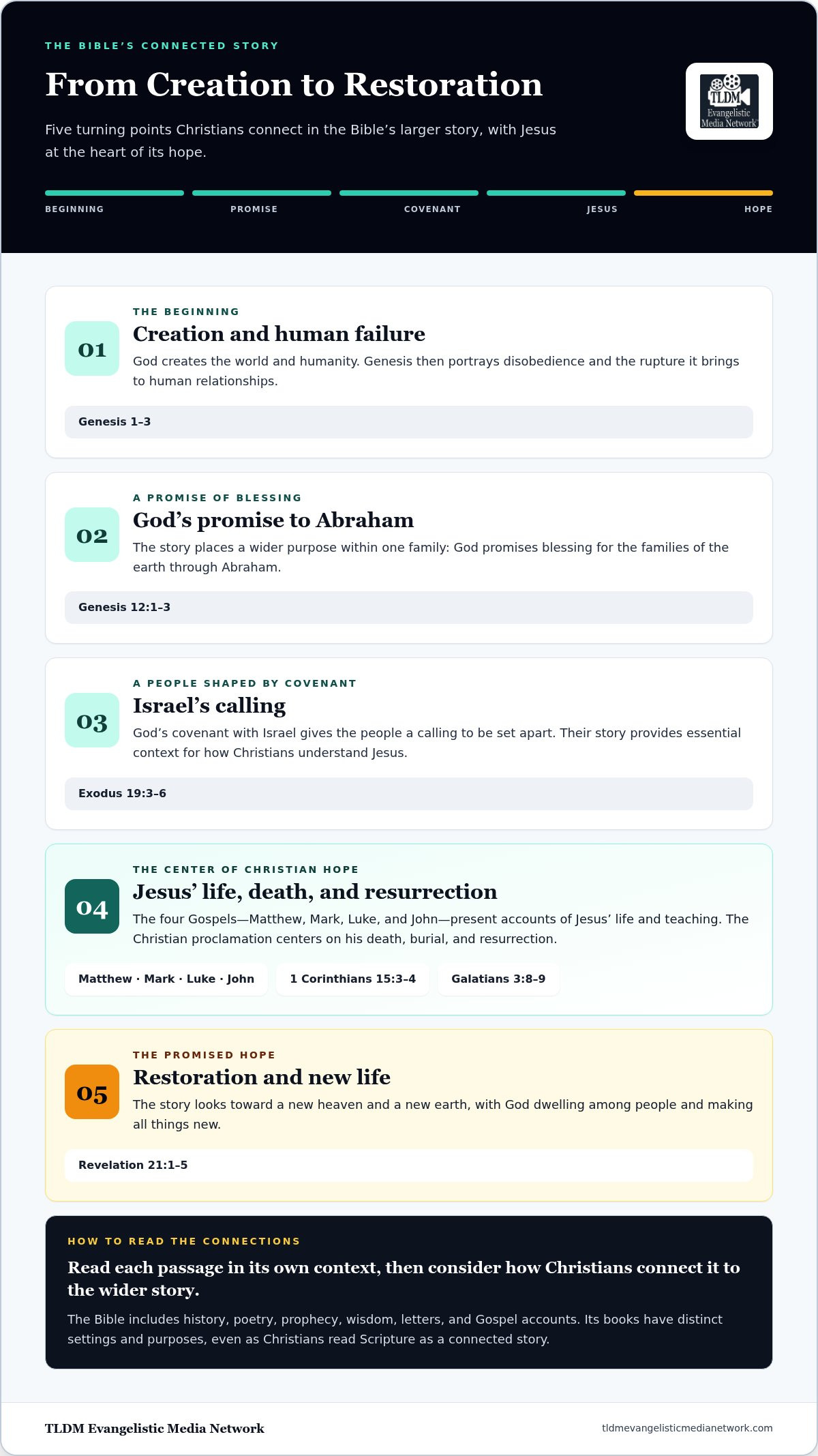
The Bible’s larger story unfolds through turning points, not just a sequence of events. In Genesis, God creates the world and humanity, and the text describes people turning away from God and the resulting rupture in human relationships (Genesis 1:26-28; 3:1-24). In a Christian reading, the rest of Scripture explores the consequences of that brokenness and God’s work to bring blessing and restoration.
In this Christian overview, the Old Testament establishes promises and hopes that the New Testament presents as coming into focus in Jesus. This is a theological summary of how Christians connect the texts, not a claim that every biblical book uses the same language or serves the same purpose.
From creation and covenant to the life of Jesus
Genesis introduces humanity’s place in creation and describes God’s promise to bless the families of the earth through Abraham (Genesis 12:1-3). Later passages describe God’s covenant with Israel, including a calling to be a people set apart (Exodus 19:3-6). Christians interpret these promises and Israel’s story as essential context for Jesus, rather than as a simple prediction repeated identically in every passage.
These connections become clearer when you first identify what each passage says, then consider how it relates to the wider story:
- Creation and human failure: Genesis 1-3 presents the world as created by God, then portrays disobedience and its consequences.
- A promise of blessing: Genesis 12:1-3 records God’s promise to Abraham, placing a wider purpose within the story of one family.
- A people shaped by covenant: Exodus 19:3-6 describes Israel’s calling in the context of God’s covenant with them.
- A Christian connection to Jesus: Galatians 3:8-9 connects the promise to Abraham with blessing for the nations through faith. This is the New Testament’s interpretation of that promise.
The Gospel accounts and the hope of new life
The four Gospels, Matthew, Mark, Luke, and John, present accounts of Jesus’ life and teaching. Christians read them as central witnesses to who he is and what he did. The New Testament also states the heart of the Christian proclamation: Jesus died, was buried, and was raised (1 Corinthians 15:3-4). Those verses summarize the message Paul says he received and passed on.
The Christian story does not end with the resurrection. Revelation 21:1-5 offers a vision of a new heaven and a new earth, with God dwelling among people and making all things new. Christians understand this vision as the promised hope of restoration. Together, these passages help answer “what is the bible message?” while leaving room to read each book carefully and hear its particular voice.
As you explore these connections, first note what a passage says directly, then consider how Christians relate it to the wider story. For continued reflection through Christian teaching, listen to the Sharing The Word Podcast.
Is the Bible’s Message Just Rules, Stories, or Moral Advice?
Biblical laws and moral teaching matter, but they do not tell the whole story. Scripture also reveals people’s struggles, records songs and prayers, offers wisdom, and presents the life and teaching of Jesus. In a Christian reading, these different forms contribute to a larger account of God’s relationship with humanity. They are not simply separate lessons or instructions detached from that story.
The form of a passage affects how you understand it. A Gospel account tells about Jesus’ life and ministry, while a psalm may express prayer through poetry. A letter addresses concerns in a particular community. Readers asking what is the bible message can learn from all these passages, but should first consider what kind of writing they are reading and what it says in context.
Why the Bible is more than a rulebook
The New Testament connects Christian living with God’s grace. Ephesians 2:8-10 presents salvation as a gift received through faith, then describes good works as part of the life believers are called to live. In this passage, responsible action matters, but it follows God’s grace rather than serving as a way to earn it. Christian teaching therefore includes grace, faith, transformation, and conduct shaped by faith.
Rules still have a place. Biblical instruction can guide choices and relationships, while stories, prayers, and teachings help readers consider why faithfulness matters and what it looks like in different circumstances. Avoid making one passage carry the weight of the entire Bible.
How context helps readers understand difficult passages
Start with three questions: What form of writing is this? What is happening in the surrounding verses? What role does the passage play in its book? These questions can clarify meaning without pretending every difficult passage has an easy answer.
- Notice the form. Poetry often uses imagery, while a letter may give direct instruction to its first readers.
- Read around the verse. Philippians 4:13, for example, belongs to a passage in which Paul discusses learning contentment in changing circumstances (Philippians 4:10-13). Its context helps readers avoid treating it as a promise of success in any chosen task.
- Separate observation from interpretation. First identify what the passage says. Then explain how you understand its meaning and what evidence in the passage or book supports that conclusion.
Christians sometimes reach different conclusions about a passage. A thoughtful reading can acknowledge those differences while weighing interpretations against the wording, context, and purpose of the text. Humility does not require treating every interpretation as equally well supported.
The Bible’s message is the larger teaching of Scripture read in context, not a meaning assigned to an isolated verse apart from its passage and book. This distinction helps readers take individual words seriously while considering how they function within the whole.
How to Read the Bible’s Message With Understanding
Reading Scripture can lead to meaningful reflection when you give yourself time to respond, not just gather information. A simple journal practice can help you notice what stays with you and turn a reading session into a thoughtful next step.
A simple passage-reading approach for beginners
After reading, write down one detail that caught your attention, one question you want to explore, and one response you might carry into daily life. Your response could be a prayer, an act of patience, or a choice to seek further understanding. Keep it modest and specific. A passage may offer wisdom for reflection without directly addressing every situation you face.
- Notice: What word, image, or idea stayed with you?
- Wonder: What would you like to understand more fully?
- Respond: What thoughtful step, if any, does this reading invite?
Questions that support careful reflection
Reflection does not need to produce an immediate answer. Ask what the passage encourages you to remember, what feeling it brings to the surface, or what hope it gives you to consider. If you are unsure how to respond, leave the question open and return to it later.
You may also find it helpful to discuss your reflections with a trusted Christian teacher or use a study resource to explore a topic further. When studying a difficult passage, note the question, read the surrounding section, and compare how the same theme appears elsewhere in the book.
The question “what is the bible message?” can stay with you as you read and reflect over time. There is no need to force a personal lesson from every passage. Let thoughtful study shape your understanding gradually, with room for questions, prayer, and continued learning.
For continued listening and reflection, explore Christian teaching through the Sharing The Word Podcast. Take what you hear at your own pace and keep engaging with Scripture thoughtfully.
Continue Exploring the Bible’s Message Through Scripture-Based Teaching
Understanding Scripture is a continuing journey. A passage may become clearer as you return to it, notice its place in the book, and learn how other parts of the Bible speak to related themes. You do not need to understand everything at once. Read steadily, reflect honestly, and make room to keep learning.
Make continued learning part of a thoughtful faith journey
Whether you are new to the Bible or have read it for years, a simple rhythm can help you stay attentive. Choose a passage, read it in context, and record a question or insight to revisit. Over time, compare your observations with the wider biblical story, distinguishing what the text states from how you interpret it.
You might keep a short reflection note after reading. Include the passage, its main idea in your own words, and one question it raises. When you return to the note later, notice which details stand out and what you want to read further. This is not a test or a formula for a particular spiritual result. It is a patient way to engage with Scripture.
Explore scripture-based audio teaching
Listening to Christian teaching can offer another way to consider biblical themes alongside personal reading. The Sharing The Word Podcast provides Christian teaching for continued reflection. Let it complement your own reading, and return to passages that prompt further thought.
As you listen or read, you may find it helpful to ask:
- What does this passage say in its own words?
- How does its setting shape what I understand?
- What question or insight would I like to carry into further reading?
These questions keep attention on Scripture rather than a quick answer. They can also help you approach “what is the bible message?” with care, connecting the broad Christian overview to particular passages without expecting every text to serve the same purpose.
Keep moving at a thoughtful pace. Read, listen, pause, and reflect as it suits you. The Sharing The Word Podcast offers another way to engage with Christian teaching and consider its themes alongside the passages you are reading.
Keep Growing Through Scripture and Reflection
Understanding what is the bible message can begin a deeper, ongoing engagement with Scripture. Give yourself room to return to passages, ask new questions, and learn at a steady pace. You do not need to have every answer before taking the next step.
TLDM Evangelistic Media Network offers the Sharing The Word Podcast, along with online sermons and scriptural education. These resources provide additional ways to listen, learn, and reflect as you continue reading the Bible.
Continue your exploration with the Sharing The Word Podcast. Explore TLDM Evangelistic Media Network, then take time to consider the biblical themes that speak to you. May your continued reading bring fresh understanding, thoughtful questions, and encouragement for the journey ahead.
Frequently Asked Questions
Why are there four Gospels in the Bible?
The New Testament includes Matthew, Mark, Luke, and John, four accounts of Jesus’ life and teaching. Each Gospel has its own arrangement, emphasis, and details, so reading them side by side can reveal different aspects of how the writers present Jesus. For example, note what each account highlights in a shared event before comparing them. Differences alone do not establish a contradiction; consider each passage’s context and purpose.
Is the Bible intended to be read in chronological order?
No single reading sequence is required to understand the Christian message. The Bible’s books are arranged by category and tradition, not as one continuous timeline, and some books revisit events from different perspectives. You can begin with a Gospel, read a particular book from start to finish, or use a reading plan. Whatever order you choose, keep track of the book’s setting and avoid assuming that neighboring books always describe the next event in time.
Can someone understand the Bible without a church background?
Yes. You can begin exploring Scripture without prior church experience or specialized knowledge. If you encounter an unfamiliar word, person, or custom, write it down and look for an explanation that distinguishes background information from interpretation. The question of what is the bible message can be explored one passage at a time. Curiosity, patience, and careful attention to the text offer a sound beginning.
What does the Bible say about suffering?
The Bible addresses suffering through lament, narrative, wisdom, and teachings about hope, but it does not give one explanation for every person’s pain. The book of Job, for example, challenges simple assumptions about why hardship happens. Psalms of lament give language for grief and honest prayer. Read these passages without using them to dismiss someone’s experience or claim to know why a particular loss or illness occurred.
How should readers approach a Bible passage they find difficult?
Read the whole section, note its literary form, and identify who is speaking and to whom. Then check whether a difficult word or idea appears elsewhere in the same book. A study resource can help explain possible meanings, but compare its claims with the passage itself. If careful readers disagree, describe the different interpretations fairly and acknowledge what remains uncertain rather than presenting one view as universally accepted.
Does the Bible promise that faith will prevent hardship?
No. The Bible speaks of hope and faithfulness, but it should not be treated as a guarantee that believers will avoid illness, loss, or other hardship. Be cautious of interpretations that blame people for suffering or promise a specific earthly outcome. Read the passage behind such claims, and notice whether it states a promise directly or whether someone is drawing a broader conclusion. Christian hope can coexist with grief and unanswered questions.