

What if faithful social media use begins not with deleting every app or crafting the perfect post, but with examining the heart behind each scroll? A Christian perspective on social media can recognize both its risks and its potential to connect, encourage, and share truth. If you’ve felt distracted by comparison, uneasy about online conflict, or unsure how Scripture applies to digital spaces, those questions deserve thoughtful attention, not fear or easy answers.
The Bible doesn’t name today’s platforms, but its wisdom speaks to the habits they invite: how we use our words, direct our attention, treat others, and bear witness to our faith. This guide offers practical ways to reflect on your online habits, respond with grace, and make room for relationships and spiritual priorities beyond the feed.
We’ll consider how Scripture can shape what you say, what you consume, and how you engage with people who see the world differently. The goal isn’t to label social media a threat or a solution. It’s to use discernment and neighbor-love as you decide what belongs in your digital life.
Key Takeaways
- Apply biblical principles to online life without assuming Scripture names modern platforms or gives a blanket command about them.
- Use passages about speech, attention, truth, humility, and care for others to reflect on how you post and scroll.
- Consider both the opportunities for connection and encouragement and the risks of distraction or harmful speech.
- A Christian perspective on social media can help you examine your motives, tone, habits, and effect on your neighbors.
- Choose one online habit to reflect on through Scripture and prayer, then make a thoughtful adjustment.
What Does a Christian Perspective on Social Media Begin With?
For Christians, online life can bring welcome connection and real spiritual tension. A message can encourage a friend, help family stay close, or introduce someone to thoughtful teaching. The same feed can invite quick reactions, comparison, or hours of distracted scrolling. These different experiences call for discernment rather than a rushed judgment about every platform or person who uses one.
A Christian perspective on social media means applying biblical principles to online choices while recognizing the difference between Scripture’s teaching and our present-day application of it. The Bible guides believers toward wise, truthful, loving conduct. Christians must consider how that guidance applies to platforms Scripture’s authors did not know.
Technology isn’t morally neutral in every practical sense: people make choices with it, and a platform’s design and routines can encourage certain habits. A notification may prompt a quick check; a comment thread may tempt someone to answer before listening. Those prompts don’t determine a person’s response, but they make it worth asking how a tool is shaping attention and conduct. The study of digital religion considers how online environments and technologies shape religious beliefs and practices. For Christians, this context makes careful reflection especially useful.
Does the Bible directly address social media?
No. Biblical texts predate social platforms, so they don’t give platform-specific commands. But Scripture remains relevant. James 1:19 instructs, “let every man be swift to hear, slow to speak, slow to wrath” (NKJV). In context, James calls believers to receive God’s word with humility and warns that human anger does not produce God’s righteousness (James 1:19-20). Applying that wisdom to a post or comment is an interpretation, not a direct biblical rule about an app.
Why Christian discernment is more useful than a simple verdict
The same medium can serve different purposes. Someone might use a group chat to check on a grieving friend, while another person uses a public thread to shame or provoke. Those actions aren’t equivalent just because they happen through the same tool. Discernment helps Christians consider both what a platform makes possible and what repeated use may encourage.
A good intention alone doesn’t settle whether a habit is wise. A person may open an app to encourage someone, then get drawn into an argument or keep scrolling past the time they meant to leave. Another may use social media briefly to maintain a meaningful connection. Rather than assume one experience fits everyone, pay attention to what a tool is doing in your own life.
Start by asking:
- What am I hoping to do here?
- Does this interaction help me treat another person with care?
- What habits does this use seem to strengthen over time?
These questions won’t produce a universal verdict. They can help you make a thoughtful choice, grounded in Scripture and responsive to the people affected by it.
How Scripture Shapes a Christian’s Online Speech and Attention
Biblical wisdom can guide the small choices that shape online life: what you say, what you believe, what receives your attention, and how you treat people. These passages address faithful living, not social platforms directly. Applying them online calls for careful attention to their meaning and to the circumstances in which you communicate.
Christian online conduct applies biblical wisdom to modern communication, shaping our words and attention around truth, humility, and love for our neighbor.
What does “quick to hear, slow to speak” mean online?
In James 1:19-20, the instruction to listen before speaking sits alongside a warning about anger: “the wrath of man does not produce the righteousness of God” (NKJV). James teaches believers a posture of humble listening and restraint. Disagreement itself isn’t sin, but anger can lead us to respond without understanding or to use words that harm rather than serve.
Before replying to a heated post, pause long enough to understand what the person actually said. Check whether the claim is accurate and whether your tone matches your purpose. A brief delay can help you choose a measured answer, ask a sincere question, or decide that a public reply won’t help.
How should truth, humility, and care guide a post?
Scripture’s teaching about speech reaches beyond avoiding insults. Ephesians 4:25 calls believers to put away falsehood and speak truth with one another, within a passage about living as members of one body. In practice, that principle calls for care before sharing a claim: consider its source, avoid repeating uncertain information as fact, and correct mistakes honestly if you discover them.
Humility matters, too. Philippians 2:3-4 urges believers to reject selfish ambition and consider the interests of others. Applied to online conversation, this can mean not treating every disagreement as an invitation to win and remembering that a real person may read your words. Ask whether your post clarifies, encourages, or serves, rather than simply drawing attention to yourself.
How can Christians examine attention and comparison?
Attention is part of faithful living. Philippians 4:8 directs believers to dwell on what is true, noble, just, pure, lovely, and praiseworthy. This isn’t a command to avoid every difficult subject. It offers a way to consider what repeatedly occupies the mind and whether it helps orient life toward what is good.
Notice what happens to your ordinary commitments when you use social media. Does checking a feed interrupt prayer, delay responsibilities, or pull attention away from someone nearby? Do other people’s carefully selected updates leave you grateful or dissatisfied with your own life? These observations aren’t a diagnosis; they’re prompts for honest reflection.
Try one practical adjustment: silence a notification during prayer, set the phone aside during a meal, or pause accounts that regularly stir envy. Continued reflection on Scripture can help you consider how faith informs daily choices. For biblical listening beyond a social feed, the Sharing The Word Podcast offers another way to engage with Christian teaching.
Is Social Media Inherently Wrong for Christians?
No blanket biblical command declares modern social media inherently wrong. Scripture predates these platforms, so Christians must use biblical principles to assess particular actions and habits rather than claim the Bible directly approves or forbids an app. A Christian perspective on social media weighs what a person does with a tool and how repeated use shapes attention, speech, and relationships.
A biblical principle gives enduring guidance; a Christian’s considered application asks how that guidance should shape a specific use of a platform. This distinction leaves room for honest discernment. Social media can help someone stay connected with family, share a thoughtful word of encouragement, or find teaching. It can also become a setting for careless speech, comparison, or neglected responsibilities. A possible benefit doesn’t make every pattern wise, just as a real risk doesn’t make every use harmful.
When can online engagement serve a constructive purpose?
Digital communication can help people maintain relationships across distance. A brief message to a friend who is ill, a prayerful note to someone facing a hard week, or a considered response in a group conversation may express care. The value lies not in posting for its own sake, but in whether the interaction serves truth, kindness, and the person receiving it.
Online sermons and Christian teaching can also give people material to listen to and reflect on. For example, online sermons and teaching can support learning when a listener engages thoughtfully with Scripture. Digital access can complement a person’s faith life, but it isn’t a guaranteed path to spiritual growth or a replacement for embodied relationships and Christian community.
When might a habit call for boundaries or change?
Pay attention to patterns, not just intentions. If checking a feed repeatedly interrupts responsibilities, fuels reactive replies, or leaves you preoccupied with comparing your life to others, the habit may deserve a closer look. These signs don’t prove that every platform interaction is harmful. They invite a practical question: is this use helping me act faithfully, or making it harder?
Boundaries are a form of stewardship, not a universal formula. One person might turn off notifications during family time; another might avoid comment threads before bed or step away from a conversation that has become hostile. Try an adjustment, then notice whether it helps you give attention to the people and commitments that matter.
If online experiences cause ongoing distress, don’t assume you must handle it alone. Consider talking with someone you trust, such as a mature Christian, pastor, or qualified professional. Seeking support is a thoughtful response, not a failure of faith. Discernment can lead to continued use, changed habits, or a break from a particular platform, depending on what best supports faithful living in your circumstances.
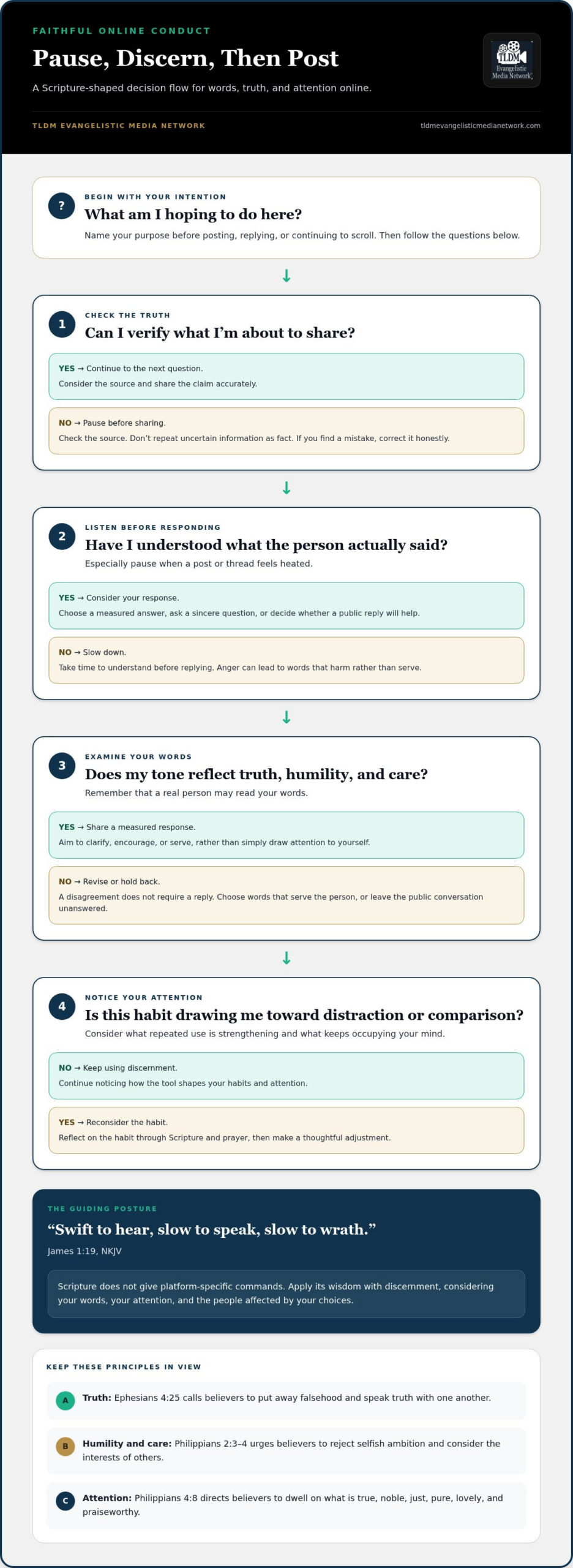
A Thoughtful Christian Approach to Social Media
A faithful online habit doesn’t require perfect judgment every time you open an app. It calls for regular, honest review. A Christian perspective on social media isn’t about removing every difficulty, but about letting biblical wisdom guide what you share, how you engage, and where you give attention.
A five-question review before posting or sharing
Before you publish a post, forward a claim, or enter a debate, pause to consider its purpose and likely effect. This short review can help put a Christian perspective on social media into practice:
- Is it truthful? Check the claim and its context before passing it along. If you can’t tell whether it’s accurate, wait rather than present uncertainty as fact.
- Is it necessary? Ask whether this needs to be said publicly, or whether a private, direct message would better serve the person involved.
- Is the tone gracious? Consider how your words may sound to someone who doesn’t know your intent. Firm disagreement can still show respect.
- Does it serve someone, or mainly seek approval? Wanting encouragement isn’t wrong, but notice whether attention and praise have become the main reason for posting.
- Who may be affected? Think about your audience and the people named or implied. A post can reach beyond the group you first had in mind.
If anger is shaping your response, don’t post yet. For example, after reading a comment that seems unfair, draft a reply, step away, and return to it when you can assess its accuracy and tone. You may still choose to respond, but a pause gives you more room to consider whether your words can clarify the issue or help the conversation move forward.
The same care applies when using digital tools to share faith. Consider whether a message communicates clearly, respects its audience, and invites genuine reflection rather than pressure. Listening to the Sharing The Word Podcast can make room for biblical reflection beyond the rapid pace of a social feed.
How can Christians set boundaries without withdrawing from everyone?
Boundaries can protect attention while leaving room for meaningful connection. Choose intentional times to check platforms, and protect commitments that deserve your presence, such as prayer, work, rest, or time with family. If you use social media to keep in touch with a particular person or community, preserve that connection while changing a less helpful habit.
Review the results without expecting instant perfection. Are you more present in conversations? Is it easier to focus on responsibilities? Do you feel freer to respond thoughtfully? Those observations can help you decide whether to continue the boundary, adjust it, reduce your use, or participate in a different way. Christians may reach different decisions, and a wise practice for one person isn’t automatically a command for everyone.
Let Biblical Reflection Guide Your Next Online Choice
A faithful approach to social media grows from the heart outward. As Scripture shapes what you value, it can guide where you place your attention, how you speak, and how you treat people online. The goal isn’t to prove that every choice is perfect. It’s to bring ordinary digital habits into thoughtful conversation with biblical wisdom, then respond with care for your neighbor.
Prayer can make that reflection more than a quick self-check. Ask God for wisdom, read a relevant passage in context, and consider how its teaching speaks to the choice before you. The Bible doesn’t prescribe one digital routine for every Christian. It offers lasting principles to help each person discern how to act faithfully in their circumstances.
Turn reflection into one manageable next step
Choose one behavior to continue, change, or approach more intentionally. Keep the step small enough to practice, then observe its effect on your attention and relationships. You might ask:
- What online habit is serving a good purpose in my life?
- What practice would I like to change, and what biblical principle can guide that change?
- How does this choice affect the people I communicate with and the people around me?
For example, you might keep sharing thoughtful encouragement but take more time to review a post before publishing it. Or you may decide to check a platform at a more intentional time so it doesn’t interrupt an important conversation. After trying the change, notice what follows. Are you more present with others? Does the new practice help you communicate with greater patience? If it doesn’t fit, adjust it. A considered choice can be revisited as you learn.
That willingness to reflect matters more than pursuing digital perfection. One Christian may find that regular participation helps maintain meaningful connections; another may need a break or firmer limits. Let Scripture, prayer, and an honest look at the effects guide your decision, rather than pressure to copy someone else’s routine.
Continue learning through Scripture-centered media
Podcasts and sermons can provide helpful material for continued learning, but they are supplementary resources, not replacements for Scripture or Christian community. Listen with discernment: compare what you hear with the biblical text, take time to reflect, and consider how the teaching applies to daily life. Audio teaching can also offer a quieter alternative to a fast-moving feed.
For continued reflection on biblical teaching, explore the Sharing The Word Podcast. Use it as one resource among others as you keep learning and discerning how faith can shape your online choices.
Carry Biblical Wisdom Into Your Next Online Moment
Your next online choice doesn’t have to be dramatic to matter. A patient reply, a thoughtful pause, or attention given to someone beside you can reflect the values you’re seeking to live by. Let a Christian perspective on social media take shape through steady practice. Ask how faith can guide not only what you post, but the person you’re becoming through everyday communication.
Choose one small step for today. You might read a passage before responding to a difficult post, or set aside a quiet moment to reflect before opening a feed. Keep learning with Scripture as your guide, and allow room for growth without expecting yourself to get every choice right at once.
Continue your Scripture-centered reflection with the Sharing The Word Podcast. Let biblical wisdom shape your words and attention, and carry care for others into your online life.
Frequently Asked Questions
Does the Bible say Christians should use social media?
No. The Bible neither instructs Christians to join social media nor names today’s platforms. A Christian perspective on social media applies biblical principles to choices Scripture’s authors could not have addressed directly. A believer might use a platform to stay connected with a distant relative, while another may decide not to use one. The question is how a particular choice fits with faithful living and care for others.
Is social media a sin for Christians?
Using social media isn’t automatically sinful. Specific actions on it can still conflict with Christian teaching, such as spreading a claim you know is false, humiliating someone, or sharing another person’s private story without permission. Consider the conduct, not just the app: what happened, whom it affected, and whether you need to correct or repair anything. This approach makes room for accountability without treating every user alike.
How can Christians use social media to share their faith?
Share faith with clarity and respect. You might explain how a Bible passage has encouraged you, post a thoughtful question about a sermon, or offer to continue a spiritual conversation privately if someone responds with interest. Avoid treating people as an audience to win. Listen to their questions, represent Christian beliefs honestly, and respect their choice not to engage. A sincere, considerate exchange can communicate more than a string of slogans.
Can social media help Christians grow spiritually?
It can support learning, but it doesn’t produce spiritual growth by itself. After encountering a verse or teaching online, read the passage in your Bible and consider its context rather than relying only on a short caption. You might also write down a question to discuss with a trusted Christian. These steps can help you use online material thoughtfully while keeping Scripture and relationships central to your learning.
What does the Bible say about arguing online?
The Bible calls believers to speak with restraint and wisdom. James 1:19-20 encourages careful listening and warns against anger, while Proverbs 15:1 commends a gentle answer. These passages don’t require silence in every disagreement. Before replying, identify the actual point at issue and consider whether a public exchange can clarify it. If the thread becomes personal or hostile, stepping away may be wiser than trading accusations.
How can Christians set healthy social-media boundaries?
Choose a boundary that addresses a real pressure point in your routine. For example, keep your phone outside the bedroom, turn off nonessential notifications during work, or check social platforms after prayer rather than during it. A Christian perspective on social media leaves room for different boundaries, so try an adjustment and notice its effect on rest, focus, and relationships. Change the approach if it isn’t helping you live with greater care and attention.