
The most helpful Bible teaching book may not be the most detailed one. With so many Bible teaching books covering similar themes, it can be hard to tell which resource will deepen your understanding of Scripture rather than simply offer another person’s reflections.
That uncertainty is understandable. A topical book, a book-by-book guide, and a devotional can all support spiritual growth, but they serve different purposes. The right choice depends on what you want to learn and how you want to engage with the biblical text.
This guide will help you compare resources by topic, teaching approach, and spiritual purpose. You’ll learn how teaching books differ from devotionals and study guides, what to look for to keep Scripture at the center, and how to choose a manageable next step. Whether you want to explore a biblical book, study a particular theme, or grow in prayer, a thoughtful choice can make your learning clearer and more sustainable.
Key Takeaways
- Match a resource to your goal, whether you want to understand a Bible book, explore a theme, or apply Scripture to daily life.
- Learn how teaching books differ from devotionals, Bible translations, and guided study workbooks.
- Assess Bible teaching books by how clearly they use Scripture, explain context, and distinguish the biblical text from interpretation.
- Compare a resource’s scope, reading level, format, and practical application before choosing your next study.
- Explore Christian books and Scripture-centered media from TLDM, including a focused resource for studying prayer.
What Are Bible Teaching Books, and What Can They Help You Learn?
Bible teaching books are resources that explain Scripture, its message, or its application to Christian belief and life. They may focus on a particular biblical book, a recurring theme such as prayer, a doctrine, or a practice such as forgiveness. Their purpose is to help readers understand the biblical text more deeply, not to take its place.
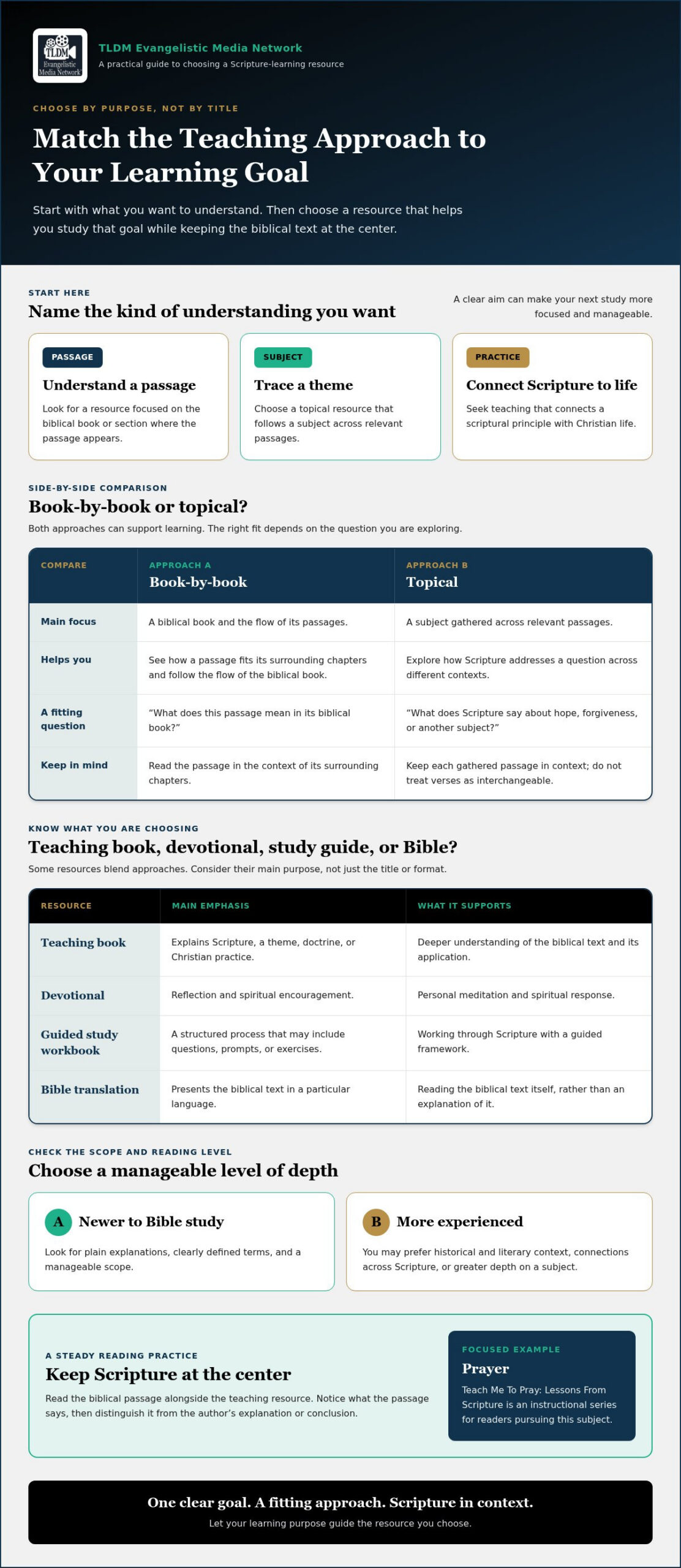
It helps to distinguish these resources from related forms of reading. A Bible translation presents the biblical text in a particular language; a teaching book explains or explores that text. A devotional usually centers on reflection and spiritual encouragement, while a guided study workbook leads readers through a structured process that may include questions, prompts, or exercises. Some resources combine these approaches, so consider their main purpose rather than relying on the title or format alone.
Serious study can involve different methods and fields, including theology, history, and literary analysis. The broad academic field of Biblical studies offers context for these approaches, though a reader’s resource should make clear how it interprets Scripture and how its explanations relate to the text. Read the biblical passage alongside any teaching book, noting what the passage says and what the author concludes from it.
How are Bible teaching books different from devotionals and study guides?
Teaching books generally explain a passage, theme, doctrine, or aspect of Christian practice. Devotionals place more emphasis on reflection and spiritual response, often offering a brief reading for personal meditation. For a closer look at resources centered on daily reflection, see this guide to Christian devotional books.
Study guides, by contrast, give readers a framework for working through Scripture, often with questions or exercises. A resource may blend teaching and guided study, but knowing its primary emphasis helps you choose what fits your current need.
What kinds of Scripture-learning goals can these books support?
Start with one clear goal. You might want to build biblical literacy by learning how a book fits within Scripture, understand a particular passage in context, or consider how a scriptural principle informs daily choices. A focused aim makes it easier to choose between a book-by-book resource and one organized around a theme or practice.
Before browsing, finish this sentence: “I want to understand…” Then look for a resource that supports that purpose while keeping the biblical text central. A book can guide your learning, but Scripture remains the foundation.
Which Bible Teaching Books Match Your Learning Goal?
Choose a resource for the kind of understanding you want to build, not simply because its topic sounds appealing. A clear goal can guide you toward a focused study, help you avoid taking on too much at once, and make it easier to see whether a book is serving your learning.
If you’re newer to Bible study, look for plain explanations, clearly defined terms, and a manageable scope. Readers with more experience may prefer resources that explore historical and literary context, trace connections across Scripture, or examine a subject in greater depth. The Open Yale Courses Bible course, for example, describes approaches to studying the text in historical and cultural context. You can consider context and careful interpretation while also assessing whether a resource supports your faith commitments.
- To understand a passage: Look for a resource that focuses on a biblical book or section of text.
- To trace a subject: Choose a topical resource that follows a theme across relevant passages.
- To grow in practice: Seek teaching that connects a scriptural principle with Christian life.
Should you choose a book-by-book or topical teaching approach?
A book-by-book approach supports sustained reading and helps you follow the flow of a biblical book, including how a passage fits its surrounding chapters. A topical approach gathers passages related to a subject, helping you explore how Scripture addresses a question across different contexts.
Neither approach is best for every reader. If you’re asking what a particular passage means, start with the book it comes from. If you’re tracing a subject such as hope or forgiveness, a topical resource may be a better fit. Keep each passage in context rather than treating gathered verses as interchangeable.
When is a focused resource on prayer the right next step?
Prayer can be a meaningful focus if you want to study how Scripture speaks about approaching God, seeking guidance, or giving thanks. TLDM’s Teach Me To Pray: Lessons From Scripture is an instructional series for readers pursuing that subject. For a different structure, explore the Christian books in TLDM’s online bookstore as you consider your next area of study.
How Can You Tell Whether Bible Teaching Books Are Scripture-Grounded?
A useful resource does more than include Bible references. It shows how its teaching grows from the biblical text and helps readers distinguish what Scripture says from how an author understands it. A polished design, strong endorsements, or popularity may draw attention, but none of these alone shows whether an interpretation is sound.
Use this brief sequence as you read:
- Check the Scripture use. Does the author refer to relevant passages and represent them accurately, or rely on isolated phrases?
- Read the surrounding context. Look at nearby verses and consider the passage’s purpose within the chapter and biblical book.
- Notice what is interpretation. Does the writer distinguish a direct quotation from an explanation, conclusion, or personal application?
- Assess the clarity and application. Are key ideas explained plainly, and do practical suggestions follow from the passage being discussed?
This process doesn’t require formal theological training. Keep the Bible open as you read, and pause when a claim seems unclear. Comparing the explanation with the passage can help you recognize what the author states directly and what the author infers.
Does the author explain Scripture in its biblical context?
Context helps readers understand how a verse works within a larger passage, rather than treating a sentence as a stand-alone rule. Notice whether the author considers the passage’s purpose and its place in the biblical book. Also check whether quoted words are clearly marked and attributed to a translation, such as the New King James Version (NKJV), while commentary is presented as explanation rather than Scripture.
Context strengthens responsible Bible teaching by showing how a passage’s meaning relates to the words and ideas around it.
Is the teaching clear, balanced, and useful in daily life?
Strong teaching defines theological terms in accessible language and avoids making a simple passage seem more complicated than it is. Its application should connect to the text’s meaning, not use a verse as a launchpad for unrelated advice. Consider whether the author explains the reasoning behind a conclusion and acknowledges where an interpretation is an interpretation.
Finally, ask whether the resource helps you return to Scripture with greater understanding. Bible teaching books should support careful reading, not ask you to accept every claim simply because an author is confident or widely praised.
How Do You Compare Bible Teaching Books Before Choosing One?
Compare resources by purpose before weighing presentation or format. A book that suits someone tracing a theme may not meet the needs of a reader studying one biblical book in depth. Use the criteria below to see which resource fits your current learning goal.
| Criterion | What to consider |
|---|---|
| Learning goal | Do you want to understand a passage, trace a theme, explore a doctrine, or consider Christian practice? |
| Scope | Does the resource cover one passage, a whole biblical book, or a subject across Scripture? |
| Reading level | Are the explanations and terms clear enough for you to follow and reflect on? |
| Format | Would print or audio better fit how you usually read or listen? |
| Application | Does the resource help you connect its teaching to Scripture and everyday life? |
Which comparison criteria matter most for your situation?
Start with topic and scope, then consider how you’ll use the book. Someone new to a subject may value a focused resource with clear explanations and a manageable range; an experienced reader may prioritize depth, context, and connections across Scripture. Reading level describes the clarity and fit of the writing, not a person’s spiritual maturity. If you’re choosing for group discussion or guided reflection, look for a format that supports that purpose. For broader reading ideas, visit the guide to Christian books for spiritual growth.
How can format support consistent Scripture learning?
Print can make it easy to revisit a passage, mark a question, or reflect away from a screen. Audio may fit naturally into a listening routine. Neither format is best for everyone; choose the one you can return to with attention. You can explore TLDM’s Christian book selection if print suits your study habits.
Keep the rhythm sustainable. Read or listen in a way that leaves room to open the Bible itself, and note questions you want to explore further. To browse Christian books for your next step, visit the TLDM online bookstore.
Where Can You Begin Exploring Bible Teaching Books and Scripture Resources?
A steady path of learning begins with one clear focus. Choose a topic you want to understand, a passage you want to read more closely, or a learning goal that matters in your life right now. Then select a resource that supports that focus without pulling your attention away from Scripture itself.
How can you turn a teaching book into a steady study practice?
Read a manageable section of the book alongside the biblical passage it discusses. As you go, record a question, a key idea, and one practical application to consider. Return to the passage when weighing the author’s interpretation, and let careful reflection shape your next step rather than rushing to cover more material.
A simple routine can help you stay engaged: read the passage, consider the explanation, then note what you want to revisit. You don’t need to resolve every question at once. Keep a list of topics for further study, and continue at a pace that leaves room for thoughtful reading.
What can you explore through TLDM’s Christian media and literature?
TLDM offers Christian books and Scripture-centered media as resources for continued learning. Readers exploring Bible teaching books can browse the TLDM online bookstore for Christian literature. For a focused study of prayer, Teach Me To Pray: Lessons From Scripture offers an instructional pathway centered on that subject.
Choose the next resource by returning to your purpose: understand a passage, follow a theme, or grow in a specific area of Christian practice. Let the resource guide your reading, keep Scripture at the center, and take one faithful step at a time.
Explore TLDM’s Scripture-centered resources for continued learning through Christian books and teaching media.
Choose Your Next Step in Scripture
The right Bible teaching books support a clear learning goal, whether you want to understand a passage, follow a theme, or apply a scriptural principle. Compare resources by scope and clarity, and look for teaching that explains Scripture in context while distinguishing the biblical text from interpretation.
Then begin with one manageable section. Read it alongside the related passage, note questions as they arise, and return to Scripture as you reflect. A steady practice can help you grow in understanding without making study feel overwhelming.
TLDM Evangelistic Media Network offers Christian books and digital scriptural education resources, including Teach Me To Pray: Lessons From Scripture, an instructional series focused on prayer. As a not-for-profit 501(c)(3) organization, TLDM provides ministry-based resources for continued learning. Explore TLDM’s Scripture-centered resources and choose a thoughtful next step in your study. Keep learning at a pace that helps you engage Scripture with care and purpose.
Frequently Asked Questions
What is the difference between a Bible teaching book and a Bible study book?
A Bible teaching book mainly explains Scripture, a biblical theme, a doctrine, or its application. A Bible study book often gives readers a structured way to engage with Scripture through questions, prompts, or exercises. The categories can overlap: a study book may include teaching, and a teaching book may offer reflection questions. Check the resource’s main purpose and structure to see whether they fit your learning goal.
How do I choose a Bible teaching book as a new believer?
Choose a resource with a clear focus, accessible explanations, and a manageable scope. You might begin with an introduction to a biblical book or a theme you want to understand, rather than trying to cover several subjects at once. Look for terms the author explains and passages you can read alongside the discussion. Let your questions guide your next choice as your familiarity with Scripture grows.
Are Bible teaching books the same as devotionals?
No. A teaching book usually aims to explain a passage, theme, or Christian belief in more depth. A devotional typically emphasizes reflection, encouragement, and personal response, often through shorter readings. Some resources blend both approaches, so consider whether you want detailed explanation or a brief prompt for reflection. Either can support spiritual growth, but each offers a different way to engage with Scripture.
How can I tell whether a Bible teaching book is biblically sound?
Read the passages an author discusses and notice whether the book considers their context, explains its reasoning, and distinguishes Scripture from interpretation. Check whether practical advice follows from the passage rather than relying on a verse taken out of context. Popularity, endorsements, and attractive design can help you discover a resource, but they don’t establish the quality of its interpretation. Keep your Bible open as you read.
Can Bible teaching books help me understand a specific book of the Bible?
Yes. A book-by-book resource can explain the flow of a biblical book, discuss passages in sequence, and show how individual sections fit the whole. As you compare options, look for a scope that matches your aim, whether you want an introduction or sustained passage-level study. Read each passage directly in the Bible, then use the teaching resource to deepen your understanding of its context and message.
What should I read alongside a Bible teaching book?
Read the relevant passage in a Bible translation you understand, including the surrounding verses and, when helpful, the full chapter. This lets you compare the author’s explanation with the biblical text. Keep a notebook or document for questions, key ideas, and applications to consider. If the resource cites other passages, read those references too, so you can follow how the author builds a point from Scripture.
Are there Bible teaching resources focused on prayer?
Yes. TLDM Evangelistic Media Network offers Teach Me To Pray: Lessons From Scripture, an instructional series focused on studying prayer through Scripture. It can serve as a focused learning pathway if you want to explore prayer as a biblical subject. Read the relevant passages alongside the teaching, note questions as they arise, and reflect on how the lessons inform your own prayer life.