

What if a Bible verse sounds convincing because it has been lifted out of context? When conflicting messages compete for your trust, learning how to discern false teachings can feel urgent. The concern can also stir fear or suspicion toward other believers. It is wise to test what you hear, but do so with care, humility, and the whole counsel of Scripture.
This guide offers a clear, Scripture-centered process for evaluating a teaching without treating every disagreement as a threat. You will learn to examine a message in context, compare it with the gospel, and consider the teacher’s conduct and the teaching’s lasting fruit. Start by writing down the claim you want to evaluate, then return to the biblical text rather than reacting to a phrase in isolation. This approach can help you recognize serious concerns and respond with wisdom, confidence, and grace.
Key Takeaways
- Distinguish serious conflict with Scripture from differences of opinion on secondary matters.
- Learn how to discern false teachings by testing a message against Scripture, the teaching about Christ, the gospel, and observable fruit.
- Evaluate sermons, books, and online messages by tracing their central claims back to passages read in context.
- Respond to concerns carefully: review the evidence, seek clarification when appropriate, and consult mature Christian counsel.
- Strengthen discernment over time through regular Scripture reading, prayer, and thoughtful learning with trusted believers.
Why Christians Need to Discern False Teachings Carefully
Discernment is the careful practice of comparing a teaching with Scripture in context so you can recognize what is faithful, mistaken, or seriously misleading. It is not fault-finding, and it does not mean treating every difference of opinion as false teaching. Christians may interpret a difficult passage differently or express a biblical idea imperfectly. A serious concern arises when a message conflicts with Scripture on a meaningful point, especially when it persistently denies central biblical teaching.
This distinction matters because teaching shapes how people understand who Jesus is, what the gospel promises, and how faith informs daily life. Panic, however, can make it harder to assess a message fairly. Careful discernment protects central convictions while leaving room for honest questions, correction, and growth. For a general introduction to the concept of discernment, the term describes the process of judging or distinguishing. Christian discernment must be guided by Scripture rather than suspicion or personal preference.
What does it mean to discern false teaching?
Start with the message, not assumptions about the speaker. Write down the claim in neutral language, find the passage being discussed, and read the verses around it. Then compare the claim with the rest of Scripture. A mistaken interpretation or unclear phrase calls for examination; by itself, it does not prove that someone rejects biblical truth. Sincerity matters in how we respond, but it cannot make an unsound claim biblically sound.
Why do biblical warnings call for discernment?
Jesus warns about false prophets in Matthew 7:15-20 and teaches, “You will know them by their fruits” (NKJV). His words direct attention to the results of a teacher’s life and message, not to rumor or speculation about hidden motives. In Acts 17:11, the Bereans receive Paul’s message eagerly and examine the Scriptures daily to see whether his claims are true. Their example joins openness with careful testing.
These passages call believers to vigilance, not alarm. If a sermon uses a verse in an unfamiliar way, pause and study before reaching a verdict. Ask what the passage says in context, what conclusion the speaker draws, and whether that conclusion changes a central truth about Christ, salvation, or Christian conduct. A single awkward sentence may need clarification; a persistent denial of biblical teaching deserves a more serious response.
Learning how to discern false teachings is a practice of patience and faithfulness. Examine the teaching honestly, allow room for clarification where appropriate, and keep the biblical text at the center. Discernment should help Christians hold fast to truth with humility, not turn concern into personal attacks or suspicion toward every believer who disagrees.
How to Discern False Teachings Through Four Biblical Tests
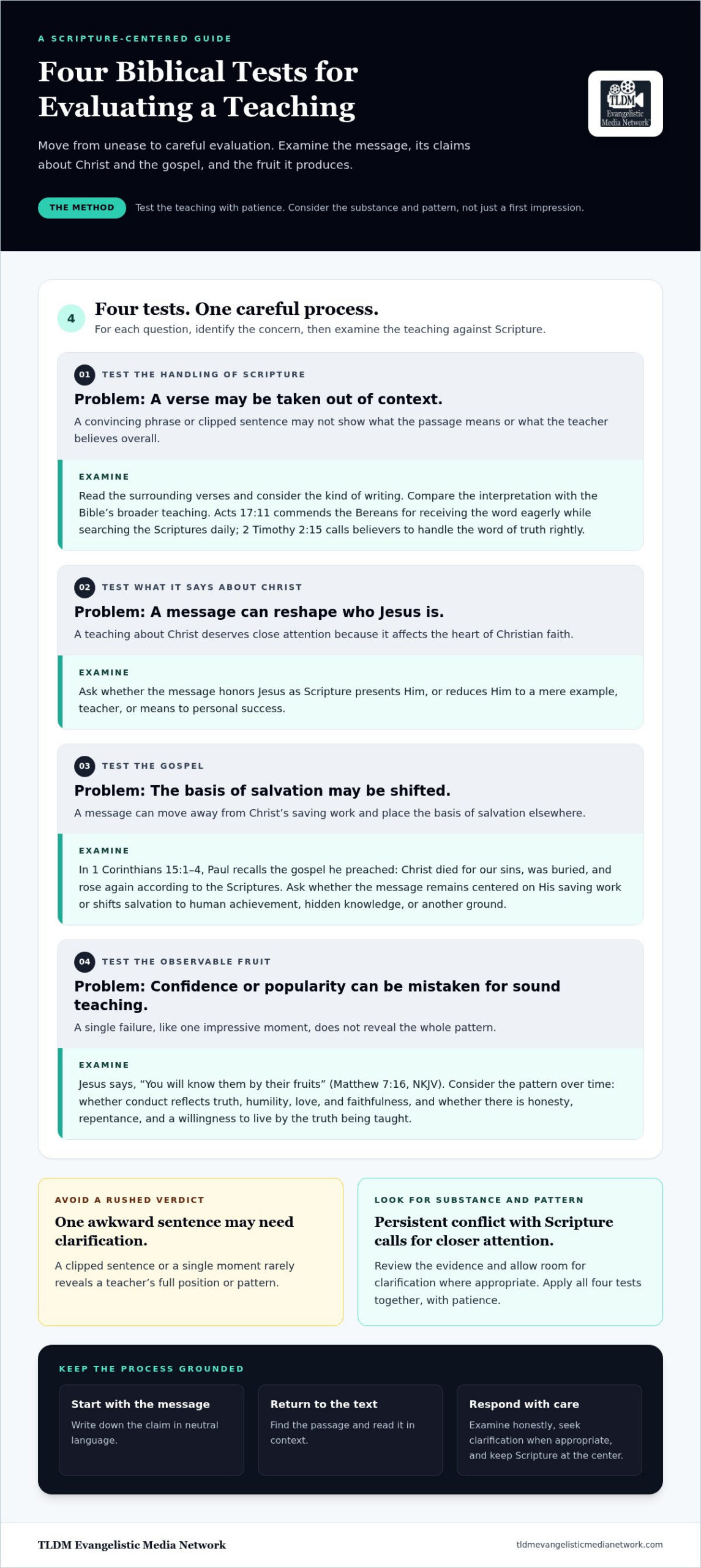
A steady process helps you move from unease to careful evaluation. Test Christian teaching by Scripture, the truth of the gospel, what it says about Christ, and the fruit it produces. Use these tests together. A clipped sentence or a single moment may raise a question, but it rarely reveals a teacher’s full position or pattern.
Use these four questions to examine a message:
- Does it handle Scripture faithfully? Check whether the teacher reads a passage in context, including the surrounding verses and the kind of writing being used. Compare the interpretation with the Bible’s broader teaching. Acts 17:11 commends the Bereans for receiving the word eagerly while searching the Scriptures daily to test what they heard. Second Timothy 2:15 likewise calls believers to handle the word of truth rightly.
- Does it present Christ truthfully? Consider who Jesus is in the teaching. Does the message honor Him as Scripture presents Him, or reduce Him to a mere example, teacher, or means to personal success? A claim about Christ deserves close attention because it affects the heart of Christian faith.
- Does it preserve the biblical gospel? In 1 Corinthians 15:1-4, Paul reminds the church of the gospel he preached: Christ died for our sins, was buried, and rose again according to the Scriptures. Ask whether a message remains centered on Christ’s saving work or shifts the basis of salvation to human achievement, hidden knowledge, or another ground.
- Does the observable fruit fit the teaching? Jesus says, “You will know them by their fruits” (Matthew 7:16, NKJV). Look for a pattern over time, including whether conduct reflects truth, humility, love, and faithfulness. Popularity, confidence, and charisma do not establish sound doctrine. At the same time, one failure does not tell the whole story. Consider whether there is honesty, repentance, and a willingness to live by the truth being taught.
Apply the tests together, with patience
These questions are not a checklist for labeling people after one sermon. They help you identify what needs closer study. For example, a speaker may phrase a point poorly, then clarify it when asked. Another may repeatedly teach a conclusion that conflicts with Scripture even after the passage’s context has been considered. The distinction lies in the substance and pattern of the message, not in a listener’s first impression.
So, how to discern false teachings? Return to the biblical text, examine the claims about Christ and the gospel, and weigh the fruit with care. For another Bible-centered resource to accompany your study, explore the Sharing the Word Podcast.
How to Evaluate a Sermon, Book, or Online Message in Context
A clear process helps you assess a message without reacting to a phrase in isolation. Whether you are listening to a sermon, reading a book, or watching a short online clip, slow down and trace the speaker’s claim back to Scripture. Consider how the whole message presents it, not only the words that first caught your attention.
- Identify the central claim. State the main point in one neutral sentence. Avoid loaded labels at this stage. For example: “The speaker says this passage teaches that believers should respond in a particular way.”
- Locate the cited passages. Find each Bible reference in the text and check whether the speaker quotes it accurately. Note whether the message relies on one phrase or draws on several passages.
- Read the passage in context. Read the surrounding verses. Consider who is speaking, whom they address, and how the passage fits into the larger argument or book.
- Compare the conclusion with the text. Ask whether the speaker’s point follows from the passage or adds an idea the text does not support. Then consider how the interpretation fits with related biblical teaching.
A simple record can make the process easier to repeat. Use a format like this as you review a message:
Claim
Cited passage
Contextual reading
Conclusion
What does the speaker say the passage means?
Which verses support the point?
What do the surrounding verses say?
Does the point follow from the passage?
Check the claim and read the passage in context
Summarizing the claim neutrally helps separate what was actually taught from what you fear it might mean. Then read the full cited passage, not only the sentence displayed on screen or quoted in a post. A conclusion should arise from the passage in context, rather than from a phrase detached from its purpose.
Separate biblical teaching from interpretation and application
Notice whether a teacher distinguishes the words of Scripture from interpretation, practical advice, or personal opinion. A recommendation may be wise without being a direct command from the Bible. On a noncentral question, a careful speaker can also acknowledge that Christians may reach different interpretations while remaining committed to Scripture.
Repeated teaching and the full message offer a fairer basis for evaluation than a clipped sentence or viral excerpt. If a point concerns you, look for its explanation elsewhere in the sermon, book, or series before drawing a conclusion. You can use the same careful approach with the ministry’s online sermons. This process makes how to discern false teachings a patient practice of checking claims, context, and conclusions against the biblical text.
What to Do When a Teaching Seems Misleading
A troubling claim deserves a thoughtful response, not an instant verdict. Before confronting someone or sharing a warning, review what was actually taught, check the relevant passages, and consider whether you have heard the full explanation. A short clip, secondhand account, or confusing phrase may leave out context that changes how the message should be understood.
Respond to concerning teaching with evidence, humility, and proportionate action. Address the claim clearly while avoiding accusations about a person’s character or motives. Scripture calls Christians to speak truthfully and treat one another with care, even when a serious disagreement needs attention.
Raise concerns with clarity and humility
Describe the specific statement and the passage that concerns you. For example, you might say, “I understood you to teach that this verse means ____. I read the surrounding passage differently. Could you help me understand how you reached that conclusion?” This keeps the conversation focused on the teaching and invites clarification without assuming bad intent.
Listen to the response. The speaker may explain an incomplete point, acknowledge an error, or show that you misunderstood the intended meaning. If the explanation continues to conflict with Scripture, name the specific disagreement and explain why the text leads you to a different conclusion. Avoid labels that shut down discussion before the biblical issue has been examined.
Seek wise counsel and choose proportionate boundaries
Some concerns are difficult to assess alone, especially when the teaching affects a church or group of believers. Bring the evidence to mature Christians who know Scripture and can listen fairly. Ask them to help you examine the passage and the response, not simply confirm your first impression. Galatians 6:1 calls for correction in a spirit of gentleness, a fitting posture for difficult conversations.
If a teacher repeatedly contradicts central biblical truth and continues to promote that message after the concern is clearly raised, boundaries may be wise. You might stop sharing the material, avoid relying on it for spiritual guidance, or explain your concern to others who are being influenced by it. Keep your response tied to what can be shown. A serious concern about a teaching does not give you certainty about the teacher’s private motives or standing before God.
This measured approach turns concern into responsible action and keeps the question of how to discern false teachings from becoming a reason for suspicion or personal attack. For continued Bible-centered teaching as you study Scripture, explore the Sharing the Word Podcast.
Build Lasting Discernment Through Scripture and Steady Learning
Discernment grows through steady attention to Scripture, not through a quick search for suspicious phrases. Regular reading helps you become more familiar with the Bible’s message and better able to recognize when a claim needs closer study. This takes time. You do not need to resolve every difficult question at once, and you can keep learning while holding fast to what Scripture makes clear.
Develop a steady practice of biblical learning
Read complete passages and, when possible, work through whole books rather than relying only on isolated verses or summaries. Notice the flow of the text and how its ideas connect. When a question arises, write it down, return to the passage, and compare your first impression with what the text says before settling on a conclusion.
Prayer can help you approach study with patience and a teachable spirit. Trusted Christians can offer perspective, raise helpful questions, and study alongside you, but their advice should never replace Scripture as the standard for evaluating a teaching.
A simple learning rhythm can make this practice manageable:
- Read a passage in context before turning to someone else’s explanation.
- Write down questions and separate what the text says from what you infer.
- Discuss challenging passages with trusted believers who are willing to examine Scripture carefully.
- Revisit your conclusions as you learn more, and be ready to correct an interpretation when the text calls for it.
For optional Bible-centered audio learning, the Sharing the Word Podcast, hosted by Dr. Thomas L. Driver, Ph.D., DMIN, can accompany your study. Treat any podcast, sermon, or book as a resource to evaluate, not as a substitute for reading Scripture yourself.
Keep discernment rooted in humility and hope
Growing in discernment includes being corrected. You may discover that a concern came from a misunderstanding or that an interpretation you once held needs another look. Humility does not require uncertainty about central biblical teaching. It means holding clear convictions faithfully while recognizing that Christians may differ on some interpretations.
Learning how to discern false teachings is not a call to live on guard against every believer. It is a steady practice of returning to Scripture, asking honest questions, praying for wisdom, and learning with others. Keep testing teaching patiently, with confidence in the biblical text and care for the people involved.
If you would like another resource for ongoing study, explore the Sharing the Word Podcast and other Bible-centered media from TLDM Evangelistic Media Network. Let Scripture remain your guide as you listen, reflect, and grow.
Carry Discernment Into Your Next Step
Discernment is not a finish line. It is a faithful way of learning to listen, study, and respond with care as new questions arise. The next time a teaching gives you pause, take time to examine it calmly and let Scripture shape both your convictions and your response.
Learning how to discern false teachings should lead not to fear, but to deeper trust in God’s Word and a readiness to keep growing. Stay open to correction, hold firmly to what Scripture makes clear, and extend patience to others as you seek understanding.
For continued encouragement through Christian media, explore Bible-centered podcasts and media. Listen to the Sharing the Word Podcast as you continue studying Scripture, and let your growing discernment serve both truth and love.
Frequently Asked Questions
What does the Bible say about false teachings?
The Bible warns believers that teaching can lead people away from truth, so Christians should hold to sound teaching and examine what they hear. Jesus warns about false prophets in Matthew 7:15-20, while Paul urges Timothy to guard the truth entrusted to him in 2 Timothy 1:13-14. These warnings call for care, not alarm. They also remind readers that Scripture, rather than a teacher’s reputation, remains the final measure.
Is every disagreement about the Bible false teaching?
No. Christians can disagree about how to interpret a passage or apply a principle without rejecting a central biblical truth. For example, believers may differ on the details of a church practice while affirming the same gospel. Ask whether the disagreement changes a foundational claim about God, Christ, salvation, or Scripture, or concerns a question where faithful Christians allow room for differing views.
Can a sincere Christian teach something that is not biblical?
Yes. A person may sincerely repeat an idea they have misunderstood or learned from someone else. Sincerity can encourage a gracious conversation, but it does not make a claim accurate. For instance, a speaker might present a personal application as though it were a direct biblical command. Clarifying that distinction can correct the teaching without assuming the speaker intended to mislead anyone.
How can I discern false teachings online?
To discern false teachings online, trace the content to its original source before drawing conclusions from a repost or short clip. Check whether the quotation matches the full sermon or article, and note when the material was published so you do not mistake an old statement for a current one. Be cautious about comment threads that assign motives without evidence. Evaluate the teaching itself, not the number of likes or shares.
What should I do if someone I know follows a false teacher?
Keep the relationship open while asking what your friend finds persuasive about the teacher. This can reveal whether they have heard a full message or are relying on a single claim. Share a specific concern calmly and invite them to read the relevant passage with you. Avoid public embarrassment or demands for an immediate decision. If the teaching is shaping a group, seek help from mature Christian leaders who understand the situation.
How can I avoid becoming judgmental while testing teaching?
Remember that you, too, can misunderstand Scripture and need correction. Apply the same standard to teaching you admire and teaching you question, and be willing to revise your view when the biblical evidence points elsewhere. Focus your words on the claim and its support, not on labeling the person. A useful self-check is to ask whether your response seeks clarity and faithfulness or simply a chance to condemn.
Should I trust a sermon just because it quotes the Bible?
No. A sermon can quote a verse accurately yet draw a conclusion the surrounding passage does not support. For example, a speaker may use a promise addressed to a particular audience as if it guaranteed the same outcome to every believer. Check how the verse fits the speaker’s point, and notice whether the sermon distinguishes what Scripture states from the speaker’s explanation or practical advice.