

To learn how to memorize scripture effectively, choose a meaningful passage, read it in context, and practice saying it aloud until you can recall it without looking. Write it down, review it regularly, and connect its message to the way you live.
It’s easy to think Scripture memory is only about getting every word right. But its deeper purpose is to carry God’s Word into everyday moments, where it can shape your thoughts, strengthen your faith, and guide your choices.
This guide will help you choose a passage that speaks to your present season, build a manageable practice, and keep verses fresh through review. You’ll also find simple ways to organize what you’ve learned and make memorization more than a mental exercise. Start with a few lines, give them your attention, and let understanding grow alongside recall.
Key Takeaways
- Choose a passage that speaks to your present needs, and read the surrounding verses to understand its meaning.
- Build a steady practice with spoken recitation, writing, and regular review, then organize verses so you can return to them.
- When repetition feels difficult, adjust your approach and treat forgotten words as a reason to review, not a reason to give up.
- Connect each passage with an attitude or action so Scripture memory can shape how you respond in daily life.
- Explore Scripture-centered teaching through TLDM Evangelistic Media Network’s Sharing The Word Podcast, Take5 Messages, Teach Me To Pray: Lessons From Scripture, and Online Sermons.
Keeping a collection of memorized verses
A useful verse collection has clear references, a simple review method, and passages grouped by purpose. Start with a small set, then add verses as you learn them.
-
Gather Verses by Topic
Choose a topic that matters in your current season, such as prayer, courage, or wisdom. Create a page or note for that theme, and record each verse with its book, chapter, and verse. For example, place Psalm 119:11 under a collection about keeping God’s Word close.
Read the surrounding paragraph before adding a verse. The Navigators recommend reading the paragraphs before and after a selected verse to understand its context. Keep your collection focused on passages that address the same theme, rather than gathering isolated lines without their meaning.
-
Create Verse-Reference Flashcards
Write the verse reference on one side of a card and the verse text on the other. For example, put “Psalm 20:7” on the front and its wording from your chosen Bible translation on the back. Review the reference first, then recite the verse before turning the card over.
Make a separate card for each verse, and group the cards by topic or book. You can also write the first letter of each word as a recall prompt. Check that the wording and reference match your Bible, especially when reviewing similar verses.
-
Use Audio, Music, and Memorization Tools
Record yourself reading a passage, then listen during a familiar daily activity. Repeated listening can reinforce the words, while reading aloud engages both visual and auditory learning. A simple melody may help you recall a verse, but keep the wording and reference accurate.
For apps and tools, use a notes app, voice recorder, or digital flashcards to store verses and track reviews. Choose tools that let you see the reference and full text together. Psalm 119:13 supports declaring God’s words aloud, making spoken review a meaningful part of your practice.
-
Practice Longer Passages One Verse at a Time
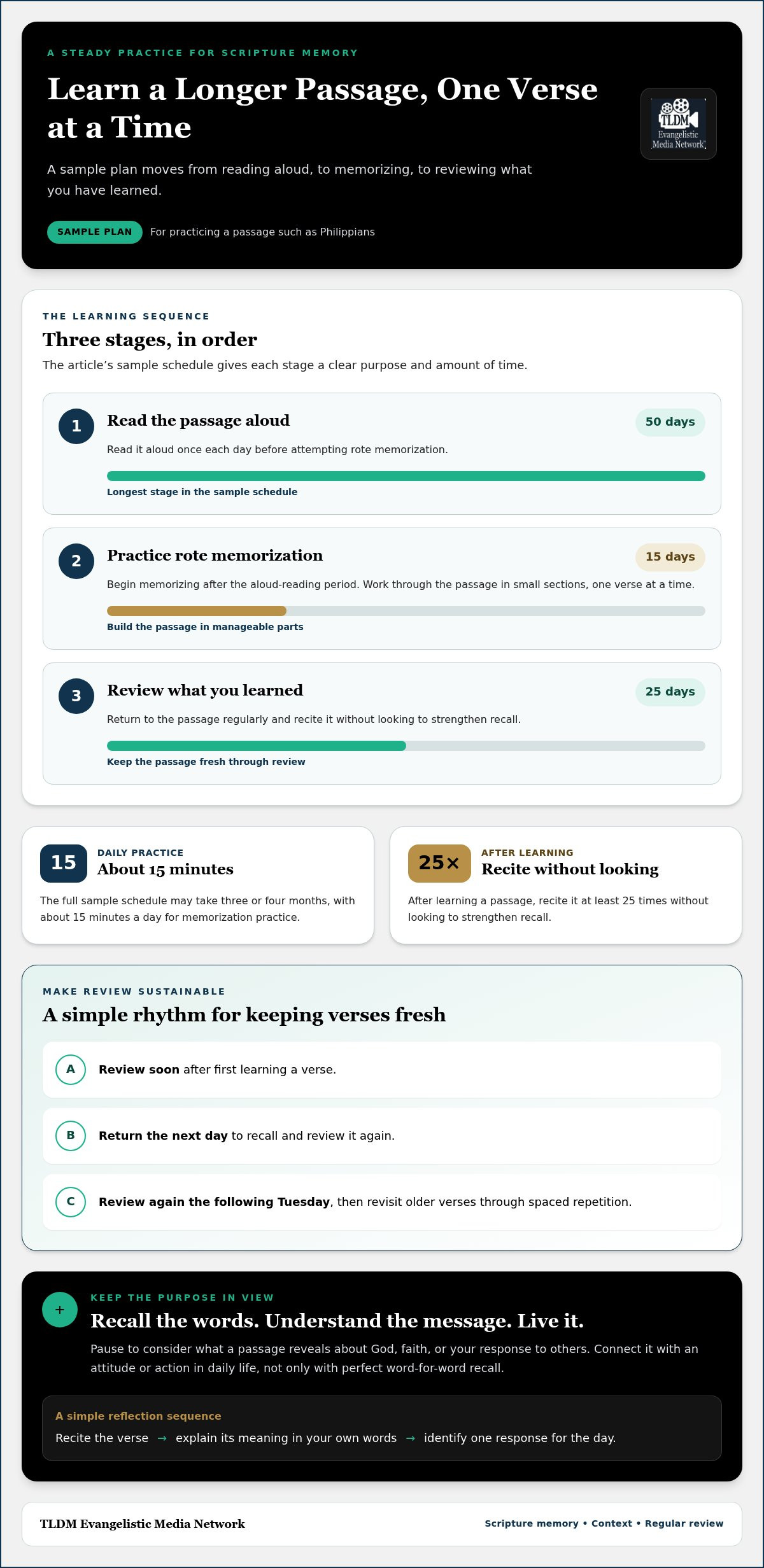
Divide a longer passage into small sections, then learn one verse before adding the next. The Navigators recommend beginning with short verses or short phrases. Read the passage aloud 50 times before attempting rote memorization, and mark your progress so each reading has a purpose.
A sample plan for Philippians uses one aloud reading each day for 50 days, followed by 15 days of rote memorization and 25 days of review. The full schedule may take three or four months, with about 15 minutes a day for memorization practice.
-
Review and Organize What You’ve Learned
Keep a dated list of verses you can recite, verses you are learning, and passages needing review. Read a selected passage aloud once or twice a day, and use a simple tally to track each reading. After learning a passage, recite it at least 25 times without looking to strengthen recall.
Return to older verses through spaced repetition instead of relying on one long review session. Build your collection from a few carefully learned passages, using references, topic labels, and regular spoken practice to find and retain each verse.
Scripture memorization and spiritual formation
Set aside five minutes a day for Scripture memory, then connect the passage with a choice or attitude you want it to shape. Keep the practice small to stay motivated, and return to a verse’s meaning, not just its wording.
-
Reflect Spiritually While Memorizing
Pause after each verse and ask what it reveals about God, faith, or your response to others. The Navigators recommend connecting a verse with an attitude or action, giving each line a practical place in daily life. For example, after learning a verse about patience, consider how it could guide a tense conversation.
Psalm 119:11 connects keeping God’s Word in the heart with resisting sin. Use that verse as an invitation to reflect, not as a formula that removes every struggle. Read the full passage in context, then name one thought or action it calls you to consider. This keeps spiritual reflection grounded in Scripture’s meaning.
Memorization can also bring a passage to mind when a familiar challenge arises. Two young men learned Ephesians 5:1-3 by heart while seeking help with sexual temptation. Their example shows how a specific passage can accompany a real spiritual concern. Let the text direct your reflection, and avoid using a verse apart from its context.
Try this sequence: recite the verse, explain its meaning in your own words, then identify one response for the day. If you’re studying prayer, Teach Me To Pray: Lessons From Scripture offers a Scripture-focused way to deepen your spiritual practice.
-
Build a Daily Memorization Habit
Choose a regular time and attach memorization to an existing routine, such as morning Bible reading. A practice of five or more minutes a day gives you a clear starting point. Another approach is to practice for 5-10 minutes each morning or evening. Select a schedule you can repeat, rather than making each session depend on motivation.
Give each session a clear purpose: recall yesterday’s verse, learn a phrase, or reflect on the passage’s meaning. Review soon after first learning a verse, again the next day, and again the following Tuesday. Spaced review helps keep older passages fresh as you learn new material.
Use a visible record to track your progress. Write the reference and a brief note about its application in a notebook, then mark each review. If you forget a line, return to it without treating the lapse as failure. The goal is faithful practice and deeper understanding, not flawless recall at every sitting.
A morning routine can hold several passages over time. One author described waking to recite Psalm 1, Psalm 23, and Philippians 4:4-9. Start with one passage, and let steady practice make room for further growth. Each time you remember and reflect, Scripture becomes part of how you meet the day.
Challenges of repetition-based memorization
Repetition can strengthen recall, but progress may feel uneven. Psalm 150 has six verses, yet one memorizer reported spending months learning it.
- Adjust the pace when recall slows. At 73, one memorizer reported taking longer to learn passages than before. Treat that change as a cue to adjust your practice, not a reason to abandon it. Work with one verse at a time, and read the surrounding lines so the words remain connected to their meaning.
For a longer passage such as Romans 8:1-11, focus on a single verse before adding the next. If a phrase remains difficult after several minutes, pause and return to it later. A slower pace can give you room to understand the passage rather than repeating words mechanically.
- Use review to guard against forgetting. Without systematic review, much of the 50 verses someone learns in a year may be forgotten five years later. Keep older passages in your practice alongside new material. Recite a learned verse from memory, then check the text and correct any missing or changed words.
Make each review specific. If Psalm 150:1 slips away, review that verse and its place in the psalm instead of restarting every passage you know. A brief record of verses needing attention can help you use your practice minutes wisely.
- Respond calmly when you forget. Forgetting a verse you learned the previous week is a normal part of practice, not proof that you cannot memorize Scripture. Return to the passage, read it aloud, and try recalling it again after a short pause. Don’t judge your progress by one difficult session.
For example, if you remember the opening of Romans 8:1 but lose the next phrase, look at the text and identify exactly where recall breaks down. Practice that portion, then recite the full verse. This targeted correction can be more helpful than repeating the whole passage without noticing the problem.
- Vary repetition when it becomes discouraging. Reading the same words silently can feel monotonous, so change how you engage with the passage. Write a verse from memory, speak it while walking, or use its first letters as prompts. These approaches keep you engaged while preserving the goal of accurate recall.
Choose one method for a difficult verse, then compare your recitation with the Bible text. For Psalm 150, you might write one line, recite it aloud, and then reconnect it with the psalm’s next line. Keep the wording faithful to your chosen translation.
- Measure consistency, not speed. A long passage may take more effort than a short verse, and the six verses of Psalm 150 can still require sustained attention. Track which passages you reviewed and which need another attempt. This record shows where to focus without turning memorization into a contest.
If you miss a day, resume with one familiar verse, then continue your planned review. Returning steadily matters more than trying to make up every missed repetition at once. Let understanding, accurate recall, and patient practice guide your next step.
Choosing personally relevant passages
Start with a present concern, then look for a passage that addresses it in context. A personal connection can give your practice purpose, while careful reading keeps the passage’s meaning clear.
- Name the concern you want Scripture to address. Write a clear phrase, such as “responding with patience” or “seeking wisdom.” If you’re learning how to memorize Scripture effectively, choose a passage that matters in your life, not simply one that seems easy to recall. Let your need guide your reading without making a verse say more than its context supports.
For example, someone feeling anxious about daily needs might study Matthew 6:25-34. Read the surrounding section before deciding whether it fits your purpose.
- Read the passage around each candidate verse. The Navigators recommend reading the paragraphs before and after a selected verse to understand its context. Note who is speaking, what the passage addresses, and how the verse contributes to the larger thought. This helps you avoid choosing a familiar line that sounds relevant but means something different in context.
Record the reference beside your concern, then summarize the passage in your own words. If your summary doesn’t match the surrounding paragraph, keep reading before adding the verse to your memory list.
- Choose a passage that suits your purpose and practice. The Navigators recommend beginning with short verses or phrases. A brief passage can still speak to a deep concern, while a longer selection may offer fuller teaching. Choose a portion you can understand and practice consistently, rather than treating length as a measure of spiritual seriousness.
One approach recommends a passage that takes approximately 15 minutes to read aloud. Use that as a guide when considering a larger section, and ask whether its central message addresses the need you identified.
- Compare possible passages before committing. Read each candidate aloud and note which one most directly addresses your concern. If you’re seeking wisdom, compare passages about wise choices and consider how each fits the question you’re facing. Note whether a selection offers instruction, encouragement, warning, or a combination.
Then write one sentence explaining your choice. That reason gives your practice direction and helps you return to the passage’s purpose when memorization feels difficult.
- Keep the passage connected to its purpose. Add the reference, your reason for choosing it, and a short context note to your collection. For Matthew 6:25-34, the note might identify the concern that led you to study it. This keeps your practice connected to why the passage matters, not only to recalling its wording.
Your needs may change, so revisit your selection when its purpose no longer fits. Read a new passage in context and choose it for a clear reason. Scripture memory becomes more personal when a passage meets a real question and remains faithful to its biblical setting.
Reasons to memorize Scripture
Memorizing Scripture serves more than recall. It keeps biblical teaching close for reflection, prayer, and faithful responses in everyday life.
- Keep Christ’s teaching close in daily choices. In John 15:5, Jesus teaches that abiding in Him is essential for bearing fruit. Remembering this passage can bring His teaching to mind when you’re deciding how to respond, serve, or persevere. The purpose isn’t to treat a memorized line as a shortcut, but to return to Christ’s words and consider what faithful action requires.
After learning a passage, identify a real situation where its message may guide your response. For example, recall John 15:5 before a demanding task, then reflect on dependence on Christ rather than self-reliance.
- Make Scripture available for prayer and reflection. A memorized passage can shape the words and focus of personal prayer. Choose a verse that speaks to what you’re bringing before God, recite it slowly, and reflect on its meaning. This approach lets Scripture inform prayer instead of relying only on spontaneous thoughts.
For instance, use a passage about trust when facing uncertainty. Read it in context before turning its words into a prayer, and distinguish the biblical text from your own reflection. This care preserves the passage’s meaning while helping you respond thoughtfully.
- Prepare to encourage others with care. Proverbs 27:17 uses the image of iron sharpening iron to describe how people can strengthen one another. Remembering Scripture can help you share a relevant passage in conversation, but listen before offering a verse. A person facing grief may need patient attention, not an immediate explanation.
Practice reciting a passage with a friend, then discuss its meaning in context. The Navigators recommend a weekly check-in with a friend or group, describing a Scripture memory check-in as taking ten minutes. A shared routine can encourage accountability without turning recitation into a performance.
- Let repeated engagement deepen understanding. Memorization requires attention to a passage’s words, structure, and message. One author reported learning all five chapters of James through repetition. Working through a whole biblical letter can reveal how its ideas connect, rather than leaving each verse isolated.
Choose a short section, identify its main point, and return to that point during review. If you memorize a paragraph from James, notice how each sentence supports the passage’s argument. This approach makes recall serve understanding.
- Practice faithfulness without measuring spiritual worth by recall. A memorized verse can offer a point of return during the day, but forgetting words doesn’t define your faith. Treat memory practice as one way to attend to Scripture, alongside reading, prayer, and action. The lasting aim is to know and live God’s Word, not collect impressive recitations.
Choose a passage, learn it carefully, and ask what response it invites today. For John 15:5, that reflection might lead you to pray for dependence on Christ before acting. Let the passage guide your attention and choices.
TLDM Evangelistic Media Network: Sharing The Word Podcast
TLDM Evangelistic Media Network offers the Sharing The Word Podcast for continued engagement with Scripture. If you want thoughtful biblical teaching alongside your memorization practice, listening provides another way to reflect on God’s Word and its place in daily life.
Explore the Sharing The Word Podcast, or choose Teach Me To Pray: Lessons From Scripture, Take5 Messages, or Online Sermons for further scriptural learning. These resources can complement personal study as you continue building a practice rooted in Scripture, prayer, and reflection. Visit TLDM Evangelistic Media Network online to explore its Christian media offerings.
Let Scripture Shape What Comes Next
Memorizing a verse is not an endpoint. Let its truth carry into your choices, prayers, and relationships. As you consider how to memorize Scripture effectively, keep your purpose close: not simply to recall words, but to know God’s Word and respond to it with care.
Carry your practice forward with teaching that keeps Scripture at the center. TLDM Evangelistic Media Network’s Sharing The Word Podcast, Take5 Messages, and Teach Me To Pray: Lessons From Scripture can accompany continued reflection and learning. Choose the resource that best fits the way you want to engage with biblical teaching.
If you’d like to explore these resources or learn more, contact TLDM Evangelistic Media Network. Take your next step with patience and an open heart, trusting that faithful attention to Scripture can continue to shape your walk with God.
Frequently Asked Questions
How Do I Practically Do It?
Begin with one short passage and connect recall to a real moment in your day. For example, choose a verse about patience before a difficult conversation. Read it in context, practice until you can say it without looking, then check the wording against your Bible. Later, ask what the verse teaches and how it might shape your response. This connects memory practice with understanding.
Rote Memorization…Again?
Rote memorization means repeating words until you can recall them, but repetition alone isn’t the whole purpose. Use it to learn the text accurately, then consider what the passage means in context. Test your understanding by explaining the verse in your own words after reciting it. If you can repeat a line but can’t describe its meaning, return to the passage and read the surrounding verses.
Why Memorize Scripture?
Memorizing Scripture makes biblical teaching easier to recall during reflection, prayer, and conversation. It can also help you follow an argument across a passage instead of treating each verse as an isolated statement. For example, remembering a section of James may prompt you to revisit how its instructions relate. Treat memorization as a way to attend more closely to Scripture, not as a measure of spiritual worth.
Why Spaced Repetition?
Spaced repetition helps you retrieve Scripture from memory instead of relying on immediate familiarity. During review, cover the final words of a verse and try completing the sentence from the beginning. Then reverse the exercise, using the ending as a prompt. This reveals which parts you can recall independently and which still depend on seeing the full text.
What Are the Most Effective Techniques for Memorizing Scripture?
Combine accurate reading with active recall. Learn the wording from one Bible translation, divide the passage at natural sentence breaks, and practice supplying the next phrase before looking. First-letter prompts can help you move from partial recall to full recitation. Finish by stating the reference and reading the passage in context, so you remember where the words belong, not just how they sound.
How Does Spaced Repetition Help With Scripture Memorization?
This helps you identify which verses are secure and which need more attention. During review, try reciting a passage before opening your notes. If you miss a phrase, check the text, correct it, and revisit that section later. This makes review responsive to what you actually remember, rather than spending equal time on every verse in your collection.
How Often Should You Review a Bible Verse to Remember It Long Term?
Review frequency depends on how readily you can recall a verse without prompting. After reciting it, note whether you remembered the wording, reference, and order of its ideas. Leave more time between reviews for passages that come easily, and return sooner to those that remain difficult. This flexible approach directs your practice to the verses that need the most attention.
What Are the Steps for Memorizing a Scripture Passage?
Choose a passage for a clear purpose, then settle on the Bible translation you’ll use. Read the complete passage in context and divide it into meaningful phrases. Learn each phrase, connect it to the next, and recite the whole selection without looking. Finally, check the wording and reference in your Bible, then reflect on the passage’s central message.