

What if the most important preparation for your wedding happens far from the venue, guest list, and ceremony? Preparing for a Christian marriage means building the understanding and habits that will shape your life together long after the wedding day. Faith and affection are a meaningful beginning, but they don’t automatically resolve differences about money, conflict, family, or spiritual priorities.
If you’re wondering which conversations matter most, you’re not alone. It can be hard to put biblical principles into practice, especially when wedding plans demand so much attention. A thoughtful foundation starts with pursuing God, listening honestly to one another, and learning to practice love and commitment in ordinary moments.
This guide explores Scripture’s vision for marriage and practical conversations about expectations, communication, finances, and family. You’ll also find shared practices for prayer, resolving disagreements, and continuing to grow in faith. The goal isn’t to enter marriage with every answer. It’s to begin with humility, clarity, and covenant-shaped habits you can strengthen together.
Key Takeaways
- Use Genesis 2 and Ephesians 5 to consider marriage through Scripture, distinguishing biblical teaching from practical application.
- Preparing for a christian marriage includes asking direct questions about expectations, conflict, finances, family, and faith.
- Build a flexible rhythm of individual reflection, shared prayer, focused discussion, and follow-up on unresolved questions.
- Choose one next practice to strengthen your relationship and revisit it as you continue learning together.
- Use Scripture-focused teaching as a resource for ongoing growth, while making room for personal discernment.
Preparing for a Christian Marriage Starts Beyond Wedding Planning
Choosing a venue and setting a wedding date can make marriage feel close, but the ceremony is only the beginning of a shared life. Couples may feel joyful and hopeful while also wondering how they’ll handle change, disagreement, and daily responsibilities. Those feelings can coexist. Preparing for a Christian marriage means making room for both celebration and honest reflection.
Christian marriage preparation is the spiritual, relational, and practical work of learning to honor God and care for one another as you enter a lifelong covenant. It goes beyond a wedding checklist. It includes growing in service, communication, forgiveness, and shared decision-making, then continuing to practice those commitments after the celebration ends.
What does preparing for a Christian marriage involve?
Preparation means learning how each of you approaches everyday choices, not trying to become identical. Shared Christian faith gives couples a foundation, but it doesn’t erase differences in personality, family background, or communication style. Christian traditions also express and interpret marriage in varied ways, as this overview of Christian views on marriage describes.
As you talk, distinguish among biblical principles, personal preferences, and cultural expectations. Scripture calls Christians to love and serve. A personal preference might be how you divide household tasks, while a cultural expectation might be a particular wedding custom. Naming these differences helps you decide what reflects your convictions and what you can shape together.
Why should couples prepare before the wedding?
Unspoken expectations can become part of shared routines before either person realizes it. Talking beforehand gives you a chance to explain what you hope for, ask what your partner assumes, and listen without treating every difference as a warning sign. Difficult topics can open a path to understanding. They are not, by themselves, proof that you’re unsuited to marry.
Begin with personal reflection, then bring your thoughts into conversation. Each person can consider:
- Hopes: What do I look forward to in our life together?
- Questions: What feels uncertain or difficult to discuss?
- Needs: Where might I need patience, support, or clearer communication?
- Expectations: What am I assuming about our future that we haven’t talked through?
Take turns answering. Listen to understand before trying to solve a problem or persuade. You don’t need to settle every question in one conversation. Noticing where you agree, differ, or need more time is useful preparation in itself. A wedding marks a beginning, not the completion of relationship growth. Enter marriage ready to keep learning, serving, and making decisions together.
Build Your Marriage Preparation on a Biblical Foundation
Scripture offers more than a list of rules for married couples. It gives a larger vision of faithful love, shared responsibility, and life before God. As you consider what its teachings mean for your relationship, read each passage in context. Distinguish its central principle from a particular couple’s preferences or traditions.
How does the Bible describe marriage and commitment?
In Genesis 2, the creation account describes the first human relationship and the formation of a shared life. God says, “It is not good that man should be alone” (Genesis 2:18, NKJV). Later, Genesis 2:24 describes a man leaving his parents, being joined to his wife, and the two becoming one flesh. Together, these verses present marriage as a profound bond of companionship and unity.
Ephesians 5 should also be read as part of its wider passage. Paul begins by calling believers to mutual submission “in the fear of God” (Ephesians 5:21, NKJV), then describes marriage through the image of Christ’s self-giving love for the church. The passage calls husbands to love sacrificially and speaks of the wife’s response within that relationship. Christians interpret some details differently, so avoid using one verse to settle every question without considering the whole passage and its purpose.
A biblical principle can guide a couple without dictating every household custom. Scripture calls spouses to faithfulness, love, and care. It doesn’t prescribe who prefers cooking, how a couple divides errands, or which family traditions they keep. Discuss those choices with humility, asking how your decisions can reflect service and mutual respect.
Christian marriage is a covenant of mutual faithfulness, lived out through daily choices to love, serve, and honor God together.
What does a shared spiritual life look like?
Spiritual unity grows through practice, not perfection. You might begin by reading a short Scripture passage together, sharing what stands out, and praying in simple words about the day ahead. If one of you feels less comfortable praying aloud, agree on a sincere way to participate, such as taking turns or praying silently together.
These habits can develop gradually. Spiritual maturity is a continuing journey, so approach differences with patience rather than expecting either person to have every answer. For continued learning about Scripture and prayer, explore a Christian teaching podcast, then reflect together on what you hear and how it speaks to your life.
As you keep preparing for a Christian marriage, let Scripture shape both your convictions and your everyday conduct. Return to its teachings with open hearts, and make room for honest conversation as you discern how to live them out together.
Discuss the Hard Questions Before You Marry
Shared faith and deep affection can give a couple a strong starting point, but they don’t make practical questions disappear. Discussing expectations before marriage helps you understand what each person hopes for and how you might handle differences. The aim isn’t to agree on everything at once. It’s to listen honestly and discern how to move forward with care.
Use the prompts below to begin. The Scripture references offer principles for reflection, not a one-line answer to every personal decision.
| Topic | Conversation prompt | Why it matters | Scripture connection |
|---|---|---|---|
| Faith | What spiritual practices do we hope to share, and where do our traditions differ? | Clarifies how faith may shape everyday choices and community life. | Colossians 3:16 on letting the word of Christ dwell richly. |
| Conflict | What helps each of us feel heard during disagreement? How will we return to a difficult topic? | Builds a shared approach to repair rather than avoidance. | James 1:19 calls believers to be “swift to hear, slow to speak, slow to wrath” (NKJV). |
| Finances | What are our habits around spending, debt, saving, giving, and making joint decisions? | Surfaces assumptions about money and stewardship before they shape shared plans. | Luke 14:28 offers a principle of counting the cost before building. |
| Family | How will we stay connected to relatives while making decisions as a couple? | Helps clarify boundaries, traditions, and expectations with extended family. | Genesis 2:24 describes forming a new household bond. |
| Work and home | How might work, household tasks, rest, and caregiving be shared? | Turns broad hopes about fairness into practical expectations. | Philippians 2:4 encourages concern for the interests of others. |
| Children | Do we hope to have children? What questions or uncertainties should we keep discussing? | Reveals hopes without assuming both partners have reached the same conclusion. | Psalm 127:3 describes children as a heritage from the Lord. |
| Intimacy | What questions, boundaries, or past experiences need to be discussed with sensitivity? | Encourages trust, mutual care, and patience around a deeply personal subject. | 1 Corinthians 7:3-5 speaks about mutual responsibility in marriage. |
How can couples talk through disagreement with care?
Choose one topic at a time. Describe a specific concern instead of assigning blame, then give each person room to respond. For example, “I’m unsure how we’ll handle saving” invites a clearer conversation than “You’re bad with money.” Ask what you may have misunderstood before deciding what a difference means.
James 1:19 appears in a passage about receiving God’s word and living faithfully, including restraint in speech and anger. Its call to listen can shape a conversation, but it doesn’t replace one or require silence. Ordinary disagreement is different from a repeated pattern of intimidation, threats, coercion, or fear. Those concerns deserve careful attention and support from a trusted, qualified source.
Preparing for a christian marriage includes making space for honest answers, unanswered questions, and continued discernment. Listen to understand, not simply to prepare your reply.
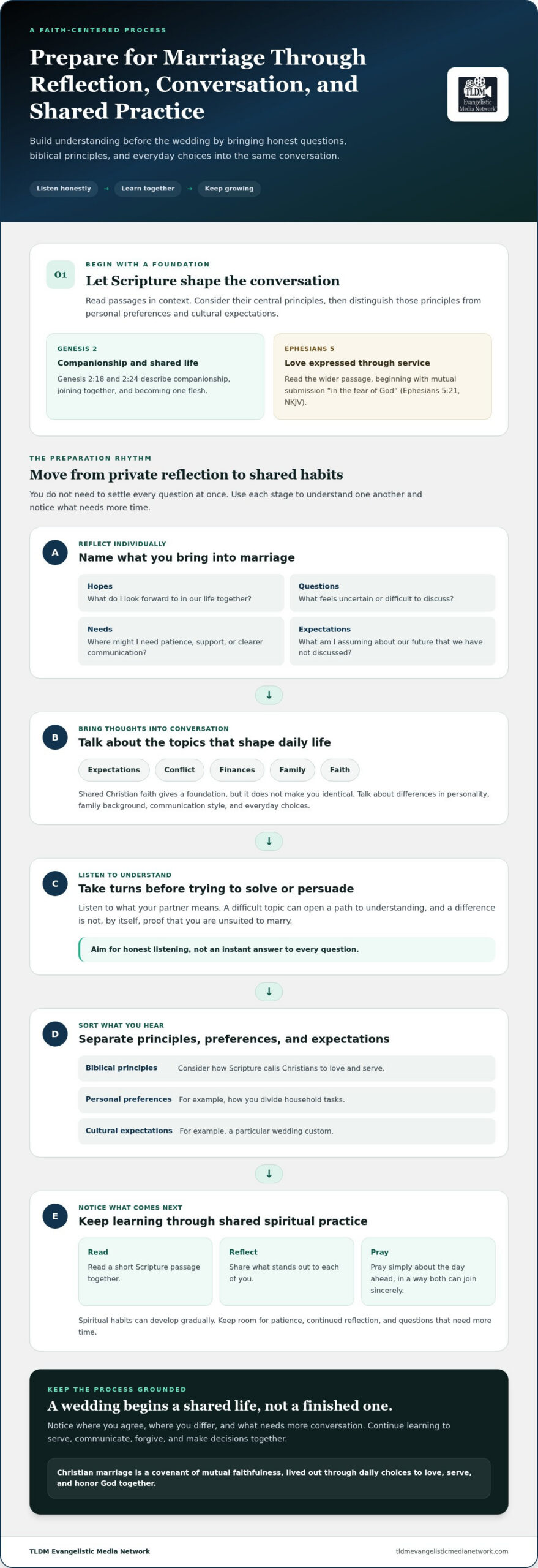
Create Shared Habits for Preparing for a Christian Marriage
Good intentions become more useful when they take shape in everyday practices. Rather than expecting constant agreement or setting an ambitious routine that feels difficult to maintain, choose a few small habits you can return to with honesty and grace. Keep the sequence flexible. The purpose is to grow in faith and understanding, not to complete a perfect checklist.
What practices can couples begin together?
Try this adaptable rhythm. Move through the steps at a pace that fits your lives, and pause when a subject needs more attention.
- Reflect individually. Before you talk, consider what you’re grateful for, what’s weighing on you, and what you hope to bring to the conversation. A few written notes can help you name your thoughts without expecting your partner to guess them.
- Read a short passage. Choose a few verses and take turns sharing what you understand. Ask what the passage reveals about God, what it calls a believer to practice, and how that principle might shape a decision you face. Avoid rushing to make every verse answer a specific relationship question.
- Pray in a sincere way. You might pray aloud together, take turns, or sit quietly and pray privately at the same time. Simple, honest words are enough. Choose a practice that feels sustainable for both of you, rather than measuring spiritual growth by how long you pray.
- Discuss one matter that needs attention. Share a concern, decision, or hope, and give each person room to speak. If you need more time, name what remains unresolved and agree to return to it instead of forcing a quick conclusion.
- Close with gratitude. Each person can name something they appreciate about the other or about the conversation. Gratitude doesn’t dismiss hard questions. It helps keep care and respect present while you work through them.
You can adapt the rhythm to changing schedules. Some couples may prefer a regular check-in; others may find it more natural to pause together when a decision arises. What matters is returning to the practice with attention, not maintaining a flawless routine.
How can couples keep learning after the wedding?
Marriage preparation doesn’t end at the ceremony. As work, family responsibilities, and personal circumstances change, revisit the commitments and habits that help you care for one another. Ask what is working, what feels strained, and what deserves renewed attention. A practice that needs adjustment hasn’t failed; it may simply need to fit a new season of life.
Continue learning through Scripture, reflection, and thoughtful conversation. Christian teaching resources, including the Sharing The Word Podcast, can provide material for continued study. Listen or reflect individually, then discuss what you found meaningful without treating a media resource as a substitute for your own discernment.
Small, repeated habits give couples a steady way to keep growing in faithfulness, understanding, and care as their shared life unfolds. Choose one practice to begin, and let it develop naturally as you learn together.
Continue Your Christian Marriage Preparation with Scripture and Reflection
Preparation isn’t a test you pass by having every future answer. It’s a chance to consider how you’ll keep seeking God, speak honestly, and face uncertainty as a team. A thoughtful review can help you choose a meaningful next step without turning readiness into a score or a promise about how married life will unfold.
How can couples reflect on their readiness without seeking perfection?
Set aside time to answer these questions individually, then share what you’re comfortable discussing. Listen for what needs attention, not for a perfect response.
- How do we each hope our faith will shape our choices and priorities?
- Can we raise concerns honestly and make room for one another’s perspective?
- Are there unresolved questions we need to keep discussing rather than avoid?
- Where are we willing to learn, adapt, and ask for help when we need it?
After talking, choose one next practice that feels useful and sustainable. You might set aside time to discuss an unanswered question, read Scripture together, or revisit an expectation that has changed. Readiness doesn’t mean uncertainty has disappeared. It means you’re willing to approach what comes with honesty, care, and a desire to keep growing.
How can Scripture-based media support continued learning?
Scripture-focused teaching can give couples ideas to reflect on and discuss, while leaving room for careful reading and personal discernment. The Sharing The Word Podcast is a digital Christian teaching resource. Teach Me To Pray: Lessons From Scripture provides scriptural education about prayer, not marriage instruction.
As you listen or study, ask what the material teaches from Scripture, what questions it raises, and how its principles might inform your choices. Then return to the biblical text and consider its context together. A resource can support learning, but it doesn’t make decisions for you or replace thoughtful conversation.
Preparing for a christian marriage is part of a longer life of faith, reflection, and growth. You don’t need to establish every habit today. Choose one small step, practice it with patience, and make space to revisit it as your shared life develops.
Scripture-focused resources for continued learning are available through TLDM Evangelistic Media Network.
Take One Faithful Step Forward Together
You don’t need to have every part of your future settled before you begin building a life together. Choose one practice you can carry forward, then return to it with patience as your circumstances change. Preparing for a christian marriage is part of a continuing journey of faith, shaped by the small choices you make with care and humility.
Let Scripture keep informing your reflections, and give one another room to keep learning. TLDM Evangelistic Media Network offers Take5 Messages and online sermons alongside other Christian media for continued learning.
Explore Christian teaching and media for resources to accompany your ongoing faith journey. May the next step you take together be grounded in hope, understanding, and a shared desire to honor God.
Frequently Asked Questions
How long before the wedding should a couple start preparing?
Begin when you’re seriously considering marriage, not according to a universal number of months. Preparing for a Christian marriage early gives you room to discuss important matters without making every conversation compete with final wedding arrangements. You can revisit those conversations after the wedding as your circumstances shift. Think of preparation as an ongoing practice of attention and learning, not a deadline to meet before the ceremony.
Can a Christian marry someone from a different denomination?
Couples from different Christian denominations should understand each other’s beliefs and practices before deciding how to move forward. Talk about worship, church community, sacraments, and, if relevant, how you hope to raise children. For example, discuss what each tradition teaches about baptism or communion and how those beliefs may shape family life. There isn’t one answer for every couple. Pray, communicate clearly, and consider what each person’s convictions require.
Is premarital counseling required for a Christian marriage?
Premarital counseling isn’t a universal biblical requirement. Some couples value guided conversations, while others prepare through structured discussions, prayer, and reflection. Either way, name questions that feel difficult to raise, such as what happens when you disagree about a major decision. Writing down concerns can help you return to them with care. The important thing is to engage honestly rather than assume affection alone will answer every question.
What if one person is more committed to faith than the other?
Talk openly about what faith means in daily life before assuming the difference will fade. Compare expectations about worship, prayer, Christian community, and future family life. One useful question is, “What do you hope faith will look like in our home?” Listen without shaming one another, and consider whether you can respect each other’s convictions in practice. The decision belongs to the couple and should reflect honest discernment and deeply held beliefs.
Should Christian couples discuss finances before marriage?
Yes. Discuss spending, saving, debt, giving, financial responsibilities, and how you’ll make shared decisions. Transparency can help you understand each other’s habits without treating one person’s approach as automatically right or wrong. Try asking, “What do financial security and generosity mean to you?” Then compare answers and talk through a practical example, such as how you’d weigh saving for a goal against giving to a cause you value.
Can couples pray together even if it feels unfamiliar?
Yes. Start simply, with a brief, sincere prayer rather than trying to establish a perfect routine. You might each name something you’re thankful for, share one concern, or read a short passage before praying. If praying aloud feels awkward, take turns or begin with a quiet moment together. Comfort may grow through practice, but prayer isn’t a performance or a measure of how devoted either person is.
What should couples do if a serious concern comes up during preparation?
Take the concern seriously instead of hiding it to protect wedding plans. A difference of opinion may call for further conversation, while a pattern affecting safety, trust, or deeply held convictions deserves careful attention. Make space to understand what’s happening and avoid making major decisions under pressure. You may want support from a trusted, qualified professional or a wise spiritual leader. Prayer can accompany discernment, but it shouldn’t be used to dismiss a real concern.