

Sermons on the second coming of Christ teach that Jesus will return, believers will be gathered to him, and his coming brings both judgment and hope. Scripture calls Christians to live in holiness as they wait, though interpretations differ about the timing and sequence of end-time events. The central biblical promise is clear: Christ will come again.
It’s natural to wonder how the rapture relates to Christ’s return, what the Bible says about judgment, and how these teachings should shape daily life. Looking carefully at the relevant passages can bring the subject into focus without letting speculation overshadow their hope and purpose.
This article explores biblical predictions of Jesus’ return, explains what sermons teach about the rapture and judgment, and considers the call to readiness and holiness. It shows how these themes connect, where interpretations differ, and how the promise of Christ’s coming can encourage faithful living today.
Key Takeaways
- Recognize the biblical passages that shape different views about when Christ will return.
- Understand how Scripture describes the rapture and the hope of being with the Lord.
- Consider what the warnings about judgment mean for faith and readiness today.
- Connect the hope of seeing Jesus with the call to pursue purity and godly living.
- Explore biblical predictions of Christ’s return and how they encourage faithful witness.
The timing of Christ’s return after the Great Tribulation
Jesus’ teaching connects his return with the events following tribulation, while Christians interpret the sequence differently. Matthew 24 and Mark 13 call believers to readiness, not date-setting.
The Visible and Glorious Return of Christ
Christ’s return is presented in Scripture as personal, literal, and visible, accompanied by power and glory. In Matthew 24:30, the Son of Man appears on the clouds, and Revelation 1:7 says every eye will see him. This matters because Christian hope rests on Jesus Christ returning in person, not merely on a symbol or private spiritual experience. The promise points believers toward heaven and faithful living.
Views on Timing and Date Prediction
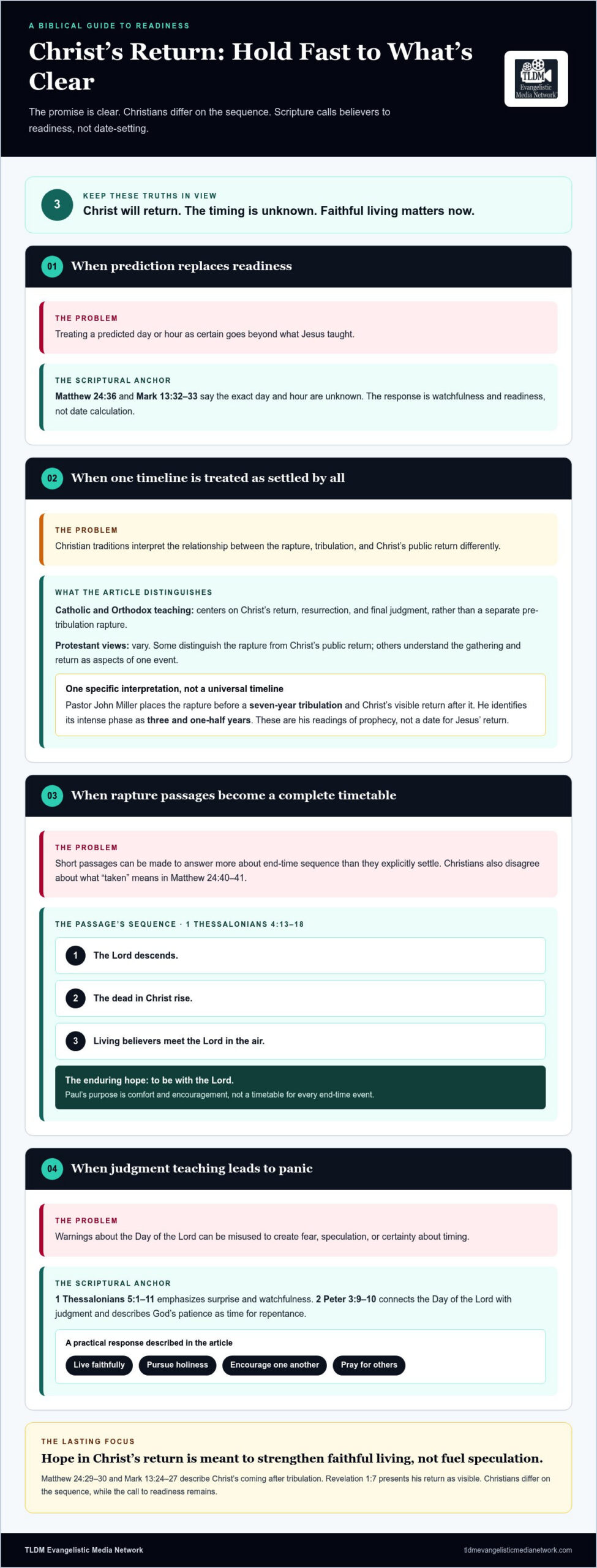
Christians differ on the sequence of end-time events, including whether the church’s rapture occurs before or after the tribulation. Pastor John Miller’s interpretation places the rapture before the tribulation and Christ’s visible return after it. Matthew 24:36 and Mark 13:32-33 reject claims that anyone can know the exact day or hour. Treating a prediction as certain confuses interpretation with what Jesus taught; readiness, rather than date calculation, is the practical response.
In Matthew 24:29-30, Jesus describes the Son of Man coming after the tribulation, with cosmic signs preceding his appearance. Mark 13:24-27 likewise describes darkened heavenly lights and the gathering of the elect. Pastor John Miller reads these passages as teaching that Jesus returns immediately after the tribulation. That view distinguishes the gathering of believers from the later, public appearance of Christ, though Christians understand the relationship between those events differently.
Pastor John Miller identifies the final tribulation period with Daniel’s 70th week and interprets its intense phase as lasting three and one-half years. This is a particular reading of prophecy, not a calendar date for Jesus’ return. For readers studying the passage, the key distinction is between an interpretation of the tribulation’s sequence and Jesus’ explicit statement that the day and hour remain unknown.
The rapture passages add another part of the discussion. In 1 Thessalonians 4:16-18, Paul describes the Lord descending, the dead in Christ rising, and believers meeting him in the air. John 14:1-3 records Jesus’ promise to receive his followers. Miller places this gathering before the seven-year tribulation, while Matthew 24:40-41 describes one person taken and another left. These passages encourage readiness without making date prediction a Christian duty.
Readiness also shapes conduct before his return. Matthew 25:1-13 uses ten virgins awaiting a bridegroom to illustrate preparedness, while Titus 2:11-14 calls believers to live soberly, righteously, and godly. To prepare, Christians can cultivate Christlikeness in ordinary choices, remain faithful in service, and encourage one another with Scripture, as 1 Thessalonians 4:18 teaches. The central purpose of sermons on the second coming of Christ is not speculation, but hope that strengthens faithful living.
The rapture and separation of believers from nonbelievers
Catholic, Orthodox, and Protestant Christians affirm that Jesus Christ will return, though they differ in how they understand end-time events. Catholic and Orthodox teaching centers on Christ’s return, the resurrection, and final judgment, rather than a separate pre-tribulation rapture. Protestant views vary: some distinguish the rapture from Christ’s public return, while others understand them as aspects of one event.
In 1 Thessalonians 4:13-18, Paul comforts grieving believers with a sequence: the Lord Jesus descends, the dead in Christ rise, and living believers meet him in the air. The passage ends with enduring fellowship with Christ, not a timetable for every end-time event. Paul’s purpose matters. He urges Christians to encourage one another, especially when death raises questions about reunion and hope.
Matthew 24:40-41 describes two people in the same setting, with one taken and the other left. Christians disagree about what “taken” means in that passage and how it relates to 1 Thessalonians 4. Some read it as the gathering of believers; others connect it with judgment. Read Matthew 24 alongside its wider context rather than treating two short verses as a complete rapture chronology.
The phrase “rapture” describes the gathering of believers to meet Christ, based especially on Paul’s language in 1 Thessalonians 4. In some Protestant interpretations, this gathering happens before a seven-year tribulation, while Christ’s return in clouds and glory occurs afterward. Other Christians see the gathering and public return as one event. These are interpretive differences, not reasons to lose sight of the shared hope of being with the Lord.
The Day of the Lord adds a related theme. First Thessalonians 5:1-11 compares its arrival to a thief in the night, emphasizing surprise and the need for watchfulness. In the sermon’s interpretation, 1 Thessalonians 1:10 and 5:9 express Christ’s rescue of believers from coming wrath. Second Peter 3:8-10 also links the Day of the Lord with judgment, while explaining God’s patience as time for repentance.
That patience shapes how Christians live now. Second Peter 3:9 presents God as desiring repentance rather than destruction, so teaching about judgment should prompt reflection, not date-setting or panic. A practical response is to remain faithful, encourage fellow believers, and pray for those who have not turned to God. Teach Me To Pray: Lessons From Scripture can support a Scripture-centered prayer practice as you reflect on the Lord’s return.
Matthew’s account also cautions against assuming that every Christian tradition uses “rapture” in the same way. Some Protestants distinguish the gathering of believers from Christ’s later public appearing; Catholic, Orthodox, and other Protestant interpretations may not share that framework. Across these views, Christian hope rests on the Father’s promise and Christ’s victory. The question is not only where believers are going, but how faithfully they live as they wait.
The unexpected, destructive, and inescapable judgment
New Testament passages portray the Day of the Lord as sudden and serious, not as a date people can calculate. They connect judgment with Christ’s authority and call people to respond faithfully before he comes.
The Mourning and Judgment of Nations
The mourning of the nations describes a public response when Christ appears and judgment becomes evident. Matthew 24:30 says the tribes of the earth mourn when they see the Son of Man coming with power and great glory; Revelation 1:7 likewise says every eye will see him. These passages matter because they frame his return as a moment with consequences beyond the church, not a private event.
First Thessalonians 5:2-3 compares the Day of the Lord to a thief in the night and describes sudden destruction. The image emphasizes surprise, not a timetable: people cannot make the day safe by predicting when it will happen. Second Peter 3:10 also uses the thief comparison and describes the heavens passing away. The warning asks readers to consider their response now, rather than assume there will be time to act later.
Judgment imagery in Revelation presents the scale of the crisis. Revelation 8:12 describes a trumpet judgment in which a third of the sun, moon, and stars are struck and darkened. Revelation 9:6 depicts people seeking death but unable to find it. These visions are severe, and readers should handle them with care, attending to each passage’s context instead of turning symbolic or prophetic imagery into unsupported predictions about current events.
Christ’s Judgment and Conquest
Christ’s judgment and conquest mean that Jesus comes as King to defeat evil and judge the ungodly. Revelation 19:11-16 portrays Christ’s victory, while 2 Thessalonians 1:7 speaks of Jesus being revealed from heaven with his angels. This matters because judgment belongs to Christ, not to human speculation or revenge; the church is called to faithfulness as it awaits his righteous rule.
Other passages explain why judgment is not merely spectacle. Second Thessalonians 2:10 says people perish because they refuse to love the truth and be saved. The point is a response to truth, not a license to condemn particular people. Read alongside 2 Peter 3:10, the warning places human choices within the larger reality of God’s judgment and the passing of the present order.
For readers, a grounded response includes taking Scripture seriously, turning from wrongdoing, and treating neighbors with compassion. The judgment texts do not bless fear-driven date-setting or hostility; they call for repentance and faithful conduct. Revelation 19 directs attention to Christ’s victory, while 1 Thessalonians 5 calls believers to remain watchful. Together, these passages offer a sobering reason to live with integrity and a hope rooted in Jesus’ final triumph.
Purity and holiness in anticipation of seeing Jesus
First John 3:2-3 connects the hope of seeing Jesus with present purification. John’s emphasis is not on predicting the moment of Christ’s appearing, but on letting that hope shape a believer’s character. Purity here means turning toward God rather than making peace with sin. A practical response is to examine whether private choices match the faith professed publicly, then bring failures honestly before God.
Luke 12:42-44 offers another picture of readiness through the faithful steward. The master blesses the servant he finds responsibly caring for the household. This example makes holiness concrete: a person entrusted with work, family care, or leadership can act with honesty even when no one is watching. Faithfulness is not limited to public religious activity. It appears in the integrity of ordinary responsibilities.
James 5:8-9 connects expectation with patience and strengthened hearts. James addresses believers facing hardship and warns against grumbling against one another. That instruction brings anticipation into relationships: waiting for the Lord should make Christians more patient, not more harsh. In practice, a believer can resist resentment, speak fairly during conflict, and offer support to someone carrying a difficult burden.
Jesus’ words in Matthew 25:21 and 25:23 describe the faithful servant entering the master’s joy. The repeated commendation highlights stewardship over time, not dramatic displays of piety. A Christian might use a skill to serve a neighbor, keep a commitment, or handle shared resources responsibly. Such choices make devotion visible. They also shift attention from appearing impressive to serving faithfully with what has been entrusted.
These passages suggest a useful way to reflect: name the responsibility in front of you, identify the character it requires, and choose an action consistent with that character. For example, Luke 12 can prompt an honest review of a duty neglected, while James 5 can guide a patient response to tension. Scripture’s call is specific, not abstract. The next faithful act may be a truthful conversation or a repaired commitment.
Holiness also grows through ongoing self-examination rather than a claim of flawlessness. First John 3:2-3 directs attention to the life believers are becoming, while James 5:8-9 calls them to steadiness with one another. Together, these passages invite believers to receive correction, seek forgiveness when they cause harm, and keep practicing faithfulness. Expectation becomes a daily orientation, shaping the way Christians treat God, neighbors, and their responsibilities.
Biblical predictions of Christ’s second coming
Biblical predictions of Christ’s return appear throughout the New Testament, in Jesus’ testimony, the apostles’ teaching, and Revelation’s closing promises. Read these passages as connected witnesses, while considering each one’s purpose and audience. This helps distinguish the promised event from interpretations that assign details the passage does not directly state.
In Mark 14:62-64, Jesus tells the high priest that he will see the Son of Man seated at God’s right hand and coming with heaven’s clouds. The prediction is striking because Jesus speaks under accusation, affirming his identity and future vindication before those judging him. For a reader, the scene highlights that Christian expectation begins with Jesus’ own words, not a modern forecast.
Jude 1:14-15 presents an older prophetic witness, describing the Lord coming with holy ones to execute judgment. The passage broadens the biblical picture: the return concerns more than personal hope; it also means God will confront ungodliness and establish justice. Reading Jude alongside the Gospels and letters helps readers see how different writers develop related themes without treating every image as a timetable.
Revelation’s final chapter gives the promise a direct, personal voice. Revelation 22:7 blesses those who keep the book’s prophecy; verses 12-13 connect Jesus’ coming with his reward and sovereign identity. In verse 20, Jesus promises to come, and John answers with a prayer for his coming. A sermon by Pastor John Miller is one example of teaching that draws attention to these scriptural predictions and their call to faithful expectation.
Revelation 21:1-6 then shows the hope toward which prophecy points: God dwelling with his people and ending death, sorrow, and pain. This future gives the promise a wider horizon than speculation about events. As you study, ask what each passage reveals about Christ, what hope it offers, and what response it calls for. Explore online sermons to continue studying these biblical predictions.
TLDM Evangelistic Media Network: Sharing The Word Podcast
TLDM Evangelistic Media Network offers the Sharing The Word Podcast as a way to continue reflecting on biblical teaching beyond this article. If you want to study Christ’s return alongside other scriptural themes, its Online Sermons provide another format for listening and learning. Take5 Messages offer brief Christian messages, while Teach Me To Pray: Lessons From Scripture supports a Scripture-centered prayer life.
These resources can help you revisit Scripture, consider its meaning, and connect biblical hope with daily faithfulness. Choose the format that best supports your study, whether you listen to a podcast, explore a sermon, or strengthen your prayer practice.
Visit tldmevangelisticmedianetwork.com to explore these resources.
Let Christ’s promise shape your next step
Let the promise of Jesus’ return shape more than your thoughts about the future. Make room for it to guide your choices today: how you speak, what you pursue, and how you care for others. As you study sermons on the second coming of Christ, keep Scripture at the center and let its hope lead you toward faithful, steady living.
If you’d like to continue exploring biblical teaching and Christian life, contact TLDM Evangelistic Media Network.
Keep growing in faith with patience and humility. The hope of seeing Jesus can strengthen your walk, renew your purpose, and encourage you to serve with love as you await him.
Frequently Asked Questions
What Bible passages discuss the second coming of Christ?
Hebrews 9:28 and John 5:28-29 are useful passages to add to a study. Hebrews connects Christ’s appearing with salvation for those waiting for him, while John records Jesus teaching about resurrection and judgment. Read each passage in its chapter, then note its central promise and warning. This helps build a broader biblical picture without relying on a single passage or sermon.
Where can I listen to or watch free sermons about the second coming of Christ?
TLDM Evangelistic Media Network offers Online Sermons and the Sharing The Word Podcast through its digital platform. These are relevant places to explore teaching on Christ’s return. The available business information doesn’t establish that every item is free, so distinguish free access from paid offerings when reviewing a specific resource. You can also use the sermon’s cited Scripture references to continue studying the subject directly in your Bible.
What do sermons teach about signs of Christ’s return?
Sermons may discuss signs as biblical warnings and calls to faithfulness, rather than as a code for calculating dates. Second Peter 3:3-4, for example, describes scoffers questioning the promise of Christ’s coming. When a sermon interprets a current event as a sign, compare that claim with the passage’s context and purpose. This helps keep careful Bible study distinct from speculation about headlines.
How do sermons explain the rapture, tribulation, and second coming?
Sermons explain these terms through different interpretive frameworks, so compare the preacher’s definitions before weighing their conclusions. Note whether the sermon presents the rapture as a distinct event, how it describes the tribulation, and how it relates both to Christ’s appearing. Then examine the scriptural reasoning for that sequence. This makes differences between teachings easier to understand without mistaking different terminology for agreement.
What should Christians do to prepare for the second coming, according to sermons?
Prepare by letting Scripture guide everyday decisions, not just end-times study. Choose a passage, note its instruction, and consider how it applies to a responsibility you face, such as keeping a promise or speaking truthfully. Prayer can help you bring that response before God. This practice grounds expectation in faithful action rather than anxiety about timing.
What are popular sermons on the second coming of Christ by well-known preachers?
The article discusses Pastor John Miller’s teaching on Christ’s visible return, the rapture before the tribulation, and Christ’s return after it. It does not identify a list of popular sermons by well-known preachers.