

What if a few quiet minutes with Scripture could do more than offer a moment of inspiration? Short scriptural devotions can help you make room to hear, consider, and respond to God’s Word, even when the day is full.
It’s understandable if lengthy study plans feel hard to sustain. A brief reflection can also feel incomplete when it pulls a verse away from its biblical setting or leaves you unsure how to apply what you’ve read. A meaningful devotional rhythm doesn’t depend on reading more pages. It begins with approaching a passage thoughtfully.
This guide shows you how to spend a short time with Scripture and reflect on it meaningfully. You’ll learn to notice a passage’s context, ask questions that lead to honest reflection, and carry a biblical insight into everyday choices. You’ll also find a simple rhythm you can return to, so brief devotions become more than encouraging words: they become a steady practice of listening and faithful response.
Key Takeaways
- Short scriptural devotions can be brief without treating Scripture as unimportant.
- Read a passage in context before reflecting on its meaning or application.
- Turn reflection into a practical response you can carry into daily choices.
- Build a sustainable rhythm by connecting Scripture reading with an existing daily transition.
- Continue exploring biblical teaching through the Sharing The Word Podcast and Take5 Messages.
What Are Short Scriptural Devotions, and What Makes Them Meaningful?
A short scriptural devotion is a focused encounter with a biblical passage: you read the words in context, consider what they communicate, and discern how to respond faithfully. Its value doesn’t depend on how many verses you cover or how long you sit. It comes from giving Scripture careful attention rather than using it as a prompt for whatever thought happens to come to mind.
A scriptural devotion brings a passage, thoughtful reflection, and a practical response together in a brief, focused time with God’s Word. Brevity describes the format, not the importance of Scripture. A concise reflection can take the text seriously, while a longer reading can remain superficial if you move through it without considering its meaning.
This distinction matters because encouraging words alone aren’t necessarily biblical reflection. A motivational thought may offer comfort, but a devotion asks what the passage says, what it means in context, and how its message should shape your understanding or conduct. Personal encouragement has a place, but it should grow from the text rather than replace or distort it.
How Is a Scriptural Devotion Different From an Inspirational Quote?
An inspirational quote can stand on its own as a memorable line. A devotion, by contrast, draws meaning from a passage and its surrounding biblical context. For example, reflecting on Philippians 4:6-7 involves considering Paul’s instruction about prayer, supplication, and thanksgiving. It does not mean treating the passage as a general promise that every difficult situation will immediately disappear.
Context helps keep interpretation grounded. Ask who is speaking, what concern the passage addresses, and how the surrounding verses clarify its message. Encouragement drawn from Scripture can strengthen the heart, but it should remain consistent with what the passage teaches.
Can a Brief Devotion Still Encourage Spiritual Growth?
Limited time doesn’t automatically make reflection shallow. Focused attention on a passage can help you notice a detail, examine your response, or consider one faithful next step. It doesn’t guarantee a particular feeling or outcome, but it creates space to listen carefully and learn.
Growth can come through returning to Scripture with patience and applying what you understand. Completing a lengthy reading may be useful, but it isn’t the only measure of meaningful engagement. A brief devotion is more than a quick inspirational pause when it keeps the text central and lets its meaning inform real choices.
To keep your focus, anchor reflection in a specific passage rather than a theme alone. Notice repeated ideas, instructions, or contrasts. If a word or idea is unfamiliar, consult a reliable Bible translation or study resource before deciding what it means. A little context can prevent a sincere reflection from becoming an unsupported interpretation.
- Passage: What do the verses say, and what surrounds them?
- Reflection: What do they reveal about God, people, or faithful living?
- Response: What thought, choice, or action could align with that meaning?
This simple pattern keeps short scriptural devotions rooted in the Bible rather than in a slogan or passing mood. The aim isn’t to force a dramatic insight from every reading. It’s to approach Scripture with care, receive its message honestly, and remain open to putting it into practice.
How to Reflect on a Bible Passage in a Short Devotional
A focused process can help you move from reading words on a page to understanding what a passage communicates. Keep the steps simple, but let the text guide each one. This keeps reflection grounded in Scripture instead of making the passage say whatever feels meaningful in the moment.
Begin With the Passage and Its Biblical Context
Context-aware reflection means reading a verse within its surrounding passage so its meaning comes from the text, not from assumption. Before drawing a conclusion from one line, read the verses around it. Notice who is speaking, who is being addressed, and what situation the passage describes when those details are clear. If a word or theological idea is unfamiliar, consult a trusted Bible reference or study resource, then return to the passage and see how the explanation fits.
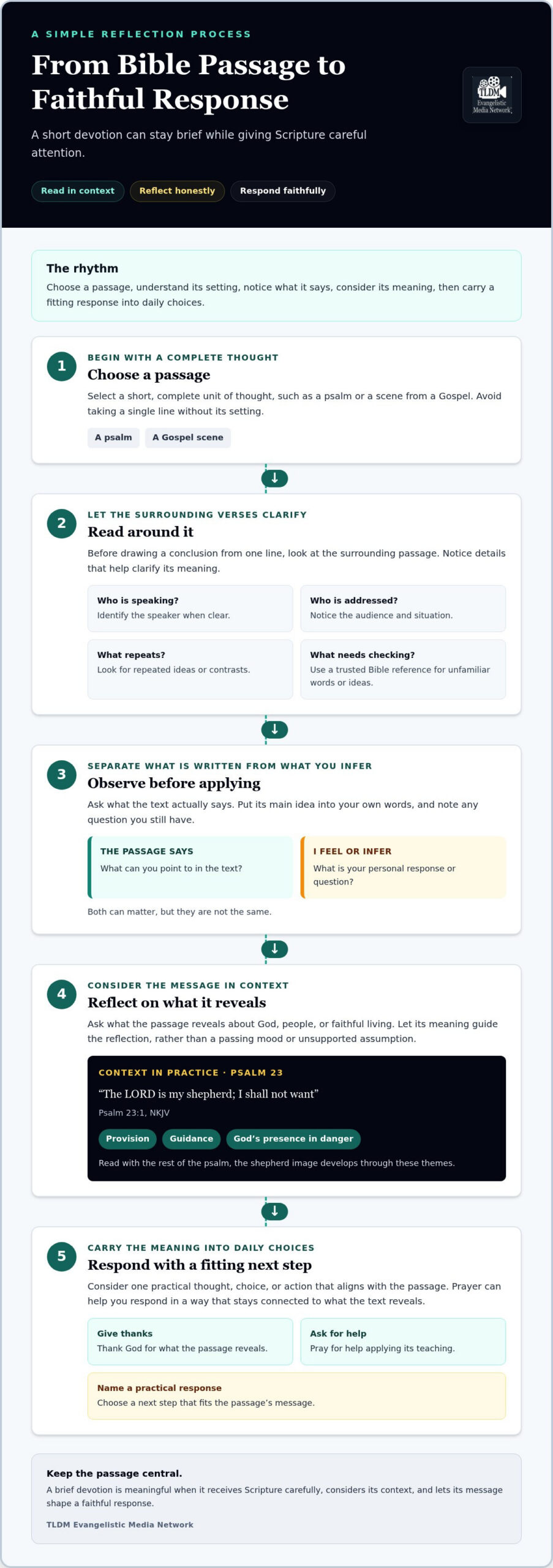
Psalm 23 offers a clear example. Its heading identifies it as “A Psalm of David” (NKJV), and its opening verse reads, “The LORD is my shepherd; I shall not want” (Psalm 23:1, NKJV). Read alongside the rest of the psalm, the shepherd image develops through themes of provision, guidance, and God’s presence in danger. The verse offers comfort, while its context gives that comfort shape and depth.
Move From Observation to Reflection and Response
Once you understand the immediate setting, separate what the passage says from what you personally feel or infer. Both can matter, but they aren’t the same. This distinction helps you receive Scripture honestly and avoid turning a personal impression into a command the text doesn’t make.
Prayer can be a fitting way to respond to a passage. You might thank God for what it reveals, ask for help applying its teaching, or bring an honest question to God. Keep your response connected to the text: ask what it reveals, then consider a practical step that fits its message.
Try this sequence:
- Choose a passage. Select a short, complete unit of thought, such as a psalm or a scene from a Gospel, rather than choosing a line without its setting.
- Read around it. Look at the surrounding verses and note the speaker, audience, repeated ideas, or situation that helps clarify the passage.
- Observe before applying. Ask what the text actually says. Identify its main idea in your own words, and mark any question you still have rather than guessing.
- Reflect with care. Consider what the passage shows about God, people, faith, or faithful living. Ask why a particular phrase stands out, while keeping your response distinct from the text’s direct teaching.
- Choose a fitting response. Identify one realistic action, prayer, or change in perspective that aligns with the passage. Treat it as a faithful application, not a universal rule unless Scripture presents it that way.
For instance, Psalm 23 may lead you to pray for trust when you feel uncertain or to remember God’s guidance before making a decision. Those are possible responses to the psalm’s themes, not a promise that every choice will become easy. Short scriptural devotions become more thoughtful when observation comes first and application follows with humility.
If you’d like to continue learning through Scripture-centered teaching, the Sharing The Word Podcast can serve as a companion to your personal reflection.
Are Short Scriptural Devotions Too Shallow? Context Makes the Difference
Not necessarily. A brief reflection can be thoughtful and faithful, while a longer reading can miss the point if it rushes past the passage’s meaning. The key question isn’t how many minutes you spend. It’s whether the devotional helps you understand the text honestly or reduces it to a quick sentiment detached from its setting.
Short scriptural devotions can offer encouragement and a focused opportunity to reflect, but they don’t replace deeper study when a passage raises questions that a brief treatment can’t answer. Think of a devotional as an entry point, not a complete explanation of every theological issue. It can draw attention to a truth worth considering, while further reading helps you examine that truth more fully.
Signs a Short Devotion Handles Scripture Responsibly
A responsible reflection makes clear which ideas come from the passage and which come from the writer’s experience or application. Check whether its main point fits the surrounding text, and whether its practical advice follows from that point without claiming more than Scripture supports.
- It respects context. The explanation fits the passage’s subject and does not rely on a line pulled away from its surrounding verses.
- It separates text from illustration. A personal story may illuminate an idea, but it isn’t presented as the biblical teaching itself.
- It applies the passage carefully. The suggested response offers a relevant way to live out the text without turning one person’s application into a command for everyone.
These signs help distinguish focused reflection from hurried reading. A disconnected verse may sound reassuring when presented alone, yet its meaning can change when read in the larger passage. Pause when a devotional makes a sweeping promise or rule. Compare the explanation with the verses themselves, and ask whether the passage supports that conclusion.
Spiritual maturity can’t be measured by reading speed, devotional length, or an unbroken completion streak. A missed day doesn’t erase the value of returning to Scripture with attention. Aim for steady learning and faithful application, not pressure to finish a plan or prove your commitment through a particular reading pace.
When a Brief Reflection Calls for Deeper Study
Some passages raise questions about history, language, doctrine, or how a teaching fits with other parts of Scripture. If a short reflection leaves you uncertain, read the full chapter, compare its explanation with the biblical text, and consult a reliable study resource. You can also note the question and return to it instead of settling for a quick guess.
When a passage raises questions about spiritual life, take time to read it in full and consider how its teaching fits with Scripture as a whole. Let any resource direct you back to the Bible. A devotional can open a door, and deeper study can help you explore what lies beyond it with care.
How to Build a Sustainable Short Devotional Rhythm
A devotional habit should make room for Scripture in the life you have, not depend on an ideal schedule. A sustainable devotional rhythm is repeatable, flexible, and rooted in Scripture. It gives you a familiar way to begin while leaving room to adjust when responsibilities, energy, or circumstances change.
Think of the practice as a simple cycle: select a passage, reflect on its message, choose a response, and revisit what you noticed. You don’t need an elaborate plan before you begin. Start with a clear next step, then let the habit take shape through regular return to the text.
Choose a Passage and a Practical Moment
Select a short, coherent passage, such as a complete psalm or a connected scene in a Gospel. This gives you enough context to follow the thought rather than choosing a single verse only because it looks convenient. Then attach reading to a familiar transition, perhaps after breakfast, before beginning work, or as you settle in for the evening. Choose a moment that allows attention, not a required time of day.
Make it easy to begin. Keep a Bible nearby, along with a notebook or another simple way to record a thought. If the moment you chose becomes busy or difficult, adjust the routine rather than deciding the practice has failed.
Carry One Scriptural Insight Into the Day
As you reflect, write down one observation, one honest question, or one possible response. Keep the note brief and personal, but connect it to what the passage says. Later, revisit your words and consider whether the passage sheds light on a choice, conversation, or attitude from your day.
A note might capture a repeated idea in the text or name a question you want to explore. You don’t need to produce a polished journal entry. The purpose is to help you remember the passage and return to its meaning with care.
Use a flexible pattern you can adapt:
- Select: Choose a passage that forms a complete thought.
- Reflect: Read it in context and note one meaningful observation or question.
- Respond: Identify a practical way its message may guide your choices.
- Revisit: Return to the passage or your note later and consider what you understand more clearly.
Some days, you may follow the full cycle. On others, reading a few verses attentively may be all you can manage. If you miss a day, begin again at the next natural opportunity. You don’t need to catch up, double your reading, or treat a missed day as evidence about your spiritual worth. Return without guilt, and let Scripture remain the center of the practice.
For continued engagement with biblical teaching alongside your personal reading, explore the Sharing The Word Podcast.
Continue Exploring Scripture With TLDM Evangelistic Media Network
Personal reflection can grow alongside continued learning. TLDM Evangelistic Media Network offers Scripture-centered media, including the Sharing The Word Podcast, as a companion for exploring biblical teaching. Listening is one way to engage with a subject, but it doesn’t replace reading the passage itself. Keep your Bible close, and return to the text to consider how an explanation relates to its words and context.
This balance matters. A message may prompt a question or draw your attention to a passage you haven’t considered closely. Rather than relying only on what you hear, note the Scripture reference and revisit it in your own reading. Compare the message with the passage, and allow the biblical text to remain central to your reflection.
Use Scripture-Centered Media as a Companion to Personal Reflection
Listening can fit naturally beside a devotional practice. You might hear a biblical teaching, write down a passage or question that stands out, and return to it later with your Bible open. That gives you a starting point for further reflection without asking audio content to take the place of direct engagement with Scripture.
A brief note can help you carry a question forward: What does this passage say? What would I like to understand more clearly? Recording the question gives you a practical way to reconnect personal reflection with the biblical text, rather than letting an interesting thought fade or become detached from its source.
Choose a Next Step That Fits Your Spiritual Learning
Different resources can support different interests. If you want to continue considering a biblical subject, explore TLDM’s Take5 Messages. You can also use its online sermons and Scripture-based teaching resources as part of continued learning, then return to a relevant passage for personal reading and reflection.
There’s no need to turn every resource into another task to complete. Choose a message or teaching that connects with a question you’re already considering, and give yourself room to think through its relationship to Scripture. The goal is not simply to take in more content, but to keep learning with care and carry biblical understanding into daily life.
Let short scriptural devotions be one part of an ongoing engagement with God’s Word. Continue reflecting on passages that speak to your questions, and explore TLDM’s biblical media as a companion on that journey.
Let Scripture Shape Your Next Step
Let your next devotional begin with a willingness to listen. Choose a passage, bring an honest question, and consider how its message might shape one choice today. Short scriptural devotions don’t need to feel perfect to be meaningful. Return to the Word with patience, and give understanding room to deepen over time.
If you’d like a companion for continued biblical learning, explore TLDM’s Scripture-centered media and teaching. Listen to the Sharing The Word Podcast or Take5 Messages, or explore its online sermons and Christian books to find a resource that supports your interests.
Each thoughtful return to Scripture can help you grow in wisdom and carry its truth into daily life. Keep moving forward in faith, one reflection at a time.
Frequently Asked Questions
What is a short scriptural devotion?
A short scriptural devotion is a brief time spent engaging thoughtfully with part of the Bible and considering its meaning. It might focus on a few connected verses, a central idea, and a response that fits the passage. Short scriptural devotions aren’t simply inspirational sayings paired with a verse reference. The biblical text remains the foundation, guiding what you consider and carry into daily life.
How do you write a short devotional based on Scripture?
Choose a passage with a clear, connected idea, then write a few lines that help a reader notice that idea and consider its relevance. For example, a reflection on patience might describe what the passage teaches, distinguish that teaching from a personal observation, and offer a realistic way to practice patience in a conversation. Keep the explanation faithful to the text, and avoid adding a promise or instruction the passage doesn’t support.
Can a short devotional help you grow spiritually?
Yes, a short devotional can support spiritual growth by helping you return to Scripture and consider how its teaching shapes ordinary choices. One reflection may prompt you to listen more carefully before responding, while another may lead you to examine how you treat a neighbor. Growth isn’t guaranteed by a devotional format, and one reading won’t answer every question. It can, however, offer a meaningful point of reflection and encourage continued learning.
How long should a short scriptural devotion take?
There’s no required duration for a short scriptural devotion. The time may vary with the passage, your questions, and the attention you can give that day. A few connected verses may invite a brief reflection, while an unfamiliar idea may call for more reading. Rather than setting a strict limit, give yourself enough time to understand the main point and avoid rushing simply to finish.
What Bible passages are good for short devotions?
Passages with a focused theme or complete scene can work well. Psalm 121 offers a meditation on God’s help, Matthew 6:25-34 addresses worry and trust, and James 1:19-27 speaks to listening and putting the Word into practice. Choose a passage that connects with a question or concern you’re carrying. Read its surrounding verses, too, so the devotional reflects the passage’s purpose rather than a phrase alone.
How can I make daily devotions a consistent habit?
Make starting simple: decide what passage you’ll read next before putting your Bible away, and leave a bookmark or note at that place. A written reminder can also help if your usual routine changes. Keep a flexible backup, such as reading a few verses during another quiet moment. If you miss a day, continue from where you left off instead of turning the interruption into a reason to abandon the practice.
Should a devotional include prayer?
Prayer can be a fitting response, but a devotional doesn’t need to follow a fixed prayer format. You might thank God for something the passage reveals, ask for help applying its teaching, or sit quietly with a question the text raises. Keep the prayer connected to what you’ve read, while speaking honestly in your own words. If prayer feels difficult, begin with one sentence drawn from your reflection.