

What if the most helpful Christian living books aren’t the ones everyone recommends, but the ones that speak faithfully to the season you’re in? With so many titles on prayer, relationships, spiritual habits, and personal growth, choosing where to begin can feel harder than finding something inspiring to read.
You’re right to look for more than encouragement. A useful book connects biblical teaching with real questions and decisions, while helping you recognize where Scripture ends and an author’s interpretation begins. The Bible remains the foundation; a thoughtful Christian book can help you reflect on its wisdom and apply it with care.
This guide will help you find Christian living books that fit a present concern, offer practical direction, and invite steady spiritual growth. We’ll explore options by the needs they address, consider what to look for in biblically grounded writing, and outline a clear next step for your reading journey.
Key Takeaways
- Choose Christian living books based on the questions, relationships, or spiritual habits you want to explore.
- Compare how clearly a book uses Scripture and connects its teaching to everyday life.
- Preview a book’s contents or description to see whether its approach fits your needs.
- Build a steady reading practice by reflecting on one insight and considering how to apply it.
- Explore Christian books and Scripture-based learning, including the Teach Me To Pray: Lessons From Scripture series.
What Christian Living Books Can Offer in Everyday Faith
Read with discernment. A book may quote or explain a biblical passage, then offer an author’s interpretation of what it means for a modern situation. That interpretation and its suggested application may be thoughtful, but they are not Scripture itself. Compare the explanation with the biblical text and its context, and treat personal application as a considered response rather than a universal rule.
How Christian living reading differs from devotional reading
Devotional books often guide brief, recurring reflection, while broader Christian living titles may spend more time exploring a theme or question. The categories overlap: a devotional can include teaching and practical steps, and a longer book can invite daily reflection. For background on the tradition, see Christian devotional literature, and explore Christian devotional books for daily growth for a related reading focus.
Start with the question you want your reading to address
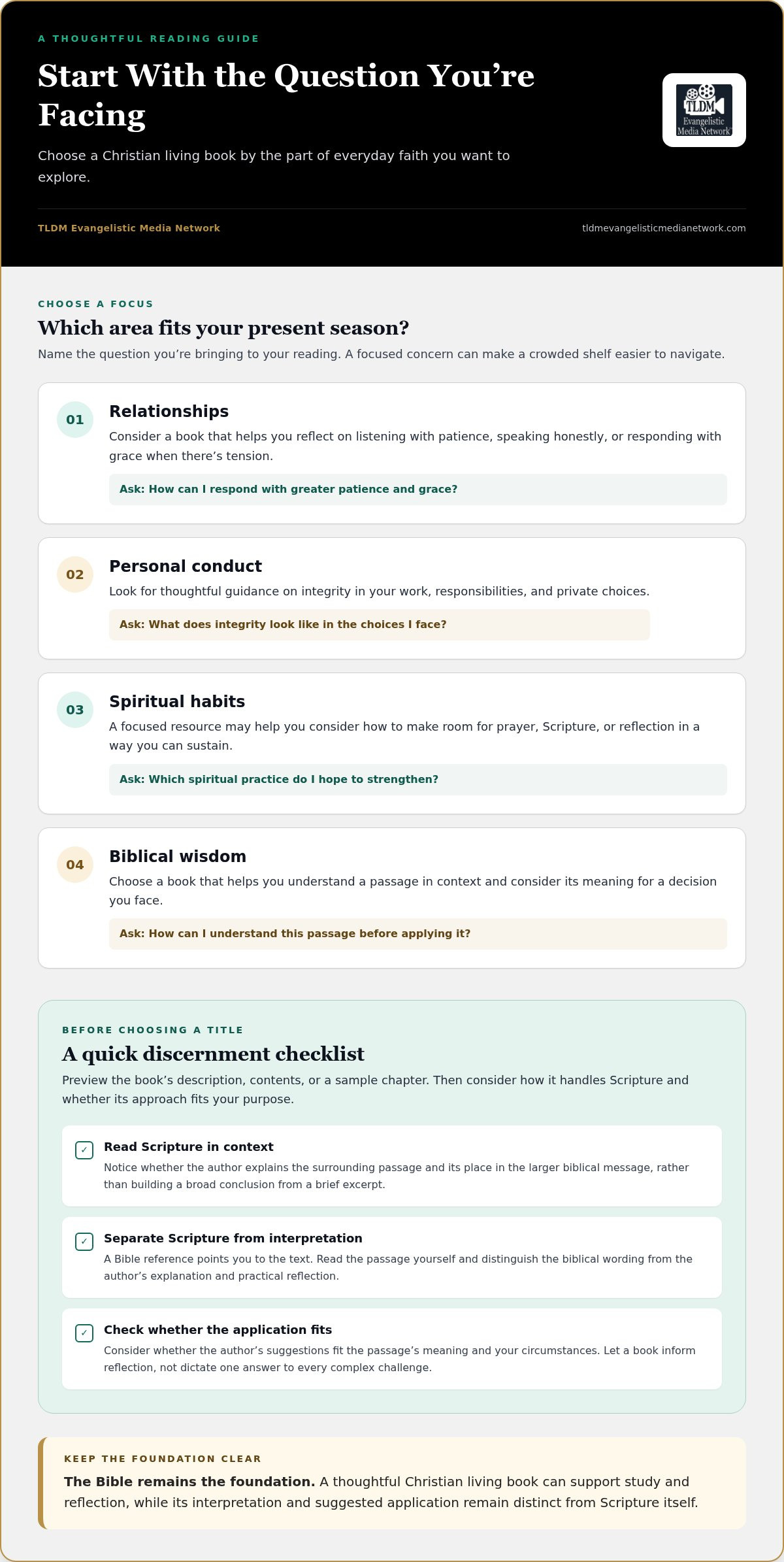
Rather than browsing a broad category without a purpose, name what you’re bringing to your reading. Is there a relationship you want to approach with greater patience, a spiritual habit you hope to strengthen, or a responsibility that calls for careful discernment? A specific question can turn a crowded shelf into a clearer starting point.
For example, someone seeking a steadier prayer practice might choose a book focused on prayer, while a reader reflecting on everyday conduct might look for guidance on applying biblical wisdom to decisions. The goal isn’t to find a title that answers every concern. Choose a resource that helps you study, reflect, and take a thoughtful next step.
Christian Living Books by the Questions You Face
A useful shortlist starts with your present concern, not with the claim that one title is essential for every reader. Christian writing has a long history, and a history of early Christian literature offers context for how believers have used writing to teach and reflect on faith. For your own reading, begin with one area of life and the question you hope to explore.
- Relationships: How can I listen with patience, speak honestly, or respond with grace when there’s tension?
- Personal conduct: What does integrity look like in my work, responsibilities, and private choices?
- Spiritual habits: How can I make room for prayer, Scripture, or reflection in a way I can sustain?
- Biblical wisdom: How can I understand a passage in context and consider its meaning for a decision I face?
These themes can guide your search without suggesting that a book will resolve every difficult circumstance. For focused Bible teaching books, explore Christian Bible study books for deeper faith.
Choose a theme that reflects your present season
Start with the area that feels most relevant now. Review a book’s description and contents to see whether it addresses that concern. A resource on communication, for example, may suit someone reflecting on relationships, while a book about spiritual disciplines may better serve a reader seeking a more consistent devotional rhythm.
Let the book inform your reflection, not dictate a single answer to a complex personal challenge. Consider how it uses Scripture, the questions it raises, and whether its practical suggestions fit your circumstances.
When prayer and spiritual habits are the main focus
Books focused on prayer give sustained attention to prayer itself, while broader Christian living resources may treat it as one part of a larger discussion about faith and daily conduct. If prayer is your main area of interest, Teach Me To Pray: Lessons From Scripture is an instructional resource from TLDM Evangelistic Media Network. For additional focused reading, see Christian prayer books for spiritual growth.
You can also browse the TLDM bookstore for Christian books as you consider which subject best fits your current season.
How to Evaluate Christian Living Books for Biblical Depth
A book can include many Bible references and still handle them poorly. Look beyond the number of citations: consider whether the author explains each passage in context, distinguishes Scripture from interpretation, and offers applications that fit the passage’s meaning. A biblically grounded book invites readers to assess its teaching in context, not simply accept isolated quotations as proof.
Before choosing Christian living books, preview a sample chapter, contents page, or description. These can show how the author develops ideas and whether the book suits your purpose. For an example of a curated Christian reading list, explore Renovaré’s 25 Books Every Christian Should Read.
Check how the author handles Scripture
Notice whether the author explains the surrounding passage and its place in the larger biblical message, or builds a broad conclusion from a brief excerpt. A Scripture reference points you toward the text; it doesn’t, by itself, show that the author’s interpretation is sound. Read the passage yourself and distinguish the biblical text from the author’s explanation and practical reflection.
Compare clarity, relevance, and practical application
Use these questions to compare books against your reading purpose. No single author or viewpoint will be the right fit for every reader, so look for a clear, thoughtful approach rather than a claim of universal agreement.
A clear book doesn’t need to oversimplify difficult questions. It should help you understand its reasoning, identify what comes directly from Scripture, and consider how its suggestions apply to your circumstances. If its examples or exercises don’t fit your purpose, another resource may serve your reading better.
How to Turn Christian Living Books into a Sustainable Reading Practice
A steady reading practice doesn’t depend on finishing books quickly. It grows through attention, reflection, and small responses you can carry into ordinary life. Rather than starting several Christian living books at once, stay with one central idea long enough to understand it and consider what it asks of you.
Try this four-step routine:
- Choose a purpose. Name what you hope to understand or practice through your reading.
- Read a manageable section. Pause at a natural stopping point instead of pushing through when your attention fades.
- Reflect. Note the main idea, the Scripture references, and any questions you want to study further.
- Apply one insight. Choose a practical response to consider, then return to it during the week.
A brief journal can keep the process grounded. Write down a question, the passages you want to revisit, and one response you’re considering. You don’t need elaborate notes. A few clear lines can help you see what you’re learning and what you want to explore more closely.
Create a realistic rhythm for reading and reflection
Connect reading with listening and study
Listening can offer another way to engage with Christian teaching, especially when it fits more naturally into your day. TLDM’s digital platform includes the Sharing The Word Podcast, Take5 Messages, and online sermons. Use these resources to complement your reflection, not replace careful attention to Scripture. Pause to look up references, weigh the speaker’s explanation, and consider how the ideas connect with your reading purpose.
For a broader reading guide, explore Christian books for spiritual growth. To continue your search for Christian literature, browse the TLDM bookstore.
Explore Christian Living Books and Scripture-Based Learning with TLDM
For readers seeking faith-centered literature alongside opportunities for scriptural learning, TLDM Evangelistic Media Network offers Christian books and faith-based media through its digital platform. The ministry also provides online sermons and Teach Me To Pray: Lessons From Scripture, an instructional resource focused on prayer and Scripture.
TLDM is a not-for-profit 501(c)(3) organization. That status provides organizational context, not an endorsement of any particular book or interpretation. As with any Christian resource, bring what you read back to Scripture and consider how the author supports their teaching.
A ministry resource for continued learning
Books can prompt careful reflection, while sermons and other faith-based media offer additional ways to engage with Christian teaching. These resources can complement one another without replacing personal Scripture study. For prayer-focused instruction, explore Teach Me To Pray: Lessons From Scripture as one option for continued learning.
Choose a format that supports your next step
A reading practice is easier to sustain when the format suits your preferences. If you prefer print, explore the Christian books available through TLDM. To browse the ministry’s Christian literature more broadly, visit the TLDM bookstore.
As you choose, keep the framework simple: begin with a question or need, assess how the book uses Scripture, and select a format and pace you can maintain. Then read with care, reflect on what the biblical text says, and consider one practical response. A single insight thoughtfully applied can be a meaningful next step in your walk of faith.
Take Your Next Step in Faithful Reading
The right Christian living books are not simply the most popular ones. Choose a resource that speaks to a question you’re facing, examine how it handles Scripture, and give yourself room to reflect and put one insight into practice. A steady reading rhythm can help thoughtful learning take root in everyday choices.
TLDM Evangelistic Media Network offers Christian books and Teach Me To Pray: Lessons From Scripture to support continued reading and scriptural learning as you grow in faith.
You don’t need to begin with a long reading list. Choose one resource, return to Scripture as you read, and consider a practical response that fits your life. Explore Christian books and Scripture-based resources to find a meaningful next step. May your reading deepen reflection, strengthen your walk, and encourage faithful living day by day.
Frequently Asked Questions
What are Christian living books?
Christian living books explore how faith and biblical principles relate to everyday life. They may focus on relationships, personal conduct, prayer, spiritual habits, or decision-making. Some offer practical reflection, while others provide more structured teaching from Scripture. Their purpose and approach vary, so read with discernment: distinguish the biblical text from an author’s interpretation and consider how the book supports its ideas.
How do I choose a Christian living book?
Choose a book that addresses a question or area of life you want to consider, such as building a prayer habit or reflecting on integrity at work. Read its description and contents page to see whether the focus matches your purpose. If possible, preview a sample. Then consider whether the author explains Scripture clearly and offers practical ideas you can thoughtfully apply.
Are Christian living books the same as devotionals?
Not necessarily. Devotionals often offer short, recurring readings designed to prompt reflection, while Christian living books may examine a topic in greater depth. The categories can overlap: a devotional may include teaching and application, and a longer book may encourage reflection as you read. Choose based on the kind of engagement you want, whether brief daily readings or a sustained look at a theme.
How can I tell whether a Christian living book is biblically grounded?
Check whether the author explains Bible passages in context instead of relying only on brief quotations. Look for a clear distinction between what Scripture says, how the author interprets it, and what practical response the author recommends. Read the cited passages for yourself and consider whether the explanation fits their context. A list of references alone doesn’t establish that an interpretation is sound.
Can Christian living books help me grow spiritually?
They can support spiritual growth by helping you reflect on Scripture, examine your habits, and consider faithful responses to everyday responsibilities. A book is a guide for reflection, not a replacement for Scripture or a guarantee of change. Growth takes continued attention and practice. Choose a resource suited to your present question, test its teaching against the biblical text, and consider one insight you can put into practice.
What is a good way to read Christian living books consistently?
Set a regular reading time and choose a manageable section rather than aiming to finish quickly. After reading, jot down the main idea, Scripture references, questions, and one practical response to consider. Return to that insight before moving on to another book. A simple routine can help you read attentively and retain what you’re learning, even if your pace varies from week to week.
Where can I find Christian living books and Scripture-based resources?
TLDM Evangelistic Media Network offers Christian books and scriptural learning resources through its digital platform. Its offerings include Teach Me To Pray: Lessons From Scripture, along with online sermons and other faith-based media. Browse the TLDM bookstore for Christian literature and explore resources that fit your reading purpose. Before choosing, review each book’s subject and approach to Scripture.