

A more literal Bible translation isn’t automatically the best choice for every reader or purpose. If a familiar verse sounds different from one version to another, you may wonder what changed and why. Understanding different bible translations starts with recognizing that translators make choices as they carry the meaning of ancient Hebrew, Aramaic, and Greek texts into English.
Those choices shape sentence structure, word choice, and readability without necessarily changing a passage’s central meaning. Labels such as “word-for-word” and “thought-for-thought” offer a starting point, but they don’t tell the whole story. This guide explains how major translation approaches work, compares familiar versions such as the ESV, NIV, and NLT, and offers practical steps for choosing a Bible for regular reading or closer study. The goal isn’t to rank translations by one label, but to understand their strengths and use them thoughtfully.
Key Takeaways
- Different wording doesn’t automatically mean a different core meaning. Understanding different bible translations begins with seeing how translators carry ancient texts into clear English.
- Formal and functional approaches balance source-language wording with natural readability in different ways.
- Compare major English versions by their translation approach and intended use, not by a single label or ranking.
- Choose a primary Bible for regular reading, then use another version to examine a passage more closely.
- When translations differ, consider the passage’s context and notes. Take time to reflect before drawing conclusions.
Understanding Different Bible Translations: Why the Wording Varies
Seeing a familiar verse phrased differently can be unsettling, but a change in wording doesn’t automatically signal a change in its central meaning. Understanding different bible translations begins with knowing what translators are doing: rendering biblical texts written in Hebrew, Aramaic, and Greek into English. Their task involves more than matching each source-language word with an English word.
Languages express ideas in different ways. A phrase that sounds natural in one language may feel awkward or confusing when translated word for word into another. Translators weigh vocabulary, grammar, idioms, and sentence structure as they seek to represent the source text clearly and responsibly. For historical background on these choices, see this overview of the history and methods of Bible translations.
A translation renders a source text into another language, while a paraphrase restates its meaning more freely in new wording. The distinction is useful, though not always a sharp dividing line: translations involve judgment, and some aim for a freer style than others.
What makes one Bible translation different from another?
Translators balance the structure of the source language with clear English expression. One version may preserve a sentence’s original form when it reads well, while another may rearrange the wording to make the idea easier to follow. Neither choice can be judged by a label alone. The passage and its purpose matter.
Historical setting, literary genre, and intended audience also shape word choices. Poetry, narrative, letters, and legal material each use language differently. An ancient idiom may need a natural English equivalent to communicate its sense. Translation approaches also overlap, so versions don’t fall into perfectly separate categories.
Does different wording mean a Bible version changes the message?
Not necessarily. Two translations may express the same idea with different English words or sentence patterns. One might preserve a familiar figure of speech, while another explains the image in language readers understand more readily. The variation may reflect a translator’s approach rather than disagreement about the passage’s central point.
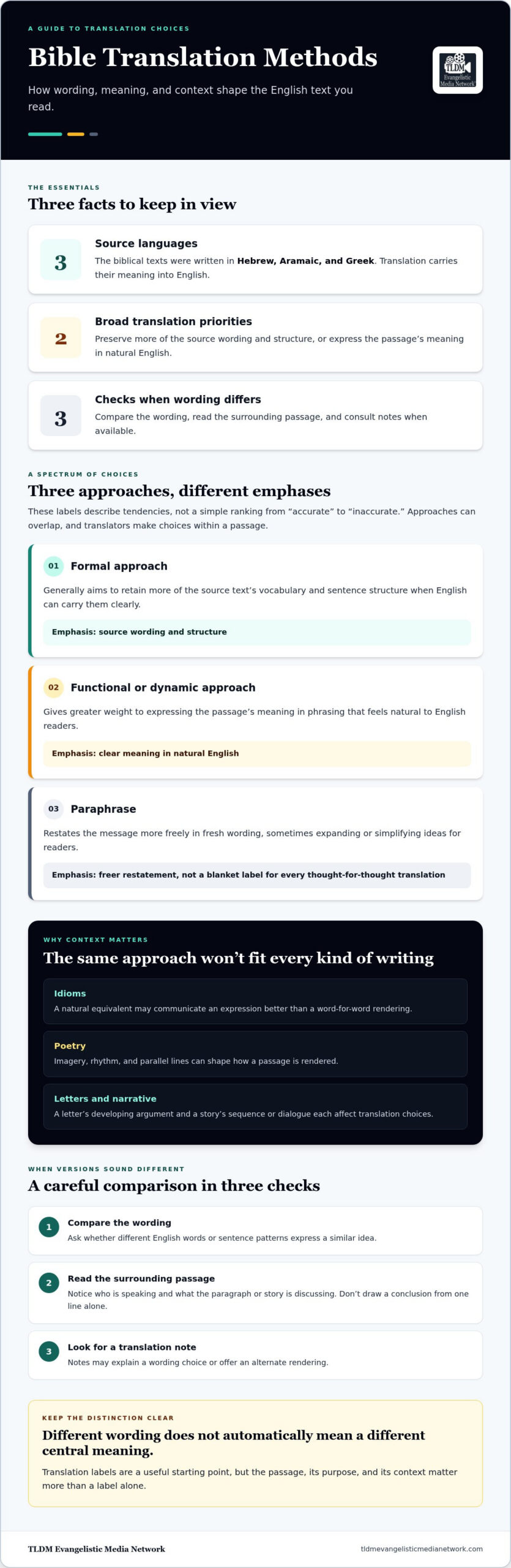
A difference deserves closer attention if versions seem to make distinct claims, leave out a phrase, or use wording that changes how a sentence connects to its context. Don’t draw a conclusion from one line in isolation. Read the surrounding verses, notice who is speaking and what is being discussed, and consult the translation’s notes when available.
- Ask whether the versions use different words to express a similar idea.
- Check how the phrase functions in the full paragraph or story.
- Look for a note that explains a wording choice or alternate rendering.
These steps help distinguish ordinary variation from a question worth exploring further. Careful comparison need not create confusion. Read patiently, keep the passage in view, and let context guide your understanding.
How Bible Translation Methods Balance Word Choice and Meaning
Translation methods describe priorities, not a simple scale from “accurate” to “inaccurate.” A more formal approach tries to preserve source-language wording and structure when English can carry them clearly. A functional, or dynamic, approach gives greater weight to expressing the passage’s meaning in natural English. Both approaches require careful work with the source text.
No translation method removes interpretation; each asks translators to make thoughtful choices about how best to carry meaning into English. That’s why understanding different bible translations means looking beyond a label and considering what the wording does in context.
What do literal and thought-for-thought translations mean?
“Literal” and “thought-for-thought” are useful shorthand, not guarantees of quality or exact word-for-word matching. A highly literal rendering can preserve a source-language pattern but sound stiff or unclear in English. A thought-for-thought rendering may read more smoothly, but readability still depends on careful attention to the original wording and meaning.
Formal equivalence generally aims to retain more of the source text’s vocabulary and sentence structure where that works in English. Functional or dynamic equivalence prioritizes communicating the same idea in phrasing that feels natural to English readers. These are broad tendencies, not fixed categories. Translators may make different choices within a single passage.
A paraphrase takes greater freedom. Rather than aiming to represent the source text through a translation method, it restates the message in fresh language, sometimes expanding or simplifying ideas for readers. That makes “paraphrase” different from a blanket label for every thought-for-thought translation. Check how a particular edition describes itself to understand the kind of work it presents.
Why translation choices depend on context
The same English strategy won’t serve every kind of writing equally well. An idiom may need an equivalent expression rather than a word-for-word rendering. Poetry may rely on imagery, rhythm, or parallel lines; a letter may turn on how its argument develops; and narrative often depends on clear sequence and dialogue. The genre belongs to the biblical text, while the translation method describes choices made in rendering it.
Context matters at the level of a single phrase, too. If a source-language expression carries an idea that English readers would misunderstand literally, translators must decide whether to preserve the image, use a natural equivalent, or make the meaning more explicit. Each option highlights something and may leave another feature less visible.
- Ask what a wording choice helps an English reader understand.
- Notice whether the passage is poetry, narrative, a letter, or another form of writing.
- Use a second translation to observe differences, then return to the passage’s argument and context.
These habits keep labels in their proper place. They can help you start comparing, but the passage itself should guide your reading.
Comparing Bible Translations: What the Main English Versions Offer
Comparing versions is most useful when you treat labels as guides, not verdicts. The table below gives a broad sense of each version’s approach and reading feel. These descriptions are general tendencies, not claims about every verse or a ranking of accuracy. Translation choices can shift with the passage, and readers may find a version easier or more familiar based on their own experience.
| Version | Broad approach | General reading feel |
|---|---|---|
| KJV | Formal, traditional rendering | Historic English style and vocabulary |
| NKJV | Formal, with a traditional style | Retains much of the KJV’s cadence while using updated English |
| NIV | Balanced approach | Contemporary phrasing intended for broad use |
| ESV | More formal approach | Often preserves source-language structure where clear in English |
| NRSVue | Formal approach | Uses contemporary English in a scholarly translation tradition |
| CSB | “Optimal equivalence,” balancing word and meaning | Aims to combine close rendering with natural English |
| NLT | More meaning-focused approach | Uses accessible, contemporary phrasing |
How to read a Bible translation comparison table
Approach describes a version’s general way of balancing source wording and clear English. Reading feel is a practical description of its style, not a measured reading-level score. Versions can vary within a single book, so use the table to choose what to explore. Then examine actual passages before deciding what works well for your study.
Why two trusted versions may phrase a verse differently
One version may choose an English synonym, while another rearranges a sentence to sound natural. Those differences can express related meaning without signaling disagreement. If the wording seems to affect the passage’s point, check the edition, surrounding context, and any translator’s notes before drawing a conclusion.
For a fair comparison, select the same passage in each version and confirm the edition you’re reading. Bible texts can be updated; for example, an ESV text update began rolling out in 2025, and the NRSVue was released in 2022. Don’t compare a quotation copied from an older edition with a current print or digital text as if they were identical.
Read the full paragraph, not only a memorable line. Notice whether the versions differ mainly in word choice or sentence structure, and whether a note explains an alternate rendering. Textual or interpretive questions deserve precise treatment, not a quick assumption based on one wording difference. Understanding different bible translations is less about finding a universal winner and more about seeing what each version helps you notice.
How to Choose and Compare Bible Translations for Your Own Study
A useful translation is one you can read with care and return to consistently. Your choice may depend on whether you’re reading through a book, studying a passage closely, or encountering Scripture for the first time. Understanding different bible translations can help you choose a main reading version and use other versions as tools for comparison.
Try this process when choosing or comparing versions:
- Identify your purpose. For continuous reading, consider whether the vocabulary and sentence flow help you stay engaged across a full chapter. For closer study, use another translation to see where wording or structure differs.
- Read the passage in context. Start with the complete paragraph or literary unit in each version. Notice the main idea, how sentences connect, and whether a repeated word appears consistently. Compare individual phrases only after you understand how they work in the passage.
- Consult the edition’s resources. Introductions can explain a translation’s aims, footnotes may identify alternate renderings, and publisher descriptions can summarize its stated approach. These resources offer helpful context, but they don’t replace reading the passage or settle every interpretive question.
- Reflect before deciding. Write down what seems clear, what differs, and what you still want to understand. If a substantial question remains, consult a trusted study resource that addresses the passage in context instead of relying on a single phrase.
Which Bible translation is easiest to understand?
Ease depends on vocabulary, sentence structure, familiarity, and purpose. A version that feels clear for daily reading may not be the one you prefer for close comparison. A familiar traditional style may work well for one reader but feel difficult to another. Sample a complete chapter before choosing a regular reading version. Notice whether you can follow its flow without repeatedly stopping to decode the language.
How to compare a passage without losing its context
Read the full paragraph, or the complete unit of thought, in each version before examining individual words. Track repeated terms, how ideas connect, and whether footnotes explain alternate wording. This helps you see whether a difference affects the passage’s argument or simply reflects a different English expression. If a significant interpretive question remains, use a trusted study resource and keep the broader context in view.
Compare complete passages before drawing conclusions from isolated phrases. That simple practice can keep a striking word difference from overshadowing the passage’s larger message. Over time, you may settle on one version for steady reading and consult another when a question calls for closer attention.
For continued engagement with biblical teaching alongside your own reading, explore the Sharing The Word Podcast.
Build a Thoughtful Bible Reading Practice with More Than One Translation
A steady reading practice doesn’t require checking every verse in several versions. Keep one translation as your usual reading text, and bring in another when a particular question deserves attention. This lets you follow a book’s larger movement while pausing to examine a word or phrase that stands out.
Keep a brief study journal. Record the passage, your question, and what you understand from the text. Separate direct observations from conclusions you’re still considering, then revisit open questions later instead of forcing an immediate answer.
When is it useful to consult a second translation?
Consult another version when a sentence remains difficult to follow or when an important term seems to shape your understanding. Comparing versions can help identify what to examine, but it cannot settle every interpretive or doctrinal question on its own. If a question has wider significance, use a trusted study resource and consider the passage as a whole.
- Write down what prompted your question.
- Mark which points come directly from the text and which are your interpretation.
- Return to the passage after further study.
Continue exploring Scripture through listening and reflection
Listening to biblical teaching can complement personal reading. After listening, return to the passage and note what you want to reflect on further. Let reading and reflection support one another without rushing to resolve every question.
Stay patient with the process. Read carefully, hold conclusions with humility, and return to Scripture as your understanding grows.
Keep Growing in Scripture with Patience
Your next step can be simple: choose a passage, read it slowly, and give yourself room to return to it. A question that remains open isn’t a failure. It can be an invitation to look again, consider the context, and keep learning with humility. Understanding different bible translations is part of a steady practice, not a test you need to finish all at once.
As you continue, let careful reading shape your reflection. Distinguish what the text says from what you infer, and hold your conclusions with care. Patient attention can make Scripture’s depth clearer over time.
For another way to engage with biblical teaching, listen to the Sharing The Word Podcast. TLDM Evangelistic Media Network also offers online sermons and Take5 Messages for continued Scripture-focused learning. Explore these resources as you keep reading, listening, and reflecting on the text.
Frequently Asked Questions
Why are there so many different Bible translations?
English changes over time, and readers benefit from versions prepared with different aims, such as public reading, personal study, or accessible language. Translation teams also make editorial choices about how to present the source texts. A newer edition may revise wording without creating an entirely new translation. When comparing versions, check the edition information so you know whether differences reflect a new translation or a revision.
What is the difference between a literal and a thought-for-thought Bible translation?
These terms describe different translation priorities. In practice, a formal rendering may help you trace repeated terms, while a meaning-focused rendering may make a passage easier to follow aloud. Neither label guarantees that a version handles every verse the same way. Treat the terms as clues about what to notice, then consider whether the wording serves your purpose for that passage.
Which Bible translation is closest to the original text?
No English translation can be treated as a perfect one-to-one copy of the ancient texts. The source material includes Hebrew, Aramaic, and Greek writings, and responsible translations must make choices as they render those languages into English. If precision is your concern, look at a version’s introduction and notes, and compare how it handles the passage you’re studying rather than relying on a single “closest” label.
Is the New King James Version the same as the King James Version?
No. The NKJV revises the KJV’s English, including older forms such as “thee” and “thou,” so readers can follow the text in more current language while recognizing its traditional style. The wording is not identical, so use the version name when sharing a verse in a study group or written note. That makes it easier for others to locate the same wording in their copies.
Can I use more than one Bible translation for Bible study?
Yes. A practical approach is to keep one version open as your main text and consult another for a specific question, rather than switching versions after every sentence. If you’re preparing notes or sharing a passage with others, record which translation you used. This small habit prevents confusion when someone’s Bible uses different wording and helps you return to the same edition later.
Are Bible paraphrases the same as translations?
No, and that distinction matters when you quote or cite a passage. Check the title page or publication information to see whether an edition identifies itself as a translation or a paraphrase. If you use a paraphrase to clarify an idea, name it accurately and compare the passage with a translation before presenting its wording as a direct quotation from the biblical text.
How do I choose a Bible translation that is easy to understand?
Try reading in the format you expect to use, whether print, digital text, or audio. Page layout, type size, headings, and study notes can affect how comfortably you read, apart from the translation’s wording. Read a few pages, not only a single familiar verse, and ask whether you can follow the passage without losing your place or relying on frequent interruptions to explain the text.
What should I do when two Bible translations use different words?
Check whether a footnote points to an alternate translation of the same wording or to a difference in the underlying textual tradition. Those are distinct issues, and notes can help identify which one you’re seeing. Record the verse and the note, then consult a reliable study reference if the distinction affects your interpretation. Avoid building a firm conclusion on one English word alone.