

Grace is not a reward for getting everything right; it is God’s freely given, undeserved favor. In Christian teaching, grace brings salvation through Jesus Christ and frees believers from sin’s dominion. Understanding the concept of grace means seeing it as both God’s gift and the source of a changed life.
If you’ve wondered how grace can be freely given and still call people to live differently, Scripture holds those truths together. It presents grace as God’s kindness, not something earned through good works, and as help for believers growing in faithful living. This guide explores grace, the Hebrew word khen, and the connection between grace, salvation, and freedom from sin.
Christians seek to grow in grace through worship, Bible study, prayer, and the wisdom of mature believers. These practices don’t earn God’s favor. They make room for reflection, dependence on God, and a deeper understanding of the gift already offered in Christ.
Key Takeaways
- See how grace means God’s freely given favor, not a reward earned through good works.
- Understand why grace offers freedom from sin’s dominion while calling believers toward holy living.
- Explore how salvation through Jesus Christ is presented in Scripture as God’s gift.
- Discover how the Hebrew word khen conveys favor and other shades of meaning.
- Consider how worship, Bible study, prayer, and Christian counsel can nurture growth in grace.
Grace as generous favor toward the undeserving
In Scripture, grace is God’s freely given favor, not payment for human achievement. Ephesians 4:7 describes grace as a gift distributed through Christ.
The Meaning of Undeserved Favor
Grace is favor God gives freely, without requiring people to earn or merit it first. Romans 11:6 contrasts grace with works, showing why salvation cannot be treated as a wage.
This matters when failure tempts someone to believe they must repair their record before approaching God. The biblical picture begins with God’s generosity, then calls recipients to respond with gratitude. Matthew 10:8 connects receiving freely with giving freely, so grace also shapes how Christians treat others.
Grace, Mercy, and Forgiveness
Grace gives undeserved favor, mercy withholds deserved judgment, and forgiveness releases a person from the debt of an offense. These ideas meet in God’s relationship with sinners, but each describes a distinct part of that relationship.
For example, a person who admits wrongdoing may receive mercy instead of deserved punishment, forgiveness for the offense, and continued kindness as an expression of grace. Keeping these distinctions clear helps show why biblical grace is more than pardon. It is generosity toward people who cannot claim it as a right.
Grace in Daily Life
Everyday examples include responding patiently to a mistake, offering practical help without expecting repayment, or welcoming someone who feels overlooked. These acts are not the same as God’s saving grace, but they can reflect its generosity in ordinary relationships.
To show grace, listen before judging, speak honestly without contempt, and offer help when it serves the other person. Matthew 10:8 gives Christians a clear pattern: because they have received freely, they can give freely. Such choices don’t excuse harm; they make kindness possible while truth remains.
Common Misconceptions About Grace
Grace does not mean people earn God’s favor through good character, nor does it mean wrongdoing has no consequence. Romans 11:6 rules out earning grace through works, while Matthew 10:8 points toward generosity rather than entitlement.
Another misconception treats grace as permission to disregard others or persist in harmful choices. That confuses a gift with indifference. Grace welcomes the undeserving, yet its generosity can inspire a changed response. Understanding the concept of grace means recognizing both truths: favor is unearned, and receiving it can reshape how people live.
The Hebrew word khen adds nuance to this picture. It can mean grace, favor, delight, charm, or beauty, depending on context. Genesis 42:21, Esther 4:8, and Ruth 2:10 offer examples associated with favor. In each case, grace is not simply an abstract quality; it describes a relationship in which favor is sought or received. That range of meaning helps readers notice how Scripture presents generosity, welcome, and kindness toward those who cannot demand them.
Grace and freedom from sin’s dominion
Grace does more than pardon sin; Scripture also connects it with changed desires and conduct. Romans describes freedom from sin’s rule as a new way of living under God’s grace.
Freedom from Sin
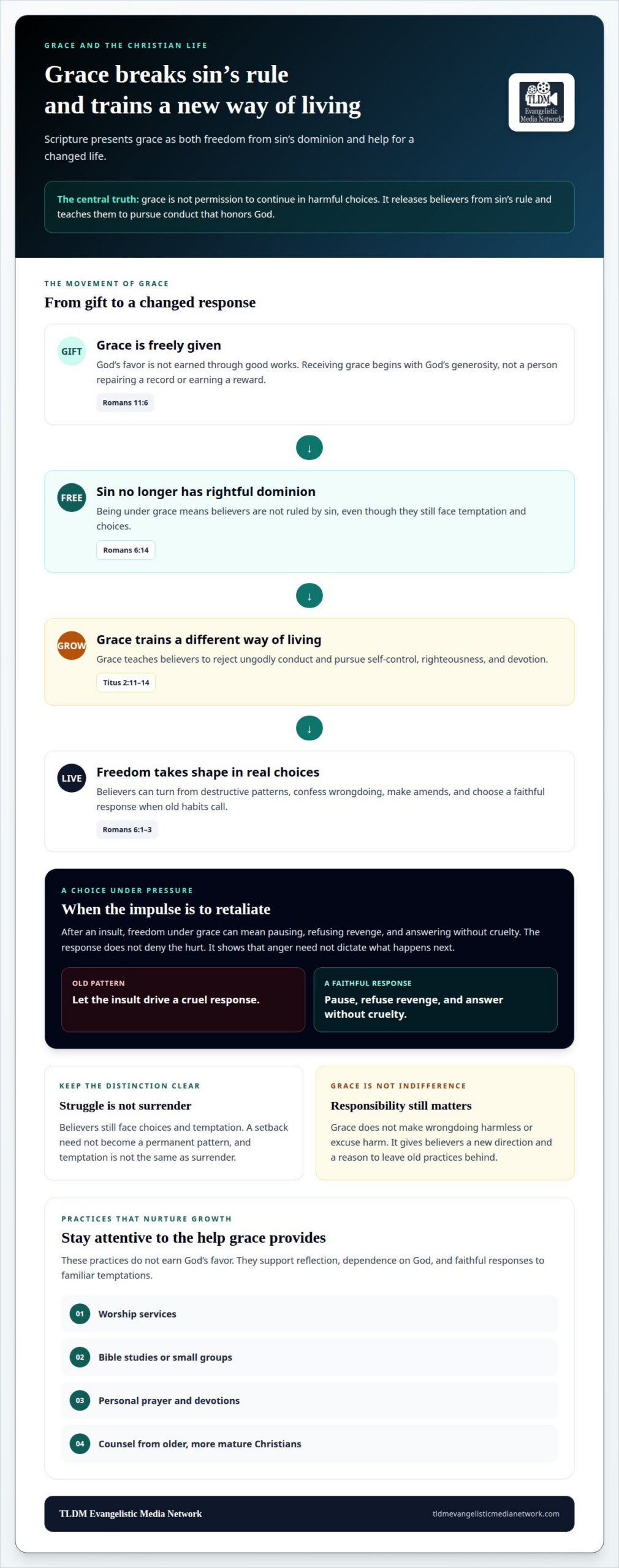
Freedom from sin means sin no longer has rightful dominion over believers, though they still face choices and temptation. Romans 6:14 grounds this freedom in being under grace rather than the law.
This matters because a struggle with sin does not have to define a believer’s direction. For example, someone who has spoken harshly can acknowledge the wrong, seek reconciliation, and choose a truthful, patient response next time.
Grace as Freedom
Grace is freedom because God’s work enables believers to resist sin and live in a way that honors Him. James 4:6 connects grace with victory over sin, showing that humility before God is central to this change.
Freedom under grace is not permission to ignore harm or responsibility. It encourages people to turn from destructive patterns and pursue conduct shaped by God’s character, even when change requires repeated repentance.
Titus 2:11-14 describes grace as training people to live in a way that honors God. In this passage, grace is active: it teaches believers to reject ungodly conduct and pursue self-control, righteousness, and devotion.
Romans 6:1-3 rejects the idea that receiving grace gives someone a reason to continue in sin. Paul presents a changed relationship to sin as a consequence of belonging to Christ. Grace doesn’t make wrongdoing harmless; it gives believers a new direction and a reason to leave old practices behind.
Consider a familiar choice: someone feels tempted to retaliate after being insulted. Freedom under grace can mean pausing, refusing revenge, and answering without cruelty. That response does not deny the hurt; it shows that anger need not dictate what happens next.
Romans 6:14 offers encouragement without claiming that believers never struggle. Sin’s dominion is broken, but Christian growth still involves daily choices. The distinction matters: temptation is not the same as surrender, and a setback need not become a permanent pattern.
Read Romans 6 alongside Titus 2:11-14 to see both sides clearly. Grace releases believers from sin’s rule and trains them toward holy living. That freedom takes shape in real decisions, such as confessing wrongdoing, making amends, and choosing a faithful response when an old habit calls.
Paul Tripp advises Christians to seek grace through worship services, Bible studies or small groups, personal prayer and devotions, and counsel from older, more mature Christians. These practices can keep believers attentive to the help grace provides as they pursue changed conduct. Returning to prayer and seeking counsel can support a faithful response when familiar temptations arise, without treating struggle as proof that change is impossible.
Grace as God’s undeserved gift of salvation
Christian Scripture presents salvation as God’s gift, received through faith rather than earned through human effort. Romans and Ephesians explain what this gift means and how it changes a person’s relationship with God.
Salvation Through Grace and Faith
Salvation through grace and faith means God saves people through Christ, and they receive this gift by trusting Him. Ephesians 2:8 describes salvation as the gift of God, not something people create for themselves.
This matters because no one can make a flawless record the basis for reconciliation with God. Romans 3:24 says people are justified freely by grace through redemption in Christ Jesus. Faith receives what God gives; it doesn’t turn salvation into a personal achievement.
Romans 5:8-10 grounds this gift in Christ’s action: He died for people while they were still sinners, and his death reconciles them to God. Salvation, then, begins with God’s initiative, not with a person proving worthiness. The question is not whether someone can save themselves, but whether they will trust Christ.
Ephesians 2:5 describes people dead in trespasses as made alive together with Christ by grace. The image underscores the depth of God’s gift: salvation brings new life where human effort could not produce it. Romans 5:15 likewise presents grace and the free gift through Jesus Christ as abounding for many.
John 3:16 connects believing in Jesus with receiving eternal life. Faith is personal trust in Christ, not simply agreement with an idea. Romans 6:23 contrasts sin’s consequence, death, with eternal life in Christ as God’s free gift. Together, these passages place the focus on Christ as Savior and God as giver.
Grace, Good Works, and Responsibility
Good works are not the price of salvation; they are a response to God’s gift and a responsibility of Christian life. Ephesians 2:8-9 rejects earning salvation, while James 2:14 asks what value a claim to faith has without good works.
This distinction helps explain how grace relates to responsibility: grace saves, and genuine faith bears fruit in action. For example, a believer who has wronged a neighbor should acknowledge the harm and seek to make it right. This response does not purchase salvation; it reflects a life shaped by God’s mercy.
Titus 3:4-6 says God saves through mercy and compassion, not because of righteous works people have done. That teaching removes boasting, but it doesn’t make daily choices meaningless. A person can receive salvation as a gift while still accepting responsibility for honesty, repentance, and care for others.
Romans 11:5-6 reinforces the difference between grace and works as grounds for salvation. Romans 5:20 adds that grace is greater than sin, directing attention toward God’s provision rather than despair. These passages encourage readers to trust Christ, receive salvation with humility, and let gratitude shape the way they live.
The Hebrew word khen and its translations
Studying biblical language can clarify how translators carry meaning into English. Hebrew khen belongs to the Old Testament’s vocabulary, while Greek charis appears in the New Testament. They are different words, so reading each in its passage helps prevent treating a translation choice as a complete definition.
English Bibles may use “grace” for a word whose precise meaning depends on its sentence and setting. A useful reading practice is to compare the verse with the surrounding lines, then ask who gives or receives favor and what response follows. This keeps attention on the author’s point rather than a dictionary list alone.
The New Testament’s use of charis is not limited to Paul’s letters. Luke uses “grace” 10 times in Acts, a detail that broadens the reader’s view beyond one author or one kind of writing. Acts places the word in a book that recounts the early Christian movement, so readers can notice how grace language appears within that narrative as well.
Paul is a central voice in the New Testament’s discussion of grace, but counting occurrences cannot explain every passage. A word’s role may become clearer by asking whether the text emphasizes God’s action, a person’s response, or grace’s effect in a community. Close reading turns a tally into a starting point for interpretation.
Try a simple comparison: read a passage containing “grace,” identify its main claim, and summarize it without relying on the word itself. Then reread the passage and check whether your summary reflects its emphasis. This can reveal whether “grace” functions as a description, an assurance, or part of an appeal to faithful living.
Careful translation study also calls for humility. English words rarely map perfectly onto terms from another language, and a single gloss cannot settle every theological question. Use a translation as a guide, attend to the passage’s argument, and distinguish what the text says from the conclusions you bring to it.
To study khen and charis thoughtfully, keep the original-language terms connected to their passages rather than turning them into isolated labels. Luke’s use in Acts and Paul’s teaching invite readers to explore how grace appears across different biblical voices. The result is more attentive reading, grounded in context and open to each passage’s distinct emphasis.
Seeking grace through worship, Bible study, prayer, and Christian counsel
Christians seek God’s help through worship, Scripture, prayer, and wise counsel. These practices do not earn grace; they help believers depend on God and grow in it.
Christian traditions explain aspects of grace differently, especially the relationship between God’s action, human response, and spiritual growth. Across traditions, grace remains central to Christian faith and is understood through Scripture and the life of Jesus Christ.
Practices for Seeking Grace
Seeking grace means turning toward God through practices that deepen trust, attention, and faithful living. Hebrews 4:16 invites believers to approach the throne of grace for mercy and timely help.
Worship can reorient attention toward God; Bible study helps readers consider what Scripture teaches; prayer brings needs honestly before God. Counsel from mature Christians can offer perspective when a decision feels difficult. These practices help Christians respond to God’s grace in daily life, rather than treating faith as an idea detached from choices.
Make the practices concrete. Read a passage such as Psalm 4:1, where the psalmist asks God for gracious help, then reflect on the need being expressed. In prayer, name that need plainly. Worship can give thanks for God’s character, while counsel from a trusted, mature Christian may help you consider a wise next step. Each practice gives a different way to attend to God.
Grace also sustains action. Second Corinthians 9:8 connects God’s abundant grace with sufficiency and good work, while 2 Peter 3:18 calls believers to grow in grace. Together, these passages point beyond a moment of comfort toward a life shaped by dependence on God. The purpose isn’t to perform spiritual routines perfectly, but to keep returning to God through Christ.
Bible Verses About Grace
Bible passages about grace show how God offers help, sustains hope, and calls believers to keep growing. Hebrews 4:16 is especially direct: it invites people to seek mercy and timely help from God.
For a broader study, compare James 1:17, which describes every good and perfect gift as coming from God, with 2 Corinthians 9:8 and 2 Peter 3:18. Psalm 102:12-14 gives words for asking God to be gracious; Psalm 102:17-21 and Isaiah 30:18-20 describe God’s compassionate response. Reading these passages together helps connect prayer, hope, and God’s character.
For a focused reflection, choose one passage and ask what it reveals about God, what help it describes, and how it may shape today’s response. Christian books can support continued study alongside Scripture and prayer. Explore Christian books for further study as you continue reflecting on grace.
TLDM Evangelistic Media Network: Sharing The Word Podcast
TLDM Evangelistic Media Network offers the Sharing The Word Podcast for listeners seeking continued reflection on Christian teaching. Its Take5 Messages and Online Sermons provide additional ways to engage with biblical messages, while Teach Me To Pray: Lessons From Scripture focuses on prayer through Scripture.
These resources can accompany personal Bible study, worship, and prayer as you consider how God’s grace shapes faith and daily life. Choose the format that fits the moment: listen to a podcast, explore a sermon, or study lessons on prayer. Return to Scripture as you reflect, keeping Christ at the center of your understanding.
For continued Christian teaching and reflection, visit TLDM Evangelistic Media Network’s website.
Let Grace Shape Your Next Step
Let what you’ve learned move beyond study and into the way you meet the day ahead. Understanding the concept of grace can deepen through continued reflection, honest prayer, and a willingness to let Scripture inform your choices. You don’t need every question settled before taking that next step. Return to a passage that challenged or encouraged you, consider what it reveals about God, and carry one insight into a real conversation or decision.
Spiritual growth is not about proving your worth. It is a continuing response to God, grounded in trust and expressed through faithful living. When you want more biblical teaching to support your reflection, TLDM Evangelistic Media Network offers a place to continue exploring Christian faith.
Visit TLDM Evangelistic Media Network to continue your study. May your next step be marked by hope, humility, and a growing trust in God.
Frequently Asked Questions
What Is Grace?
Grace is a central biblical theme describing God’s freely given kindness and action toward people. To understand a particular passage, notice what grace is doing there: Is it comfort in weakness, help for faithful work, or a reason for hope? For example, reading the verses around a reference to grace can show whether the writer emphasizes God’s character or its effect on a believer’s life.
What does grace mean in everyday language?
In everyday speech, grace often describes considerate behavior or calmness under pressure. For example, if a neighbor accidentally damages a fence, responding patiently while discussing how to repair it is a gracious response. The word can also describe elegance, as when a dancer moves with grace. The surrounding situation tells you which meaning someone intends, since everyday conversation does not always use the word in a theological sense.
What does it mean to be saved by grace?
It means a person’s hope of salvation rests on God’s action through Christ, not on a claim of personal superiority. One practical consequence is humility: believers have no basis for treating anyone as beyond God’s reach. Grace also makes room to face failure honestly. A person can acknowledge wrongdoing, seek restoration, and continue in faith without pretending mistakes define their standing before God.